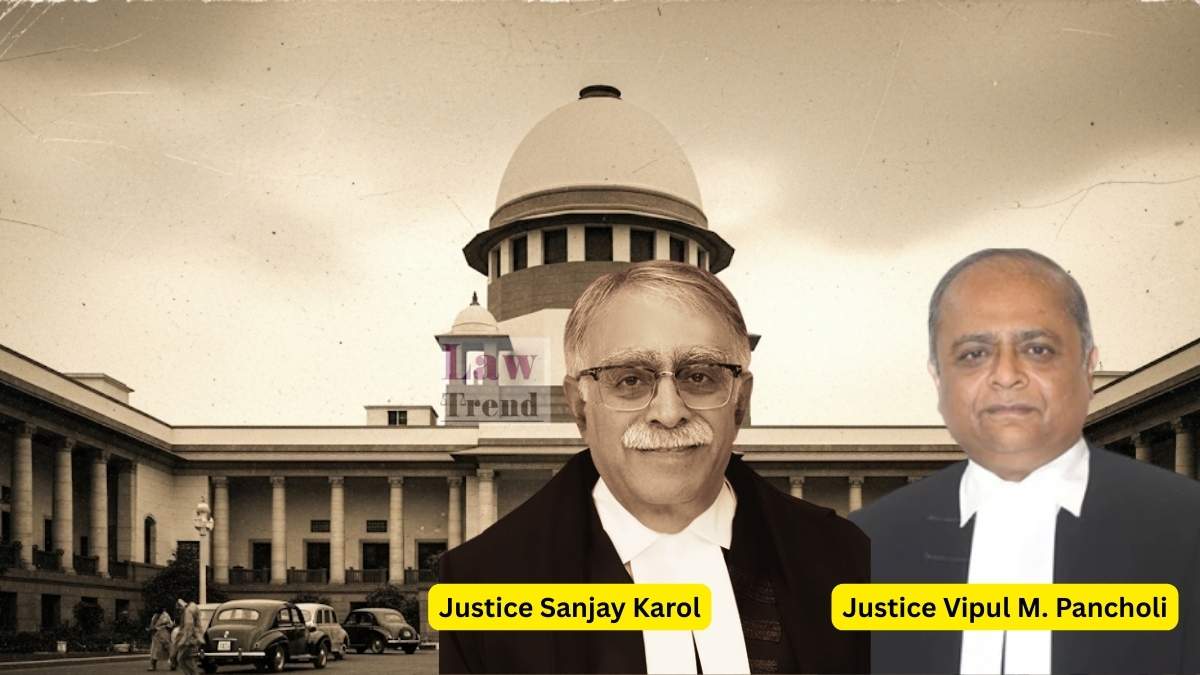
The Supreme Court has set aside a judgment of the High Court of Karnataka that had reversed a Trial Court’s order of acquittal in a murder case involving allegations of conspiracy and abduction.
The Bench, comprising Justice Sanjay Karol and Justice Vipul M. Pancholi, allowed the appeals filed by the accused, holding that the High Court failed to consider that the view taken by the Trial Court was a “plausible view” based on the evidence. The Apex Court observed that the prosecution failed to establish a complete chain of circumstances and termed the sole eye-witness as “planted.”
The Supreme Court was hearing appeals filed by Tulasareddi @ Mudakappa and others against the November 28, 2023, judgment of the High Court of Karnataka, Dharwad Bench. The High Court had quashed the acquittal granted by the Additional District and Sessions Judge, Gadag, and convicted the appellants under Sections 302, 120-B, 201, and 506 read with Section 34 of the Indian Penal Code (IPC), sentencing them to life imprisonment.
The Supreme Court, in its judgment dated January 16, 2026, set aside the High Court’s conviction and restored the Trial Court’s order of acquittal, directing the immediate release of the appellants.
Background of the Case
The prosecution’s case originated from a missing person complaint lodged on December 16, 2011, by the son of the deceased, Martandgouda. The complainant stated that his father had been missing since December 11, 2011. Initially registered as a missing person case, the investigation took a turn on January 3, 2012, when the complainant gave a further statement suspecting his uncle, Veerupakshagouda (Accused No. 1), due to prior civil disputes regarding land property.
The prosecution alleged that the accused persons entered into a criminal conspiracy, abducted the deceased, murdered him, and disposed of the body in a canal to screen themselves from punishment. The investigation led to charges against six accused persons.
On March 30, 2019, the Trial Court acquitted all accused, recording findings that the prosecution failed to establish a complete chain of circumstances. The motive was termed “weak and speculative,” and the theory of conspiracy “unsubstantiated.”
Aggrieved by the acquittal, the State and the complainant approached the High Court, which allowed the appeals and convicted Accused Nos. 1 to 4, while confirming the acquittal of Accused Nos. 5 and 6.
Arguments of the Parties
The Appellants: Counsel for the appellants argued that there was no allegation of “last seen” or participation in abduction or murder against Accused No. 1. It was submitted that the dispute was purely civil in nature. Regarding Accused Nos. 2 and 3, the counsel contended that the prosecution’s case relied heavily on PW-5, the alleged eye-witness, whose statement was recorded 21 days after the incident and who had turned hostile regarding other accused.
The defence highlighted that PW-14, the doctor who conducted the post-mortem, opined that death might have occurred 10 days prior to the post-mortem (conducted on January 4, 2012), which contradicted the prosecution’s case that the deceased was killed on December 11, 2011. It was further argued that the recovery of the body was not duly proved as the persons who retrieved the body (CW-22 and CW-23) were not examined.
The Respondents (State and Informant): The State argued that the case was proved beyond reasonable doubt through the voluntary disclosures of Accused Nos. 2 to 4 under Section 27 of the Indian Evidence Act, which led to the discovery of the body in the canal. The counsel submitted that this knowledge was special to the accused. Reliance was placed on the deposition of PW-5, arguing that his delay in reporting was due to threats from the accused. The State also contended that the motive was established through civil litigation and the stay order obtained by the deceased shortly before his disappearance.
Court’s Analysis and Observations
The Supreme Court scrutinized the evidence, particularly the testimony of PW-5 and the medical evidence.
On the Sole Eye-Witness (PW-5): The Court observed that PW-5, the driver of the vehicle allegedly used in the crime, did not inform the police for 21 days. The Court noted:
“It is surprising that though PW-5 is projected as eyewitness, he did not inform the police about the incident in question for a period of 21 days. The only explanation given by him for such delay is the threat given by the accused to him.”
The Bench further pointed out that PW-5 admitted he did not know the accused personally and failed to raise an alarm or contact the police when the body was allegedly dumped. The Court stated:
“Thus, looking to the aforesaid aspects, it can be said that PW-5 can be said to be a planted witness.”
On Medical Evidence: The Court found a significant discrepancy between the medical opinion and the prosecution’s timeline. The judgment noted:
“PW-14, doctor who conducted the post-mortem of the dead body of the deceased, has specifically stated that the death might have been occurred 10 days ago. However, it is the case of the prosecution that the deceased was missing on 11.12.2011 and killed by the accused on the same day. Thus, we are of the view that the medical evidence also does not fully support the case of the prosecution and raises doubt.”
On Recovery and Conspiracy: The Court held that merely relying on confessional statements and a discovery of the body that was “not duly proved” was insufficient for conviction. It noted that the High Court itself did not believe the story of conspiracy involving Accused Nos. 5 and 6.
On Appellate Interference: Citing precedents like Babu Sahebagouda Rudragoudar v. State of Karnataka (2024), Ramesh v. State of Uttarakhand (2020), and Basappa v. State of Karnataka (2014), the Court reiterated the principles governing appeals against acquittal. The Bench emphasized:
“If the view taken is a possible view, the appellate court cannot overturn the order of acquittal on the ground that another view was also possible.”
The Court concluded that the High Court failed to consider that the Trial Court’s view was plausible and based on evidence.
“The appellate court can interfere with the order of acquittal only if it comes to a finding that the only conclusion which can be recorded on the basis of the evidence on record was that the guilt of the accused was proved beyond a reasonable doubt and no other conclusion was possible.”
Decision
The Supreme Court held that the prosecution failed to complete the chain of circumstances.
“We are of the view that the High Court has failed to consider the aforesaid aspect while dealing with the acquittal appeals.”
Accordingly, the Court allowed the appeals, set aside the judgment of the High Court dated November 28, 2023, and restored the Trial Court’s order of acquittal dated March 30, 2019.
Case Details:
- Case Title: Tulasareddi @ Mudakappa & Anr. v. The State of Karnataka & Ors. (with connected appeal)
- Case No.: Criminal Appeal Nos. 2120-2121 of 2024 & 2542-2543 of 2024
- Coram: Justice Sanjay Karol and Justice Vipul M. Pancholi