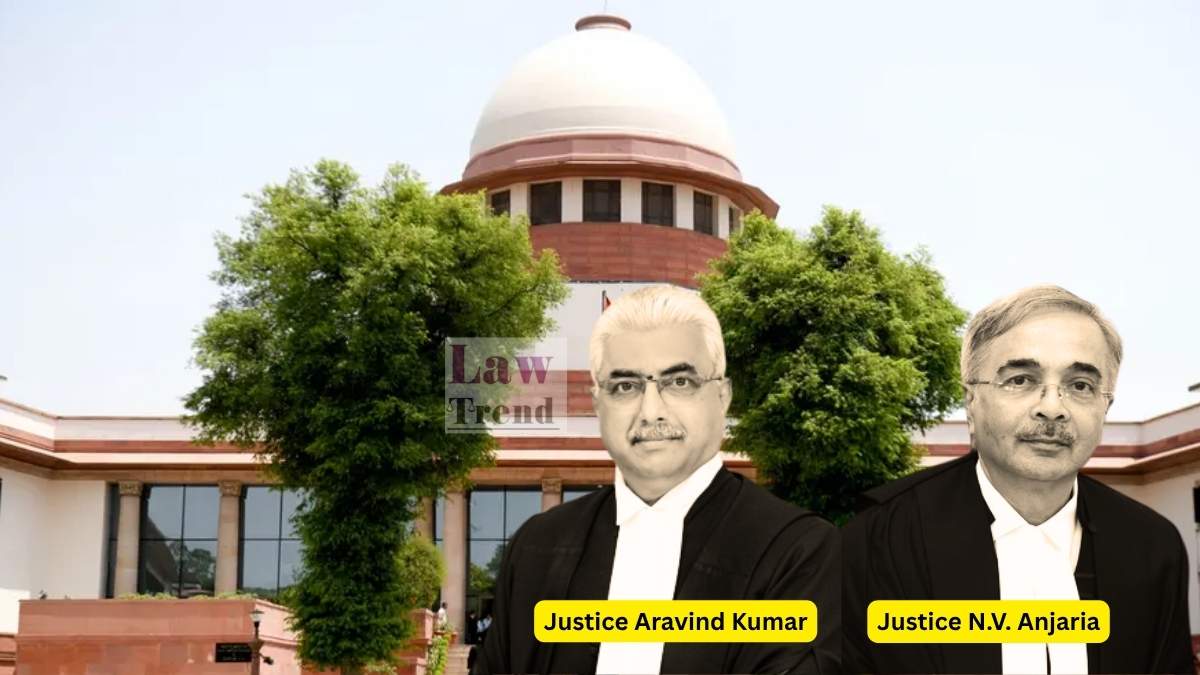
The Supreme Court of India has held that a High Court cannot exercise its supervisory jurisdiction under Article 227 of the Constitution to strike off a plaint when a specific remedy for the rejection of the plaint is available under the Code of Civil Procedure (CPC), 1908, particularly under Order VII Rule 11.
The Bench, comprising Justice Aravind Kumar and Justice N.V. Anjaria, observed that the power of superintendence under Article 227 must be exercised sparingly and cannot be used to “engulf” specific statutory remedies provided by the legislature.
The apex court set aside a judgment of the Madras High Court which had struck off a plaint in a civil suit by invoking Article 227. The Supreme Court ruled that since the CPC contains specific provisions for the rejection of a plaint (Order VII Rule 11) and striking out pleadings (Order VI Rule 16), the High Court committed a manifest error in bypassing these statutory procedures to exercise its constitutional powers. The Court restored the suit to the file of the District Munsif Court, Tambaram.
Background of the Case
The appellant, P. Suresh (original plaintiff), instituted Original Suit No. 93 of 2020 before the District Munsif Court, Tambaram, seeking a permanent injunction against the respondents (defendants) regarding a property comprised in Survey Nos. 125/1A, 125/1C, and 230/1B.
The plaintiff claimed title to the property through his mother, Meena, who allegedly purchased it from one Sambandam Chettiar via a registered sale deed dated October 20, 1975. The plaintiff averred that he inherited the property after his mother’s death in 1985 and was in exclusive possession.
The defendants contested the suit, claiming that the sale deed relied upon by the plaintiff was fabricated and did not pertain to the suit property. They asserted that the property had belonged to Sambandam Chettiar and his mother since 1922/1928 and was subsequently inherited by the defendants.
Instead of filing an application before the Trial Court under the CPC, the defendants filed a Civil Revision Petition before the Madras High Court under Article 227 of the Constitution. On June 3, 2025, the High Court allowed the petition, recording a finding that the plaintiff’s document was forged and the suit was false. Consequently, the High Court struck off the plaint.
Arguments of the Parties
The counsel for the appellant argued that the High Court was not justified in exercising powers under Article 227 to set aside the plaint. It was submitted that supervisory powers are to be exercised sparingly, especially when a specific provision in the form of Order VII Rule 11 CPC exists in the statute book.
Conversely, the counsel for the respondents contended that the supervisory powers of the High Court are wide enough to strike off an erroneous or fraudulent plaint. Reliance was also placed on Order VI Rule 16 CPC, which permits the court to strike off frivolous or vexatious pleadings.
Court’s Analysis
Justice N.V. Anjaria, authoring the judgment, emphasized that while Article 227 invests the High Court with the power of superintendence, this power is discretionary and must be exercised with a high degree of judicial discipline.
Referring to precedents such as Shalini Shyam Shetty vs. Rajendra Shankar Patil (2010) and State vs. Navjot Sandhu (2003), the Court reiterated that jurisdiction under Article 227 is not meant to correct mere errors or to function as an “appeal in disguise.”
The Court relied heavily on the principle laid down in Virudhunagar Hindu Nadargal Dharma Paribalana Sabai vs. Tuticorin Educational Society (2019), stating:
“In respect of cases falling under the first category, which may involve suits and other proceedings before civil courts, the availability of an appellate remedy in terms of the provisions of CPC, may have to be construed as a near total bar.”
On Order VII Rule 11 CPC: The Court noted that Order VII Rule 11 CPC lists specific grounds for the rejection of a plaint, such as non-disclosure of a cause of action or the suit being barred by law. The Court observed that determining these grounds often requires a factual inquiry.
“Therefore, it would be entirely proper to conclude that when the grounds for rejection of the plaint, provided in statutory provision, require the consideration of the facts of the case, such issue should not be gone into by exercising supervisory jurisdiction under Article 227 of the Constitution.”
On Order VI Rule 16 CPC: The Bench rejected the respondents’ reliance on Order VI Rule 16 CPC to justify the High Court’s order. The Court clarified that Order VI Rule 16 deals with striking out specific parts of pleadings that are scandalous or unnecessary, not the rejection of the entire plaint.
“It would be stretching beyond the logic of law to interpret and imply that Order VI Rule 16 can be utilized and employed for striking down the entire plaint.”
Conclusion on Article 227: The Court held that the availability of a remedy under the CPC acts as a “near total bar” on the exercise of Article 227.
“It is held, therefore, that once the specific provision under Order VII Rule 11 of the CPC, is available, the High Court cannot exercise powers under Article 227 to reject or strike off the plaint.”
Decision
The Supreme Court allowed the appeal and set aside the judgment of the Madras High Court dated June 3, 2025.
- Suit Restored: Original Suit No. 93 of 2020 is restored to the file of the District Munsif Court, Tambaram.
- Direction to Parties: The parties are directed to appear before the trial court on February 16, 2026.
- Liberty Granted: The defendants are granted liberty to file an application under Order VII Rule 11 CPC, which is to be considered by the trial court strictly in accordance with the law.
Case Details
- Case Title: P. Suresh vs. D. Kalaivani & Ors.
- Case Number: Civil Appeal No. 739 of 2026 (@ SLP (Civil) No. 20423 of 2025)
- Coram: Justice Aravind Kumar and Justice N.V. Anjaria