

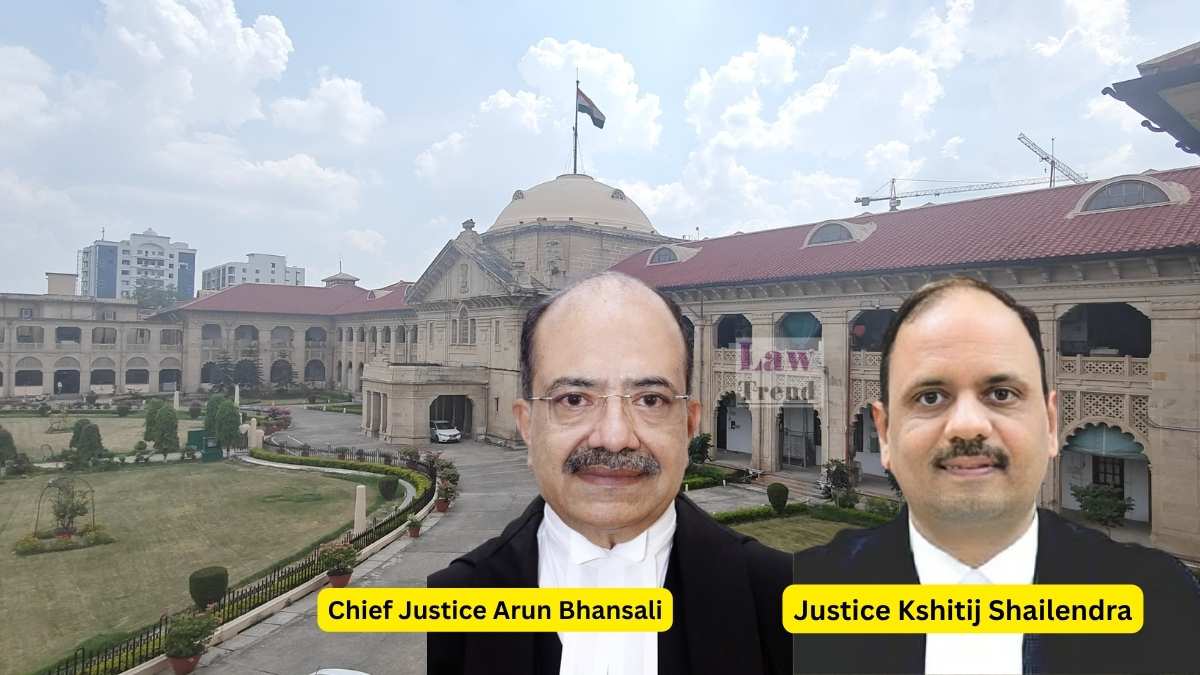
The High Court at Allahabad has set aside a Single Judge’s order that had dismissed a Habeas Corpus petition for the custody of a minor child on the grounds of alternative remedy. A Division Bench comprising Chief Justice Arun Bhansali and Justice Kshitij Shailendra held that a writ of Habeas Corpus cannot be dismissed merely because the parties can approach a forum under the Guardians and Wards Act, 1890, especially when the best interest of a child of tender age is involved.
Background
The case (Special Appeal No. 1205 of 2025) arose from a matrimonial dispute between the mother (Appellant No. 1) and her husband (Respondent No. 6). The appellant alleged that her 15-month-old son had been forcibly taken away by the respondent. Despite an order dated September 10, 2025, from the Child Welfare Committee (C.W.C.) directing the father to hand over the child to the mother, the custody was not restored.
The mother approached the High Court through a Habeas Corpus writ petition (No. 931 of 2025). However, a Single Judge dismissed the petition on November 6, 2025, observing that the custody of the child with the father could not be established as “illegal or improper” and that the parties should approach the appropriate forum under the Guardians and Wards Act, 1890.
Arguments of the Parties
The counsel for the appellants argued that the respondent, being in police service, had been influential in avoiding action for non-compliance with the C.W.C. order. It was further contended that the welfare of a 15-month-old child lies naturally with the mother, and the dismissal of the writ petition based on the availability of an alternative remedy was contrary to settled law.
Conversely, the Senior Counsel for the respondent (the father) argued that the C.W.C. order was ex-parte and under appeal. He maintained that as the natural guardian, the father’s custody of the son could not be termed illegal. He further claimed that the mother lacked the funds to ensure the well-being of the child.
Court’s Analysis and Observations
The Division Bench noted that the Single Judge had failed to consider the custody claim on its merits. The Bench referred to the Supreme Court’s decision in Yashita Sahu Vs. State of Rajasthan and others (2020), which established that:
“it is too late in the day to urge that a writ of habeas is not maintainable if the child is in the custody of another parent and the court can invoke its extraordinary writ jurisdiction for the best interest of the child.”
The Court also cited Gohar Begum Vs. Suggi (1960), highlighting that in cases involving infants who cannot exercise a choice, the Court must ensure they are placed in “proper custody.”
The Bench emphasized that in custody matters, the “welfare of the child is of paramount consideration.” It observed with concern that despite previous court orders, police officials appeared to be “busy in writing letters to one another” while the child remained at the Police Lines in Jaunpur in violation of the C.W.C. directions.
The Decision
Allowing the special appeal, the Division Bench set aside the Single Judge’s order dated November 6, 2025. The Court ordered the restoration of the Habeas Corpus Writ Petition No. 931 of 2025 to its original status.
“The matter has to be considered by the writ court on merits where the parties would have their full say,” the Bench concluded. The petition has been listed for hearing before the appropriate Bench on April 16, 2026.
Case Details Block
- Case Title: Smt. Rinku Ram @ Rinku Devi and another Vs. State of U.P. and 7 others
- Case Number: Special Appeal No. 1205 of 2025
- Court: High Court of Judicature at Allahabad (Chief Justice’s Court)
- Bench: Chief Justice Arun Bhansali and Justice Kshitij Shailendra
- Date: April 03, 2026




