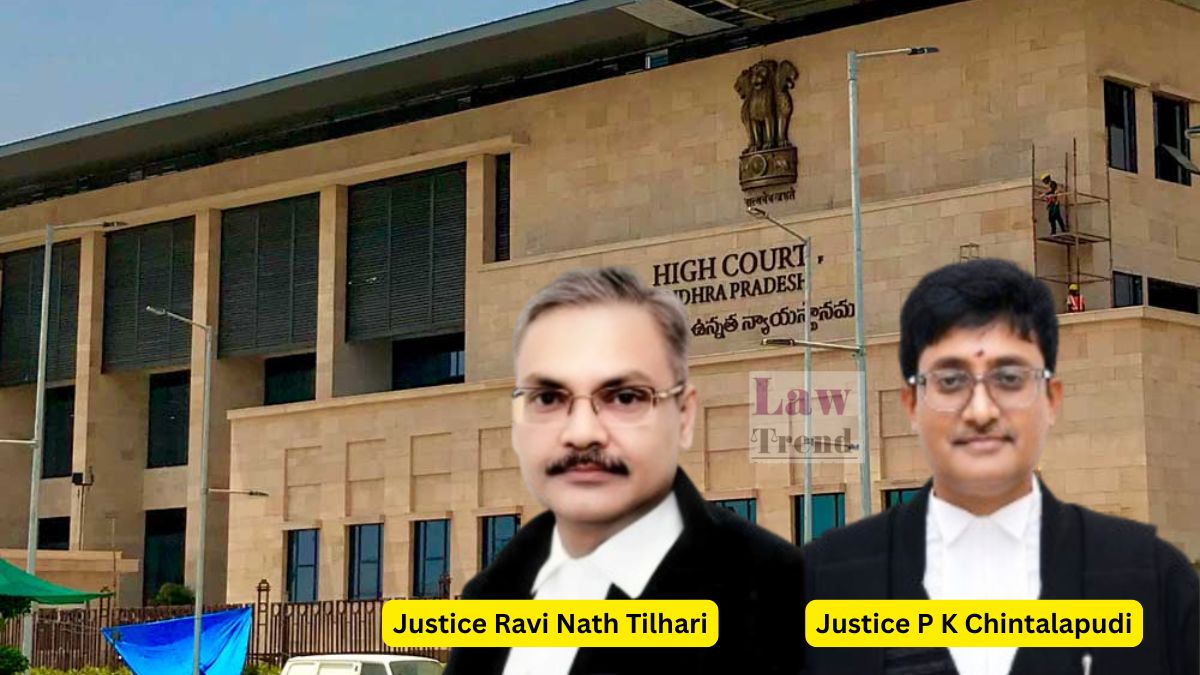
The High Court of Andhra Pradesh at Amaravati, comprising a Division Bench of Justice Ravi Nath Tilhari and Justice Purushottam Kumar Chintalapudi, has held that a writ of Habeas Corpus cannot be invoked to resolve matrimonial disputes where a spouse leaves the matrimonial home of her own free will. Dismissing a second Habeas Corpus petition filed by a husband seeking custody of his wife, the Court characterized successive filings as an abuse of court process and imposed costs of Rs 10,000 on the petitioner.
Background of the Case
The petitioner-husband filed a writ petition seeking a writ of Habeas Corpus for the production and custody of his wife, alleging that she was in the illegal custody or detention of her father (Respondent No. 4).
This marked the second time the husband had approached the High Court seeking the same relief. In the previous proceeding, the alleged detenue appeared before the Court following her production by police officials from Mangalagiri Rural Police Station and Vemuru Police Station. Upon inquiry by the Court, she confirmed her marriage to the petitioner but expressed her willingness to remain with her parents, stating that she was living with them of her own free will. Recording her statement, the High Court dismissed the earlier petition, granting liberty to the petitioner to pursue appropriate legal remedies available under the law.
Arguments of the Parties
In the present petition, counsel for the petitioner submitted that the petition had been rendered infructuous. Counsel informed the Court that after the earlier order, the wife had returned to the petitioner and started living with him, but later went back to her parental home, leading to the filing of the second petition. However, in the interim, the wife again returned and resumed living with the petitioner.
Learned Assistant Government Pleader appearing for Respondent Nos. 1 to 3 pointed out that the petitioner had previously filed a writ petition for the same prayer, where the wife had appeared and stated that she was living with her parents on her own free will, leading to the dismissal of that petition.
Court’s Analysis and Observations
The Division Bench observed that the facts and circumstances did not establish a case of illegal detention. The Bench noted that the matter pertained to a matrimonial dispute where the wife moved between her husband’s house and her parental home on her own accord.
The Court observed:
“The wife is sometimes living with the husband and then leaving him, she returns to her parental home and again goes to the husband at her own will. It appears to us to be a matrimonial dispute. The remedy is not a writ of Habeas Corpus, if the wife is leaving the husband, again and again the remedy lies before other forum and under different statute and not by way of Habeas Corpus, as there is no question of any detention much less an illegal detention.”
Addressing the repetitive nature of the litigation, the Court further noted:
“Filing of the successive writ petitions is nothing but an abuse the process of this Court, wasting of the precious public time.”
Decision of the Court
The High Court dismissed the writ petition and imposed costs of Rs 10,000 on the petitioner, directing the amount to be paid to the Andhra Pradesh High Court Legal Services Committee within three weeks.
The Court directed that if the costs are not paid within three weeks, the Registrar (Judicial) shall take necessary steps to realize the amount as per law and place a compliance report on record. The matter has been ordered to be listed on August 25, 2026, solely for perusal of the compliance report. All pending miscellaneous petitions were ordered to be closed.
Case Details:
Case Title: Pilli Venkata Chinni Krishna v. State of Andhra Pradesh & 3 others
Case No.: Writ Petition No. 20367 of 2026
Bench: Justice Ravi Nath Tilhari and Justice Purushottam Kumar Chintalapudi
Date: 30.07.2026