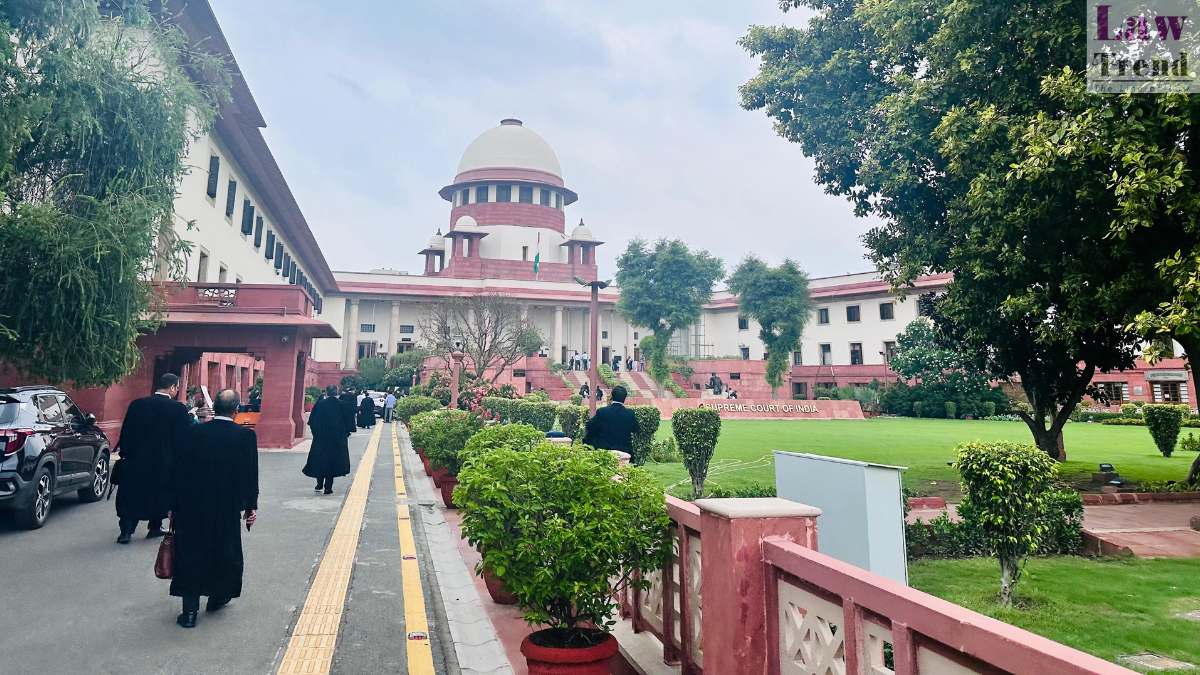
The Supreme Court of India has quashed an FIR registered under the Scheduled Castes and Scheduled Tribes (Prevention of Atrocities) Act, 1989, observing that the criminal proceedings were an “abuse of process of law” as they arose from a civil dispute and contained allegations contradictory to a civil suit filed by the complainant on the same day.
The Division Bench comprising Justice Ahsanuddin Amanullah and Justice K. Vinod Chandran set aside the judgment of the Jharkhand High Court which had refused to quash the FIR.
The core legal issue before the Apex Court was whether criminal proceedings under Sections 3(1)(g) and (s) of the SC/ST Act could be sustained when the allegations in the First Information Report (FIR) were inconsistent with a civil suit filed by the same informant on the same date regarding the same property. The Supreme Court held that while a civil dispute and criminal case can coexist, in this instance, the allegations in the FIR were found to be “unbelievable” and the proceedings were deemed an abuse of process. The appeal was allowed, and the FIR was quashed.
Background of the Case
The appellants, Amal Kumar and others, were arrayed as accused in FIR No. 18 of 2022 at Police Station Kanke, Ranchi. They approached the High Court for quashing the FIR, which alleged that they had criminally conspired to interfere with the possession of land owned by the informant/respondent No. 2. The FIR claimed the appellants attempted this by fabricating documents and further alleged that the informant, a member of a Scheduled Caste, was abused using their caste name.
The High Court refused to quash the FIR, holding that there were direct and specific allegations constituting offences punishable under Sections 3(1)(g) and (s) of the SC/ST Act. The High Court further observed that the existence of a pending civil dispute was “not sufficient to quash the criminal proceedings since it is trite that on the same set of facts there could be a civil dispute and criminal case lodged.”
Arguments of the Parties
Submissions on behalf of the Appellants: Mr. Shoeb Alam, learned Senior Counsel appearing for the appellants, submitted that the first appellant had purchased the subject property from a vendee of the other appellants in 2020 and was in possession of the same. He contended that the FIR was instigated by one Pankaj Singh after the first appellant refused to succumb to an extortion attempt of Rs. 10,00,000.
The counsel highlighted that the first appellant had already lodged a complaint regarding interference with his property and demolition of a structure on January 20, 2022 (Annexure P8). He argued that the subject FIR, lodged on January 25, 2022, was a “counter blast.” Specifically, the FIR alleged an incident occurred on January 21, 2022. However, Mr. Alam pointed out that a civil suit (Annexure P9) filed by the informant on the very same day (January 25, 2022) “did not indicate such an incident having occurred.”
Submissions on behalf of the Respondents: Mr. Abhishek Rai, learned counsel for the informant, argued that the appellants were involved in a “racket of grabbing properties belonging to SC/ST.” He alleged that documents were fabricated and possession was clearly taken over from the informant. He contended that there was no reason to quash the proceedings as the appellants would have the right to disprove the case in a trial.
Mr. P.S. Sudheer, learned Standing Counsel for the State of Jharkhand, supported the registration of the FIR and argued that the investigation should be completed.
Court’s Analysis and Observations
The Supreme Court examined the records, noting that the first appellant had purchased the land via a sale deed dated February 7, 2020. The Court observed that title confirmation for the other appellants had been passed by the Deputy Collector, Land Reforms, as early as January 17, 2012.
The Bench placed significant reliance on the discrepancy between the FIR and the civil suit filed by the informant. The Court noted that while the FIR alleged that the accused came to the land on January 21, 2022, and hurled abuses, the civil suit registered on the same date made no mention of this occurrence.
Key Observations:
- On Discrepancies: “In the plaint the cause of action is traced to the month of September 2020 and several other days… the last of which occurrence is said to be in December 2021. The incident as on 21.01.2022 is not at all mentioned.”
- On Possession: The Court noted that the vendor of the first appellant was not arrayed as an accused. With the sale deed of the first appellant being from 2020, the Court stated, “As of now the land is covered by a sale deed in favour of the first appellant.”
- On Section 3(1)(g) of the Act: “There can be no question of an offence being charged under Section 2 (3)(g) [sic] of the Act of 1989, of wrongful dispossession of a member of a Scheduled Caste/Schedule Tribe from their land.”
- On Section 3(1)(s) of the Act: “Likewise, there is no offence as coming out under Section 3(1)(s) of the Act of 1989 since there is no allegation that the casteist slur was made in a place within public view or that there was any member of the public present at the spot.”
Decision
The Supreme Court concluded that “in the totality of the circumstances as noticed above, the FIR based on the FIS is a clear abuse of process of law.” The Court found the allegations in the FIR “unbelievable going by the clear averments made in the suit filed on the very same day.”
Consequently, the Court allowed the appeal and set aside the order of the High Court. The Bench directed: “Having not done so we set aside the order of the High Court and quash FIR No. 18 of 2020 registered in Police Station Kanke, Ranchi and direct that no further proceedings shall be taken by the police against the arrayed accused in pursuance of the said FIR.”
Case Details:
- Title: Amal Kumar & Ors. v. The State of Jharkhand & Anr.
- Case No: Criminal Appeal No. of 2025 (@ Special Leave Petition (Crl.) No. 5913 of 2025)
- Coram: Justice Ahsanuddin Amanullah and Justice K. Vinod Chandran
- Citation: 2025 INSC 1402