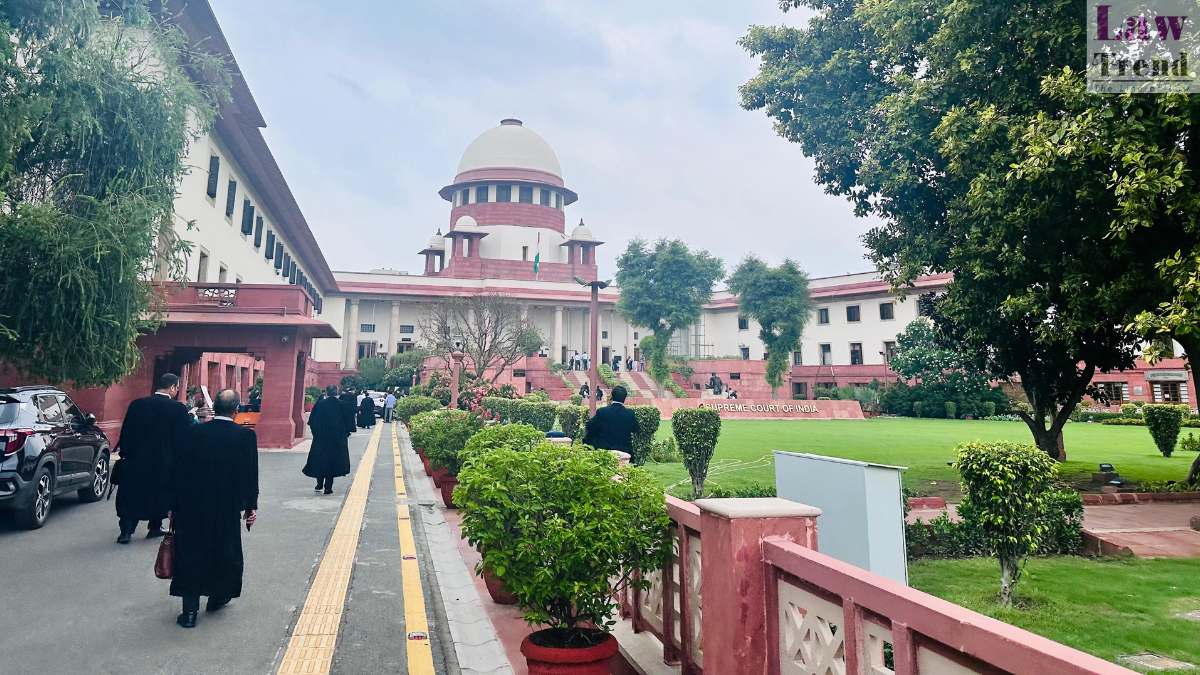
The Supreme Court of India has clarified that the acquittal of a co-accused on conspiracy charges does not automatically lead to the exoneration of another individual if independent evidence of bribery exists. Setting aside a High Court acquittal, the Bench restored the conviction of an Income Tax Inspector in a 2010 trap case, while reducing his sentence due to his age.
A Bench comprising Justice Sanjay Kumar and Justice K. Vinod Chandran modified the sentence of the respondent, Baljeet Singh (A2), from four years to one year of rigorous imprisonment, while confirming the fine of ₹1 lakh imposed by the Trial Court.
Background of the Case
The case originated from a complaint filed by PW1, a partner in a firm whose assessment for the year 2008-09 was pending before the Joint Commissioner of Income Tax, Arun Kumar Gurjar (A1). The complainant alleged that the Income Tax Inspector, Baljeet Singh (A2), acting as a subordinate to A1, demanded a bribe of ₹5 lakhs for the finalization of the assessment without hurdles.
The Central Bureau of Investigation (CBI) laid a trap on December 29, 2010. During the trap proceedings, the complainant handed over an envelope containing ₹2 lakhs in marked notes to A2 in the office of A1. The CBI team subsequently apprehended A2 and recovered the marked currency from his coat pocket.
While the Trial Court convicted both A1 and A2 under Section 120B of the IPC (Conspiracy) and Section 7 of the Prevention of Corruption (PC) Act, 1988, the High Court overturned the conviction, citing a lack of proof regarding the conspiracy and the initial demand. The CBI appealed the acquittal of A2 before the Supreme Court.
Arguments of the Parties
The CBI, represented by Additional Solicitor General Mr. Kanakamedala Ravindar Kumar, argued that the recovery of the tainted money from A2’s person and the positive phenolphthalein test results provided conclusive evidence of his guilt under the PC Act.
Senior Counsel Mr. Vikas Pahwa, appearing for Baljeet Singh, contended that if the conspiracy element failed, the entire case must fail. He argued that since the bribe was allegedly for A1, and A1 had been acquitted, A2 could not be held liable as an individual.
Court’s Analysis and Observations
The Supreme Court rejected the defense’s contention that the failure of the conspiracy charge necessitated the acquittal of both accused. The Court noted that A2 was independently charged under Section 7 of the PC Act. It held:
“True, if the charge under the PC Act linked with the charge of conspiracy was the only one levelled, then if one is acquitted the other cannot be convicted. But here there is another charge of demand and acceptance against both, which as against the two are not inextricably linked by a definite charge of conspiracy.”
Regarding the role of a co-accused’s statement, the Court observed:
“As rightly observed by the High Court, there was neither proof of demand nor acceptance by A1 but for the statement of PW1 that A2 demanded the bribe on behalf of A1. There can be no reliance placed on such statement made by the co-accused and there can be no conviction entered into on that account.”
However, the Court found the evidence against A2 to be robust. It noted that even though independent witnesses prevaricated, their testimony corroborated the “post-trap” recovery. Citing Neeraj Dutta v. State (Govt. of NCT of Delhi) (2023), the Court held:
“Even if a witness is treated as ‘hostile’ and is cross examined, his evidence cannot be written off altogether but must be considered with due care and circumspection and that part of the testimony which is creditworthy must be considered and acted upon.”
The Bench also emphasized that A2’s conduct during the trap, such as remaining silent when challenged, was relevant under Section 8 of the Indian Evidence Act.
The Decision
The Supreme Court concluded that while the High Court was correct in acquitting A1 due to lack of evidence of direct demand, it erred in acquitting A2. The Court restored the Trial Court’s finding of guilt against Baljeet Singh under Section 7 of the PC Act.
Considering the passage of time and the respondent’s age, the sentence was modified:
“The sentence of four years of RI handed down by the trial court is modified to one year… with a fine of Rs.1 lakh with a default simple imprisonment of three months as awarded by the trial court, which will stand restored and confirmed.”
The Court directed Baljeet Singh to surrender within four weeks.
Case Details:
- Case Name: Central Bureau of Investigation v. Baljeet Singh
- Case No: Criminal Appeal No. 942 of 2026 (@ SLP (Crl.) No. 12486 of 2025)
- Coram: Justice Sanjay Kumar and Justice K. Vinod Chandran
- Date: March 10, 2026