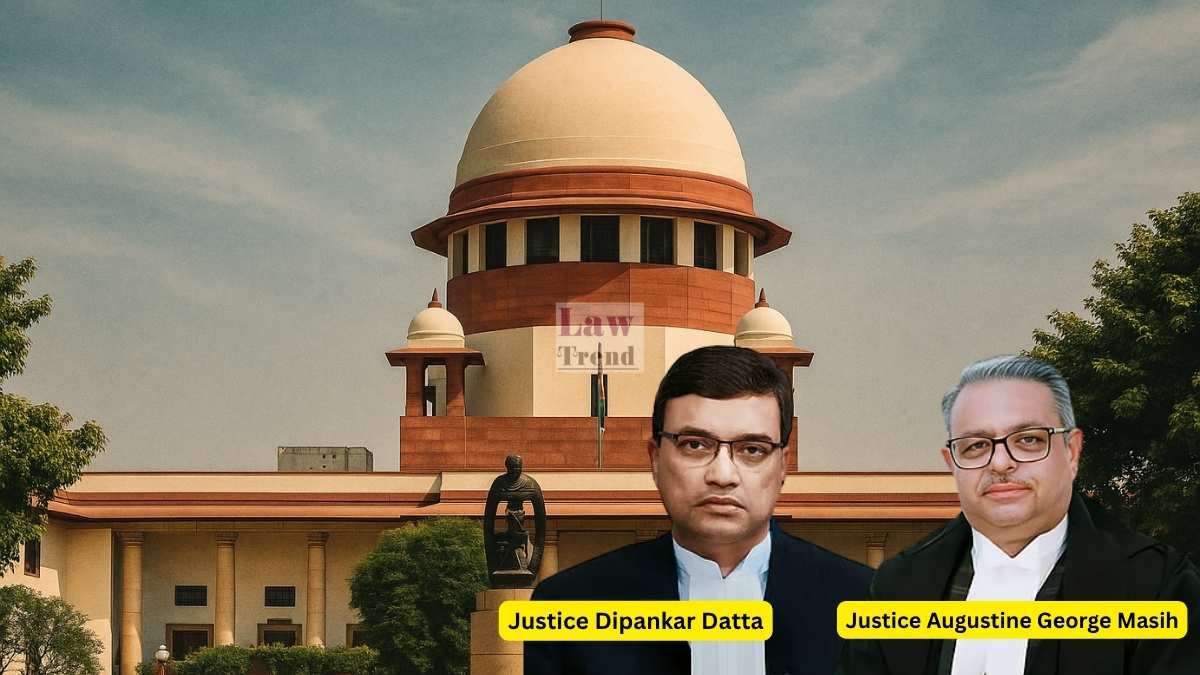
The Supreme Court of India has ruled that execution proceedings cannot be initiated against the directors or promoters of a company if they were not parties to the final order or decree sought to be executed. The Court emphasized that the executing court cannot travel beyond the decree and that the liability of a company cannot be shifted to its directors in execution proceedings absent any prior adjudication of their personal liability.
The Bench, comprising Justice Dipankar Datta and Justice Augustine George Masih, dismissed the appeals filed by the Ansal Crown Heights Flat Buyers Association and other individual homebuyers, upholding the National Consumer Disputes Redressal Commission’s (NCDRC) decision to decline execution against the directors of M/s Ansal Crown Infrabuild Pvt. Ltd. (ACIPL).
Background of the Case
The dispute originated from Flat Buyer Agreements executed between the appellants and ACIPL for residential units in the ‘Ansal Crown Heights’ project. The developer promised possession within 36 months, a period that expired between December 2013 and December 2015. Aggrieved by the non-delivery of possession, the Flat Buyers Association filed consumer complaints before the NCDRC in 2018.
Crucially, while admitting the complaint (CC/86/2018) on January 25, 2018, the NCDRC directed that the proceedings would continue solely against the company, ACIPL, and not against its directors or promoters (Respondents 2 to 9). The appellant was directed to file an amended memo of parties impleading ACIPL as the sole respondent. This order was not challenged by the appellants.
On February 28, 2022, the NCDRC allowed the complaints and directed ACIPL to complete the project, obtain the occupancy certificate, and hand over possession with delayed interest, or strictly refund the amounts with interest.
When ACIPL failed to comply, the appellants initiated execution proceedings. During this period, a Corporate Insolvency Resolution Process (CIRP) was initiated against ACIPL under the Insolvency and Bankruptcy Code, 2016 (IBC), leading to a moratorium. Consequently, the NCDRC adjourned the execution proceedings sine die, citing the moratorium.
The appellants approached the Supreme Court, which, by an order dated January 17, 2024, set aside the adjournment and allowed execution to proceed against the directors, subject to the condition that they could raise objections regarding their liability. Upon revival, the NCDRC dismissed the execution applications against the directors, holding that the original decree was only against the company. This dismissal was challenged in the present appeals.
The Legal Issue
The core legal question before the Supreme Court was whether persons who were arrayed as respondents in the initial complaint but against whom no notice was issued—and who were not parties to the final adjudication—could be brought within the net of execution proceedings on the premise that they are directors or promoters of the judgment-debtor company.
Supreme Court’s Analysis and Observations
The Supreme Court rejected the appellants’ contentions, laying down the following key legal principles:
1. Execution Must Strictly Conform to the Decree: The Court observed that the NCDRC had consciously admitted the original complaint only against the company (ACIPL) and declined to issue notice to the directors. This order attained finality. Since no pleadings were filed against the directors and no findings of liability were recorded against them in the main judgment, the final order bound strictly ACIPL and no one else.
Citing the precedent in Rajbir v. Suraj Bhan (2022), the Court reiterated:
“It is well settled that the executing court cannot go beyond the decree. The decree must be executed as it is.”
2. Distinct Legal Entity and Shareholder Liability: The Bench emphasized the fundamental principle of corporate law that a company is a distinct legal entity separate from its shareholders or directors. The Court noted that the liability of shareholders is confined to their shareholding or specific guarantees. In this case, there was no evidence that the directors had furnished any personal guarantees or that Section 14(3) of the IBC applied.
Referring to Electronics Corpn. of India Ltd. v. Secy., Revenue Deptt., Govt. of A.P. (1999), the Court quoted:
“A clear distinction must be drawn between a company and its shareholder… In the eye of the law, a company registered under the Companies Act is a distinct legal entity other than the legal entity or entities that hold its shares.”
3. Due Process and Adjudication are Prerequisites for Liability: The Court upheld the NCDRC’s view that the Consumer Protection Act envisages a complete adjudicatory process involving service of notice, pleadings, and evidence.
“These are not mere procedural formalities but substantive safeguards that precede the fastening of liability… In the absence of these foundational elements, execution proceedings cannot be utilised as a surrogate forum to impose liability where none has been adjudicated.”
4. Piercing the Corporate Veil Requires Specific Adjudication: The Court rejected the attempt to lift the corporate veil at the execution stage. It held that lifting the corporate veil is an exceptional measure reserved for cases where the corporate personality is abused for fraud. Such a finding requires specific pleadings and determination on merits during the trial, not in execution.
“In the absence of a prior and reasoned determination justifying disregard of the corporate personality, the directors/promoters cannot be exposed to personal liability through execution.”
5. Clarification on Previous Supreme Court Order: Addressing the appellants’ reliance on the Court’s earlier order from January 2024, the Bench clarified that the previous order only removed the bar of the IBC moratorium for directors if they were otherwise liable. It did not create new liability where none existed in the decree.
The Decision
The Supreme Court dismissed the appeals, holding that the NCDRC committed no error in declining to execute the order against the directors who were not parties to the complaints.
The Court held:
“The order binds only ACIPL… [The Appellant] cannot now enlarge the order through execution.”
However, the Court clarified that the dismissal does not preclude the appellants from pursuing other independent legal remedies against the promoters/directors under the Companies Act, IBC, or civil law, provided statutory requirements are met.
Case Details
Case Name: Ansal Crown Heights Flat Buyers Association (Regd.) vs. M/s Ansal Crown Infrabuild Pvt. Ltd. & Ors.
Case No.: Civil Appeal Nos. 8465-8466 of 2024 (and connected matters)
Bench: Justice Dipankar Datta and Justice Augustine George Masih