

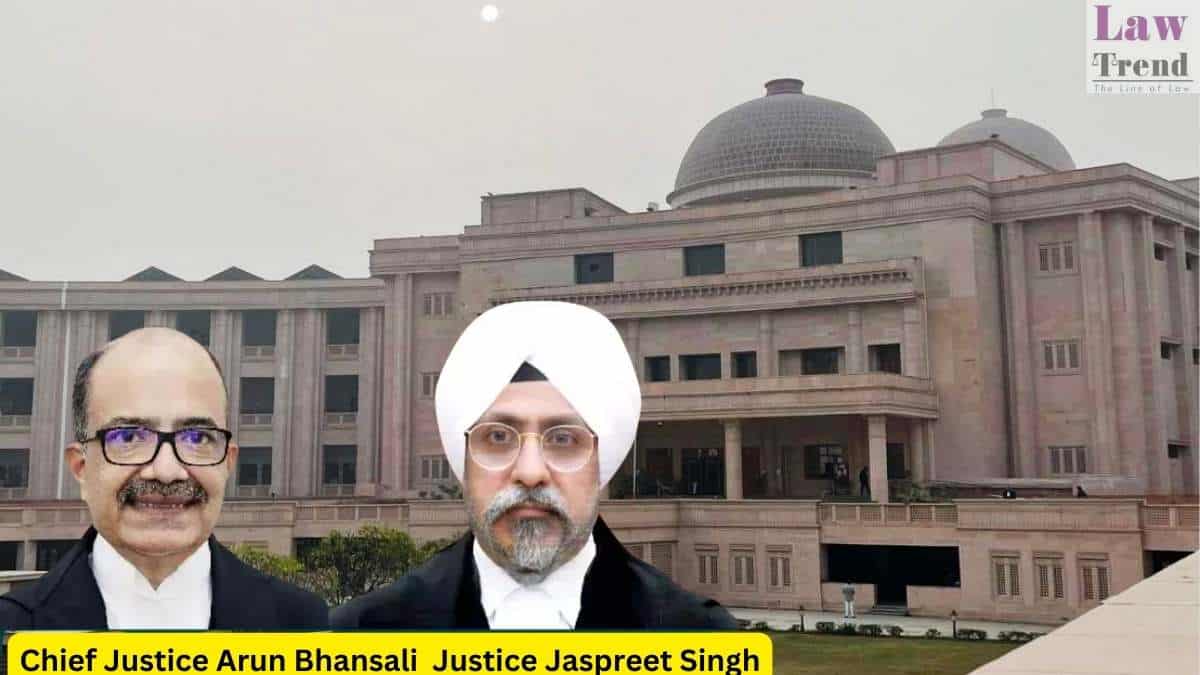
The Lucknow Bench of the High Court of Judicature at Allahabad has dismissed a special appeal filed by an employee challenging the reinstatement of his colleague, holding that a third party lacks the locus standi to interfere in service matters between an employer and employee unless a direct legal injury is demonstrated.
The Division Bench, comprising Chief Justice Arun Bhansali and Justice Jaspreet Singh, delivered the judgment in a Special Appeal filed by Niraj Kumar Singh against the reinstatement of Anand Kumar Mishra at King George’s Medical University (KGMU). The Court held that the appellant did not fall within the category of an “aggrieved person.”
Background of the Case
The dispute originated from the appointment of the respondent, Anand Kumar Mishra, at KGMU in 2004 on compassionate grounds. In 2018 and 2020, complaints were filed alleging that Mishra’s appointment violated statutory rules. Following these complaints and subsequent litigation, KGMU dismissed Mishra from service on December 2, 2022.
Mishra challenged his dismissal in Writ-A No. 1414 of 2023. A Single Judge Bench allowed the writ petition on July 15, 2024, setting aside the termination and directing his reinstatement with consequential benefits. The appellant, Niraj Kumar Singh, who is also an employee at KGMU, sought leave to appeal against this order, despite not being a party to the original writ proceedings.
Arguments of the Parties
For the Appellant (Niraj Kumar Singh): Senior Counsel Sanjay Bhasin argued that the respondent’s appointment was void and against statutory rules. He contended that because the appellant and respondent belong to the same cadre, the respondent’s continued employment affects the appellant’s seniority and promotion prospects. It was urged that since the employer (KGMU) failed to appeal the order, the appellant, as an “aggrieved party,” was entitled to do so.
For the Respondent (Anand Kumar Mishra): Senior Counsel Jaideep Narain Mathur raised a preliminary objection regarding the maintainability of the appeal. He argued that the appellant is a “complete stranger” to the proceedings. He maintained that service disputes are primarily between the employer and the employee, and a third party cannot allege grievance unless there is a specific legal injury.
Court’s Analysis and Observations
The Court focused on the definition of “locus standi” and “aggrieved person” in the context of service jurisprudence. It observed that KGMU falls under the definition of ‘State’ under Article 12, making its disputes with employees “private” in nature regarding the individuals involved.
The Bench cited the Supreme Court’s decision in Jasbhai Motibhai Desai v. Roshan Kumar (1976), noting that an “aggrieved person” must have legal rights that are adversely affected. The Court categorized litigants into three groups: (i) “person aggrieved”; (ii) “stranger”; and (iii) “busybody or meddlesome interloper.”
The Court made the following key observations:
- On Public Interest Litigation (PIL): Referencing Hari Bansh Lal v. Sahodar Prasad Mahto (2010), the Court noted, “Except for a writ of quo warranto, PIL is not maintainable in service matters.”
- On Direct Impact: The Court emphasized that a person aggrieved must be one who is “directly affected or impacted by a judgment,” citing Rajasthan Public Service Commission v. Yati Jain (2026).
- On Seniority: The Court noted a significant gap in seniority—the respondent is at S.No. 73 and the appellant at S.No. 118. The Bench remarked, “At such a difference of seniority, even if the employment of the writ-petitioner/respondent is held to be bad, yet it may not impact the seniority or any chance of promotion of the appellant.”
The Court further clarified the role of a complainant: “He may have been a complainant… however, such a complainant can only be treated as an informant… his right to participate in proceedings… cannot be stretched to an extent as to confer right on such a complainant to file an appeal which is confined only to a person aggrieved.”
The Decision
The Court concluded that the appellant failed to demonstrate any real injury or adverse impact caused by the Single Judge’s order.
“In absence of any real injury, the appellant cannot be treated to be an aggrieved person,” the Bench ruled.
While dismissing the application for leave to appeal and holding the special appeal as not maintainable, the Court clarified that it was not expressing an opinion on the validity of the respondent’s appointment. The Court stated that if the employer (KGMU) chooses to challenge the reinstatement, this order would not stand in its way.
Case Details
- Case Title: Niraj Kumar Singh v. Anand Kumar Mishra And 4 Others
- Case Number: Special Appeal Defective No. 554 of 2024
- Bench: Chief Justice Arun Bhansali and Justice Jaspreet Singh
- Date: March 19, 2026




