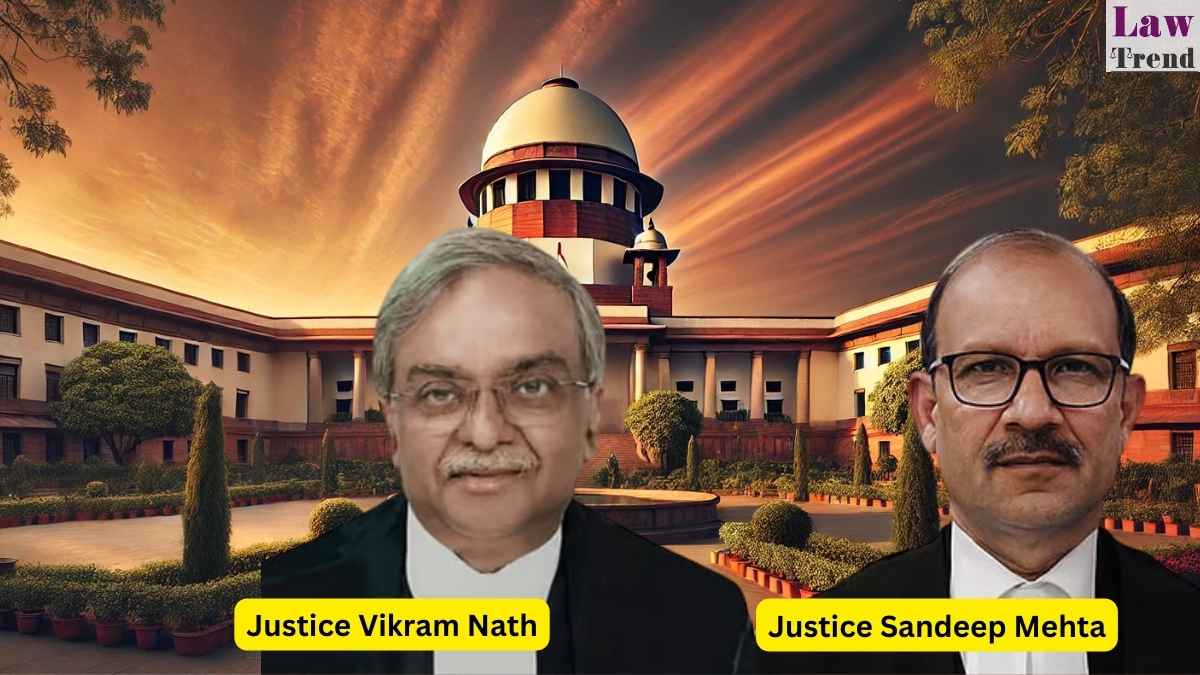
A Supreme Court bench comprising Justice Vikram Nath and Justice Sandeep Mehta held that courts cannot impose overly restrictive conditions on police custody that render custodial interrogation ineffective, ruling that such conditions run counter to the statutory scheme of Section 187 of the Bharatiya Nagarik Suraksha Sanhita, 2023 (BNSS). Setting aside restrictive conditions imposed by a Magistrate and modified by the Andhra Pradesh High Court, the Supreme Court allowed the Special Investigation Team (SIT) to interrogate a police officer accused in a custodial death case at a designated facility in Vijayawada, clarifying that statutory provisions do not mandate the continuous physical presence of a lawyer throughout interrogation or uninterrupted videography during road transit.
Background of the Case
The case arises from the alleged custodial death of one Gade Sai Krishna on May 6, 2026. The respondent-accused, Suda Suresh Veera Venkata Naga Raju, an Inspector of Police, was entrusted with the deceased-victim after he was apprehended by Task Force personnel at Markapur and brought to Krishna Lanka Police Station in Vijayawada. According to the prosecution, the victim was never produced before a Magistrate, and several witnesses saw him inside the police station with visible injuries.
Following a Habeas Corpus petition filed by the victim’s mother before the High Court of Andhra Pradesh—during which the accused officer allegedly suppressed the fact of detention—the Inspector was placed under suspension on June 17, 2026. On June 19, 2026, the mother lodged a formal complaint alleging illegal detention, custodial torture resulting in death, and disappearance of the body to screen offenders and destroy evidence. Consequently, Crime No. 107 of 2026 was registered under Sections 127(4), 127(6), 103(1), and 238 of the Bharatiya Nyaya Sanhita, 2023 (BNS).
A preliminary examination of the police station’s DVRs showed that CCTV footage for the crucial period was missing. On June 21, 2026, the State Government constituted a Special Investigation Team (SIT) to investigate the crime. The accused was arrested on June 23, 2026, produced before the Magistrate on June 24, 2026, and remanded to judicial custody at Central Prison, Rajamahendravaram.
On June 25, 2026, the prosecution filed a memo under Section 187 of the BNSS seeking 12 days of police remand to trace the fate of the victim, identify co-accused persons, recover material evidence, confront the accused with falsified official records, and reconstruct the crime scene. On July 2, 2026, the II Additional Judicial Magistrate of First Class, Vijayawada, granted eight days of police custody, but subject to 15 stringent conditions. These included confining interrogation entirely within Central Prison, Rajamahendravaram; continuous audio-visual recording without interruption; the presence of an advocate during interrogation behind a glass partition or 10 feet away; and an absolute outer limit barring extension of police custody beyond July 10, 2026.
The State challenged these conditions before the Andhra Pradesh High Court under Section 528 of the BNSS. On July 7, 2026, the High Court modified the order to allow taking the accused to scene-of-crime locations for recovery, but directed continuous videography of his every movement between Rajamahendravaram and Vijayawada (a distance of 160 km) and retained all other conditions imposed by the Magistrate. The State subsequently filed an appeal before the Supreme Court.
Arguments of the Parties
Senior Advocate Sidharth Luthra, appearing for the State of Andhra Pradesh, argued that the conditions imposed by the lower courts directly interfered with the statutory right of the investigating agency to conduct interrogation in a proper manner. He submitted that confining interrogation to a prison 160 kilometers away from the crime scene and requiring uninterrupted videography during road travel rendered the exercise nugatory and made scene reconstruction and recovery of the untraced body impossible. He stressed that courts had proceeded on an unwarranted apprehension that the SIT would resort to third-degree methods.
On the other hand, Senior Advocate L. Narasimha Reddy, representing the respondent-accused, opposed the State’s appeal. He submitted that taking the accused officer to Vijayawada posed a serious threat to his life because criminals previously arrested by him were lodged in the prison there. He contended that the conditions imposed by the Magistrate and High Court merely safeguarded the constitutional rights of the accused and aligned with established precedents of the Supreme Court.
Court’s Analysis
The Supreme Court examined the narrow question of the legality and practical workability of the custody conditions imposed during the police custody period. Addressing the location of interrogation, the Court observed that the alleged custodial death occurred in Vijayawada, the victim’s body remains untraced, and original hard disks are missing. The bench noted that effective investigation and recoveries under Section 23 of the Bharatiya Sakshya Adhiniyam, 2023 (BSA) require taking the accused to actual places of discovery rather than questioning him from a distance of 160 kilometers.
Analyzing Section 187(2) and (3) of the BNSS, the Supreme Court pointed out that unlike Section 167 of the repealed Code of Criminal Procedure, 1973, the BNSS enlarges the window during which police custody (up to 15 days in aggregate) can be sought in parts across the first 40 or 60 days of total detention. The bench observed that:
“This legislative change was intended precisely to meet situations, such as the present, where fresh facts, discoveries or leads may emerge during the course of investigation warranting further custodial interrogation, and an unduly rigid or premature foreclosure of that statutory window, whether by a Magistrate or by a court in the exercise of its supervisory jurisdiction, would run counter to the object of the provision.”
Interpreting Section 38 of the BNSS regarding the right of an arrested person to meet an advocate, the Court clarified that while an advocate may be present within line of sight, the provision “does not, by any means, contemplate the continuous, ongoing physical presence of an advocate for the entirety of each interrogation session, whatever be the visual or audible distance maintained.”
On the requirement of videography, the bench agreed that audio-visual recording of interrogation is a salutary safeguard. However, it held that mandating continuous recording during road transit of approximately 160 km each way is unworkable due to signal loss, equipment limitations, and travel contingencies. The Court emphasized:
“What the safeguard requires is that the interrogation itself, that is, the actual questioning of, or interaction with, the respondent-accused be continuously and contemporaneously recorded; the requirement cannot extend to an inflexible mandate to record every minute of transit, which is a totally logistical exercise.”
Regarding safety concerns, the bench held that the accused could be interrogated at the designated SIT interrogation center or an equivalent secure police facility in Vijayawada, with named investigating officers and prison authorities held jointly and severally responsible for his personal safety and physical well-being.
The Decision
The Supreme Court allowed the appeal and modified the terms and conditions imposed by the Magistrate and High Court as follows:
- The period of police custody shall commence from the date of production of the respondent-accused before the Magistrate pursuant to this judgment and remain in force for seven days, ensuring the total period of police remand does not exceed 15 days.
- The Investigating Officer shall have unrestricted access to the accused during police custody for interrogation.
- The condition confining custodial interrogation exclusively to Central Prison, Rajamahendravaram is set aside. SIT is permitted to interrogate the accused at its designated facility or an equivalent police facility in Vijayawada.
- The requirement for audio-visual recording stands satisfied by recording actual interrogation sessions and discovery proceedings; uninterrupted videography of transit is not required.
- The investigating agency shall not subject the accused to any threat, inducement, coercion, physical assault, mental harassment, or third-degree methods.
- The lawyer for the accused may remain present within sight of interrogation where he can see the accused, but shall not be permitted to intervene in the process of investigation or remain continuously present throughout.
- Original CCTV footage and videographic recordings, along with a certificate under Section 63 of the BSA, shall be produced before the Magistrate upon completion of custody.
- Named investigating officers and prison/facility authorities remain jointly and severally responsible for ensuring the safety, life, and physical well-being of the accused.
- SIT shall conduct an impartial, fair, and scientific investigation strictly in accordance with law, uninfluenced by any observation made in this judgment or in the High Court judgment.
Case Title: The State of Andhra Pradesh v. Suda Suresh Veera Venkata Naga Raju
Case No.: Criminal Appeal No. of 2026 (Arising out of SLP (Crl.) No. 12344 of 2026)
Bench: Justice Vikram Nath, Justice Sandeep Mehta
Date: July 27, 2026