

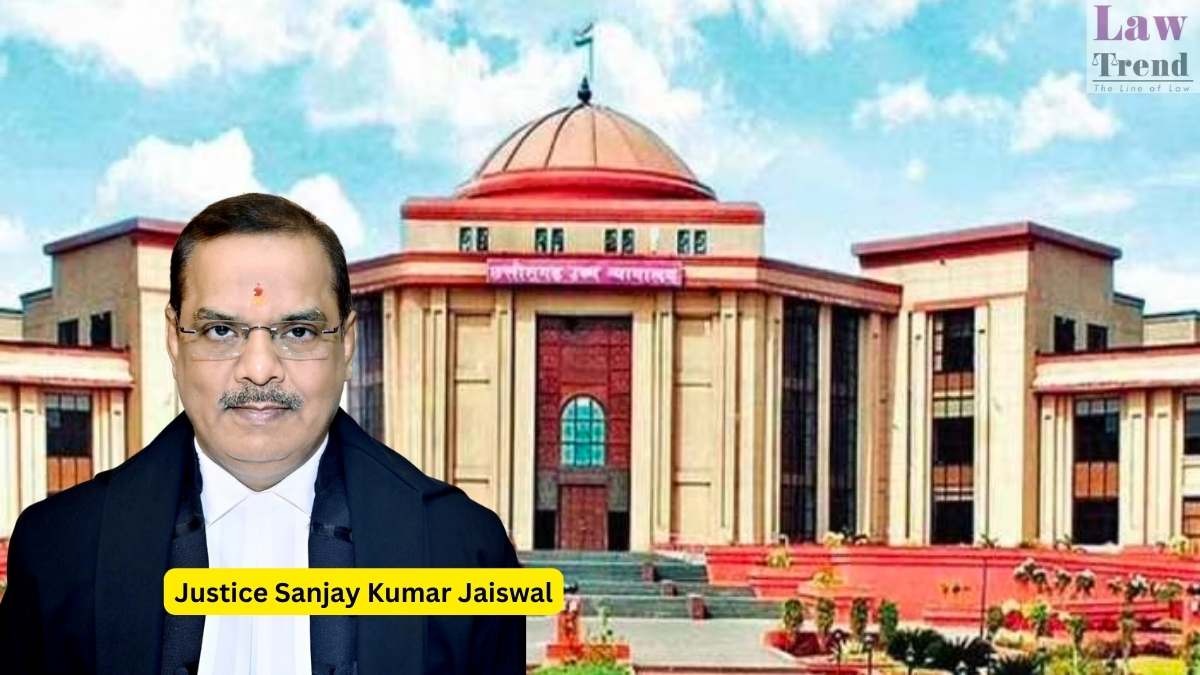
The Chhattisgarh High Court has dismissed a criminal revision petition filed by a police constable accused of embezzling over ₹26 lakh in government funds. Justice Sanjay Kumar Jaiswal upheld the appellate court’s decision to remand the case for a fresh trial, observing that the court cannot remain a “silent spectator” when the prosecution fails to produce witnesses in serious criminal matters involving public money.
Background of the Case
The petitioner, Satya Prakash Bhagat, joined the Chhattisgarh Police as a constable in 2008. From 2010 onwards, he was posted as an assistant to the salary clerk in the Superintendent of Police (SP) office, Surguja. His duties included preparing salary bills via computer and transferring funds through e-payment to the bank accounts of personnel.
According to the prosecution, Bhagat manipulated the system to transfer excess funds into his own account and that of his father. This included:
- Inflating his Naxalite allowance from ₹1,610 to ₹16,100 in June 2011 and June 2012.
- Transferring ₹6,50,000 instead of ₹650 as “special ration money” on three separate occasions in 2013 and 2014.
- Transferring ₹6,64,192 into a bank account belonging to his father, Dayaram Bhagat, under the name of Constable Sunil Kumar.
In total, a sum of ₹26,40,870 was allegedly embezzled. Consequently, an FIR (Crime No. 91/2014) was registered at Ambikapur Police Station under Sections 420 and 409 of the Indian Plain Code (IPC).
Trial and Appellate Proceedings
On March 9, 2016, the trial court (Judicial Magistrate First Class, Ambikapur) framed charges. However, despite nearly 28 opportunities and the issuance of summons, bailable warrants, and arrest warrants, not a single witness was examined. The trial court, noting the prosecution’s apparent lack of interest, closed the evidence and acquitted Bhagat on January 17, 2020.
The State challenged this acquittal. The Fifth Additional Sessions Judge, Ambikapur, set aside the acquittal, noting that the accused was a public servant charged with serious offenses punishable by up to 10 years of imprisonment. The appellate court remanded the matter, directing the trial court to provide sufficient opportunity to the prosecution and ensure witness attendance.
Arguments of the Parties
Counsel for the petitioner argued that the trial had already seen 28 opportunities and could not continue indefinitely. He contended that the trial court had acted within its rights to close the evidence, and the appellate court’s decision to grant further opportunities was not legally sound.
Conversely, the State’s counsel emphasized that the case involved a public servant’s breach of trust involving government funds. He pointed out that all witnesses were government employees (police, bank, and treasury staff) and that the police were responsible for ensuring their attendance. He cited the Supreme Court decision in Bablu Kumar and others v. State of Bihar and another (2015) 8 SCC 787 to support the need for an active judicial role in ensuring a fair trial.
High Court’s Analysis and Observations
Justice Jaiswal referred extensively to the Bablu Kumar precedent, quoting:
“The court cannot be a silent spectator or a mute observer when it presides over a trial. It is the duty of the court to see that neither the prosecution nor the accused play truancy with the criminal trial… The law does not countenance a ‘mock trial’.”
The High Court observed that since the accused, the investigators, and the witnesses were all part of the police department or related government offices, the failure to produce a single witness over 28 hearings raised serious questions about the police administration’s functioning.
The Court noted that the passage of time (the incidents date back to 2011-12) likely led to the transfer of personnel, requiring senior-level intervention to ensure their presence in court.
The Decision
Finding no illegality in the appellate court’s order, the High Court dismissed the revision petition and issued the following directions for the resumed trial:
- The trial court must fix at least two dates per month for prosecution evidence.
- Bailable warrants should be issued to witnesses at the outset rather than simple summons.
- The Inspector General of Police (IGP), Surguja Range, Ambikapur, is held personally responsible for ensuring the service of warrants and the attendance of witnesses.
- The defense must fully cooperate to ensure a speedy trial.
- The trial court is expected to conclude the proceedings within five months.
Copies of the order were directed to be sent to the IGP, Surguja Range, and the Director General of Police (DGP), Raipur, for necessary action and compliance.
Case Details:
- Case Name: Satya Prakash Bhagat vs. State of Chhattisgarh
- Case Number: Criminal Revision No. 323/2022
- Bench: Justice Sanjay Kumar Jaiswal
- Date: March 16, 2026




