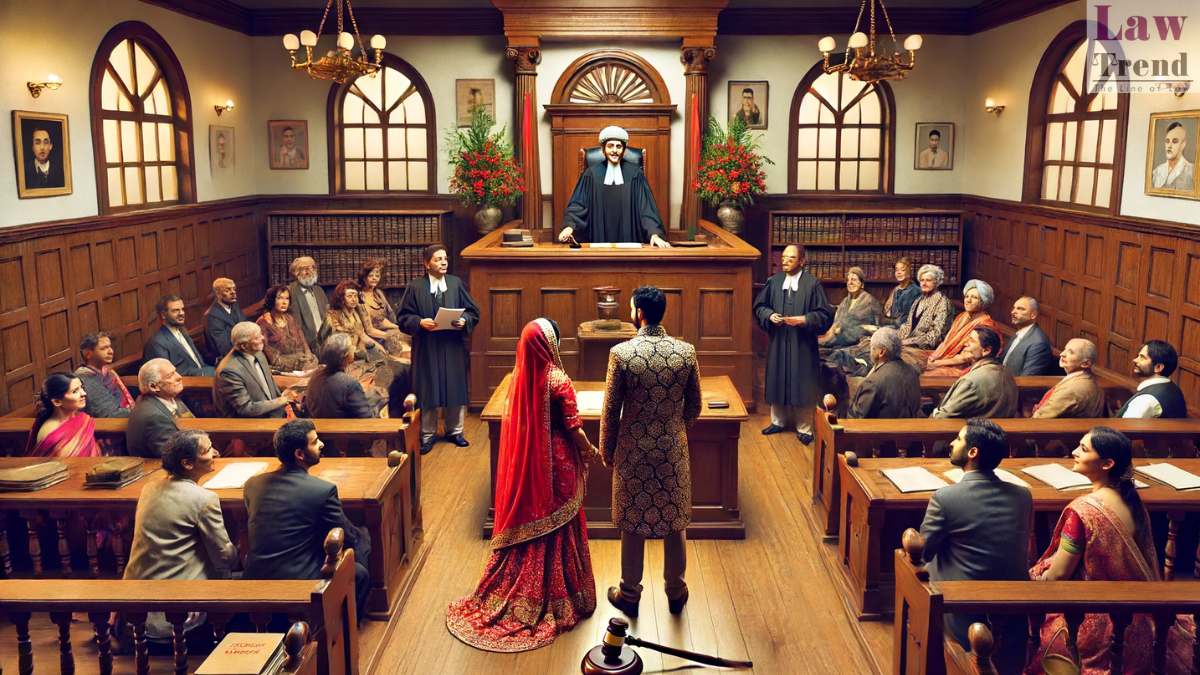
Observing that continuing a marriage after two decades of separation would “serve no meaningful purpose,” the Supreme Court of India has exercised its extraordinary powers under Article 142 of the Constitution to dissolve the marriage of a teacher couple. The Bench, comprising Justice Vikram Nath and Justice Sandeep Mehta, held that the marriage had “irretrievably broken down” and set aside the lower courts’ dismissal of the divorce petition, granting a decree of divorce subject to a permanent alimony payment of ₹20,00,000.
Background of the Case
The appellant-husband and the respondent-wife were married on June 22, 2003, at Morinda, District Ropar, Punjab. Both parties are employed as teachers. No child was born from the wedlock.
The marital discord began early; according to the appellant, the relationship became strained shortly after marriage. He alleged that following an accident in February 2005, his wife failed to care for him and attempted to obtain his signatures on documents under duress. This dispute initially led to a civil suit for an injunction, which was later withdrawn after a compromise.
By November 2005, the couple had shifted to Nawanshahr, but the respondent-wife left the matrimonial home soon after and did not return. The appellant’s initial attempt to seek restitution of conjugal rights under Section 9 of the Hindu Marriage Act, 1955, was withdrawn in 2007.
Later, on December 14, 2009, the appellant filed for divorce under Section 13 of the Hindu Marriage Act on the grounds of cruelty and desertion. The Trial Court dismissed this petition on August 14, 2012, finding that the allegations were not established. The High Court of Punjab and Haryana subsequently upheld this dismissal in its order dated February 28, 2014, leading the appellant to approach the Supreme Court.
Arguments of the Parties
In the Supreme Court, the appellant-husband argued that the marriage was dead for all practical purposes. He highlighted that the parties had been living separately for nearly 20 years and that their differences were irreconcilable. He prayed for the dissolution of the marriage under the plenary powers of Article 142 of the Constitution.
The respondent-wife opposed the plea, contending that the appellant had not made sincere efforts to reconcile. She denied the allegations of cruelty and argued that the case was not fit for the exercise of powers under Article 142.
Court’s Analysis and Observations
After hearing the counsel and interacting with the parties in person, the Bench noted the undisputed fact that the couple had been living apart for approximately twenty years. The Court observed that despite opportunities for settlement, including a referral to the Supreme Court Mediation Centre, no reconciliation was possible.
In a key observation regarding the futility of maintaining the legal bond, the Court stated:
“At this stage, there appears to be no possibility of reconciliation between the parties. The continuance of the marital bond, in such circumstances, would serve no meaningful purpose and would only prolong the agony of both parties. We are therefore of the considered view that this is a fit case where the marriage has irretrievably broken down, warranting exercise of this Court’s powers under Article 142 of the Constitution of India.”
Decision on Permanent Alimony
The Court then addressed the issue of permanent alimony. Both parties are government teachers in Punjab. While the appellant-husband offered to pay ₹15,00,000, the Court determined that a higher amount was appropriate given the long separation and the parties’ status.
The Bench ordered:
“Keeping in view the respective positions of the parties, their long separation, and other attendant circumstances, we are of the view that a sum of ₹20,00,000/- (Rupees Twenty Lakhs only) would be a just and reasonable amount towards permanent alimony, payable as a one-time settlement.”
Verdict
The Supreme Court allowed the appeal, setting aside the orders of the High Court of Punjab and Haryana (dated February 28, 2014) and the Additional District Judge (dated August 14, 2012). The marriage was dissolved under Article 142 of the Constitution, subject to the appellant paying ₹20,00,000 to the respondent-wife within two months.
The Court also directed that upon payment, “any civil or criminal proceedings, if still pending between the parties, shall stand closed.”
Case Details:
- Case Title: Jatinder Kumar vs. Jeewan Lata
- Case Number: Civil Appeal No. [] of 2025 (Arising out of SLP (C) No. 35588 of 2025 @ D.17190 of 2024)
- Coram: Justice Vikram Nath and Justice Sandeep Mehta