

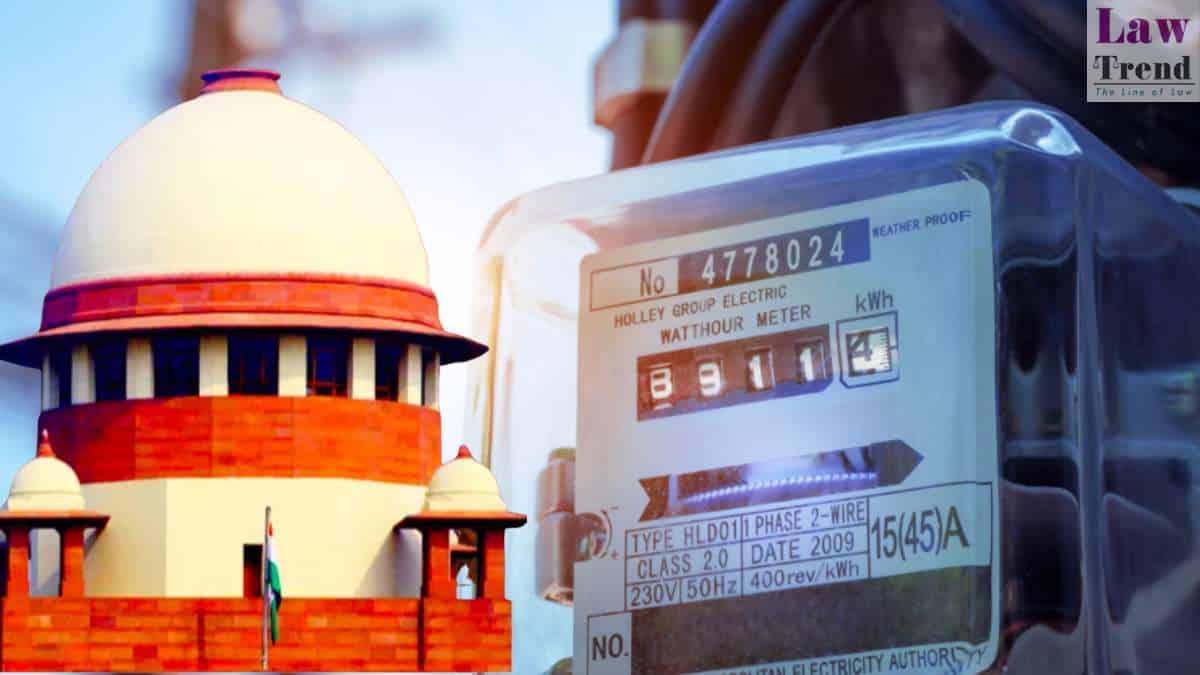
The Supreme Court has held that a consumer whose power supply is disconnected on an allegation of electricity theft can object to, and appeal against, the assessment of the amount payable for restoration of supply. The Court ruled that the “assessed amount” under the third proviso to Section 135(1A) of the Electricity Act, 2003 must be determined by the same procedure as an assessment under Section 126, until the Supply Code prescribes a separate procedure.
A Bench of Justice Manoj Misra and Justice K.V. Viswanathan dismissed two appeals filed by Gujarat’s power distribution companies against orders of the Gujarat High Court.
Background
In the first case, Dakshin Gujarat Vij Company Limited issued a supplementary bill dated 03.01.2024 to Vaibhav Metal Crusher, demanding ₹92,99,077.55 for alleged theft of electricity and ₹23,45,845 as compounding charges. A Single Judge of the High Court allowed the consumer to deposit 50% of the bill and directed reconnection. The Division Bench later directed that the consumer could file a reply to the bill before the Executive Engineer, with a right of appeal under Section 127.
In the second case, a Single Judge directed Jamanbhai Nanajibhai Bhuva to deposit 50% of a supplementary bill dated 01.06.2023 and allowed him to apply for a fresh connection. The Division Bench remitted the matter to the Single Judge for a fresh decision.
Arguments
Senior Advocate Ranjit Kumar, appearing for the distribution licensees, argued that an assessment for theft under Section 135(1A) is different from one under Section 126 and is not open to objection or appeal. He submitted that allowing an appeal would make the Special Court’s power to determine civil liability under Section 154(5) nugatory, and that the High Court should not routinely order restoration on a 50% deposit in theft cases.
Raghenth Basant, appearing for the consumers, argued that in the absence of any other provision, the “assessed amount” must mean the amount assessed under Section 126. He submitted that since an appeal is a continuation of the original proceedings, it would include the amount determined in appeal, and that this finality would remain subject to the Special Court’s determination under Section 154(5).
Court’s Findings
The Court found that the Act and the Supply Code provide no separate procedure or Assessing Officer for theft cases, and that the Supply Code uses a single formula for both theft and unauthorised use. Relying on West Bengal State Electricity Distribution Company Ltd. v. M/s. Orion Metal Pvt. Ltd. (2020) 18 SCC 588, it held that the assessment must follow Section 126, including service of a provisional assessment, objections and a hearing.
Describing the third proviso to Section 135(1A), the Court said, “It is an emergency provision which enables a consumer who has suffered disconnection, being accused of electricity theft, to seek restoration of the supply of electricity, a commodity essential for all aspects of life including business.”
Rejecting the argument about Section 154(5), the Court held that in theft cases, “the finality attached to the order of the appellate authority is limited to determining the amount required for restoration of the supply of electricity disconnected under sub-section (1A) of Section 135.” Where a criminal complaint is filed, the Special Court is not bound by that determination, and any excess deposit must be refunded under Section 154(6).
On restoration through writ petitions, the Court cautioned that “in cases of theft, which necessarily involves a criminal intent (i.e. mens rea), adoption of a liberal approach may not be appropriate.” However, given the time the assessment process can take, it held that “where the provisional assessment is prima facie arbitrary, in our view, the High Court may, for reasons to be recorded, order restoration of the supply by directing the writ petitioner to pay such amount, out of the demanded amount, which should not be less than 50%.” The Court explained that it chose 50% because Section 127(2) requires a deposit of half the assessed amount to file an appeal.
Outcome
The Court held that the High Court was within its jurisdiction in ordering restoration on a 50% deposit and in allowing the consumer to file objections. It clarified that the determination would be subject first to any appeal under Section 127 and finally to the civil liability determined by the Special Court under Section 154(5), in case of prosecution. Subject to this clarification, the first appeal was dismissed. The second appeal was also dismissed, as the High Court had only remanded the matter to the Single Judge.
Case Title: Dakshin Gujarat Vij Company Limited & Anr. vs. Vaibhav Metal Crusher (with Paschim Gujarat Vij Company Limited & Anr. vs. Jamanbhai Nanajibhai Bhuva)
Case No.: Civil Appeals arising out of SLP (C) No. 17868 of 2024 and SLP (C) No. 8778 of 2025
Bench: Justice Manoj Misra and Justice K.V. Viswanathan
Date: October 26, 2026


