

Consensual Relationship Not Vitiated by “False Assurance of Marriage”: Delhi HC Upholds Discharge of Constable in Rape Case
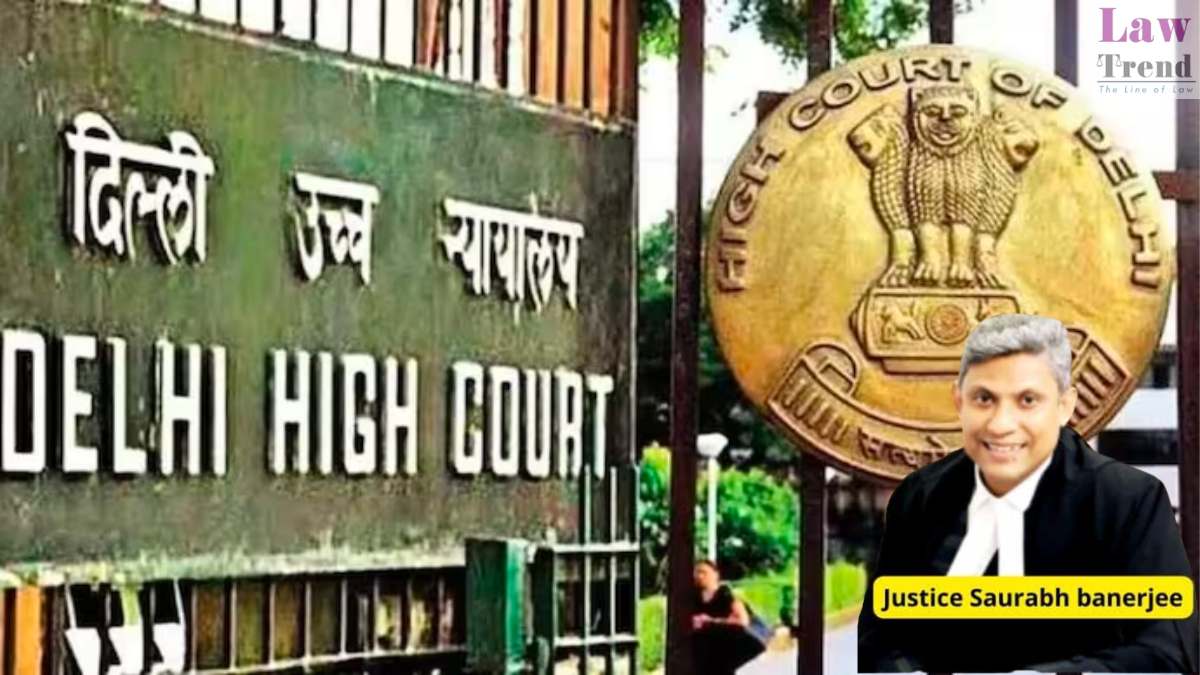

The High Court of Delhi has upheld the discharge of a Delhi Police Constable accused of rape, observing that the sexual relationship between the parties was consensual and established within the context of a long-standing relationship. The Bench ruled that the allegation of “false assurance of marriage” did not hold weight given the specific facts of the case, and consent was not vitiated under Section 90 of the Indian Penal Code (IPC).

Justice Saurabh Banerjee dismissed the revision petitions filed by the Prosecutrix and the State against the order of the Additional Sessions Judge (ASJ), Tis Hazari Courts, which had discharged the accused.

Background of the Case

The accused, a Constable in the Delhi Police, is a distant relative of the Prosecutrix. According to the prosecution, the two had been in a relationship for two years. The alleged incident occurred on October 8, 2015, when the Prosecutrix traveled from Ghaziabad to Delhi to meet the accused at his rented accommodation in Nehru Vihar.

The Prosecutrix alleged that relying on his promise of marriage, the accused established physical relations with her. She claimed that when she protested, he reassured her of his intention to marry. Later that night, the accused dropped her at Ghaziabad, where she was picked up by her father.

A complaint was filed on November 2, 2015, and an FIR was subsequently registered on December 1, 2015, under Section 376 of the IPC at Police Station Timarpur. On May 31, 2017, the Trial Court discharged the accused, prompting the current revision petitions.

READ ALSO  Delhi HC to hear on Dec 6 plea by Sukesh Chandrasekhar seeking quashing of money laundering case

Submissions of the Parties

The counsel for the Prosecutrix argued that the Trial Court exceeded its jurisdiction by “meticulously sifting the evidence,” contrary to the principles laid down by the Supreme Court in State of Bihar vs. Ramesh Singh (1977). It was submitted that the accused refused to marry the Prosecutrix after establishing intimate relations, and thus Section 90 of the IPC should apply. Relying on Yedla Srinivasan Rao vs. State of Andhra Pradesh (2006), the counsel argued that consent based on a misconception of fact stands vitiated.

The State supported the Prosecutrix, arguing that sufficient material existed to proceed with the trial, particularly because the accused reiterated his refusal to marry even after the incident.

Conversely, the counsel for the Respondent (accused) argued that the Prosecutrix’s statements under Sections 161 and 164 of the Cr.P.C. were inconsistent. Citing Union of India vs. Prafulla Kumar Samal (1979) and Amit Kapoor vs. Ramesh Kumar Chandra (2012), the defense contended that where two plausible views exist and the evidence gives rise only to “suspicion” rather than “grave suspicion,” the Court is within its rights to discharge the accused.

Court’s Observations and Analysis

Justice Saurabh Banerjee examined the timeline and the nature of the relationship. The Court noted that the Prosecutrix, an educated and mature woman, had been in a relationship with the respondent for two years without any prior allegations.

READ ALSO  दिल्ली हाईकोर्ट ने POCSO मामले में आरोपी की बरी को बरकरार रखा, कहा: विश्वसनीय साक्ष्य का अभाव

The Court observed: “It is also noteworthy that the alleged incident was/ is the sole instance and thus, it can be safely inferred that there was no periodical/ repeated instance(s) of the same kind before.”

The Bench highlighted the voluntary nature of the Prosecutrix’s actions, noting that she traveled to meet him, stayed with him, and was dropped back to her native city where her father received her. The Court stated: “This, in fact, reflects that she was all throughout acting voluntarily and consensually. Therefore, there is no grave suspicion warranting framing of a charge under Section 376 of the IPC against the respondent.”

Regarding the application of Section 90 of the IPC, the Court held: “The learned Trial Court has correctly observed that the parties were well acquainted and that no material suggests any compulsion or inducement to establish a physical relationship on a false assurance of marriage, as also that her consent cannot be said to have been vitiated within the meaning of Section 90 of the IPC.”

The Decision

The High Court affirmed the principles regarding discharge, citing Union of India vs. Prafulla Kumar Samal, reiterating that if the evidence produces only “suspicion but not grave suspicion,” the judge is entitled to discharge the accused.

READ ALSO  HC refuses to advance hearing of plea challenging dissolution of Jamia teachers' association

Justice Banerjee concluded that there was no illegality or perversity in the Trial Court’s order. Consequently, the petitions filed by the Prosecutrix and the State were dismissed.

Case Details:

  • Case Title: Prosecutrix (X) Vs. State & Anr and State GNCT of Delhi Vs. Sumit
  • Case Number: CRL.REV.P. 630/2017 & CRL.REV.P. 648/2017
  • Coram: Justice Saurabh Banerjee
  • Counsel for Petitioner: Mr. Anupam S. Sharma and Ms. Anisha P. Das
  • Counsel for Respondent: Mr. Akshay Chandra, Mr. Bharat Sharma, Mr. Durga Dass Vashit, and Ms. Viapsana Bubna

Law Trend
Law Trendhttps://lawtrend.in/
Legal News Website Providing Latest Judgments of Supreme Court and High Court

Related Articles

Latest Articles

