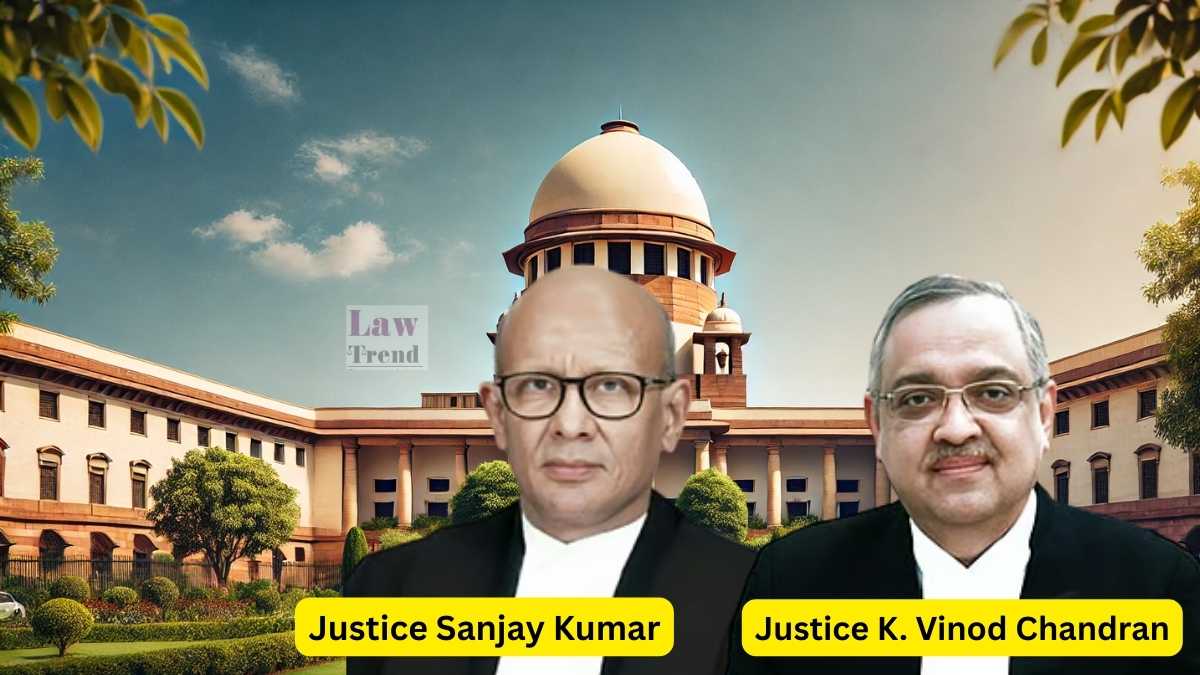
The Supreme Court of India has ruled that a technical collaborator, whose involvement was essential for a contractor to technically qualify for a bid, is a “veritable party” to the arbitration agreement and is entitled to invoke the arbitration clause. Setting aside a High Court judgment that had declined the appointment of an arbitrator on grounds of lack of privity, the Bench comprising Justice Sanjay Kumar and Justice K. Vinod Chandran observed that the inextricable connection between the parties through a ‘Deed of Joint Undertaking’ (DJU) and subsequent tripartite agreements made the collaborator an integral part of the contract.
Background
The case arose from a contract for installing a Coal Handling Plant Package for the Nabinagar Thermal Power Project of the Employer (Bhartiya Rail Bijlee Company Limited). The Contractor (Respondent No. 2) collaborated with the Appellant (Elecon Engineering Company Limited) to satisfy the qualification requirements regarding experience in the design and commissioning of integrated bulk material handling plants. As a condition of the bid, the parties submitted a ‘Deed of Joint Undertaking’ (DJU) executed jointly by the Collaborator and the Contractor on February 22, 2010.
During the execution of the project, the Contractor faced liquidation proceedings and was ordered to be liquidated on January 16, 2020. The Employer subsequently called upon the Collaborator to take up full responsibility for the successful performance of the contract as per the DJU. A tripartite agreement was entered into between the Employer, Contractor, and Collaborator on April 5, 2016, which authorized direct payments to the Collaborator. When disputes emerged regarding outstandings and the allegedly wrongful encashment of a bank guarantee, the Collaborator invoked arbitration. The High Court rejected the Section 11(6) petition, finding no “inextricable connection” and citing a lack of privity of contract.
Arguments of the Parties
Appellant (Collaborator): Senior Counsel Sri Sridhar Potaraju argued that the Contractor would not have been able to satisfy the eligibility criteria without the collaboration. He highlighted that the DJU and subsequent communications from the Employer—which threatened to execute balance work at the Collaborator’s “risk and cost”—proved the Collaborator was an inseparable party to the contract.
Respondent (Employer): Senior Counsel Sri Aman Lekhi contended that the notice under Section 21 of the Act sought “consent” for arbitration, implying the Collaborator’s own understanding that no arbitration clause existed. He argued that the tripartite agreement eclipsed earlier contracts and that, following the Contractor’s liquidation, the Collaborator could raise no claim against the Employer.
Court’s Analysis
The Supreme Court rejected the High Court’s findings, noting that the bid documents explicitly required the DJU for technical qualification. The Bench observed that the DJU clearly indicated that the Collaborator was an “inseparable part of the contract and its execution.”
The Court addressed the “privity of contract” issue by noting that the Employer had reaffirmed the Collaborator’s obligations under the DJU when the Contractor defaulted. The Bench clarified:
“The consent required by the Collaborator in the letter dated 02.07.2022 was for reference of the matter to the Delhi International Arbitration Centre and not necessarily a consent for resolving the dispute through arbitration; which provision was already available in the agreement executed by the contractor to which the Collaborator is an essential and inextricable part.”
The Court held that the “joint and several” liability established in the DJU and the tripartite agreement made the Collaborator a “veritable party” to the contract. The Bench further noted:
“The tripartite agreement only asserted the responsibility of the Collaborator to fulfill the contract and was only a measure of ensuring payments to the Collaborator directly, in the wake of the inability of the Contractor and does not wipe out the earlier contract.”
Decision
The Supreme Court set aside the impugned judgment and allowed the petition filed under Section 11(6) of the Arbitration and Conciliation Act, 1996. The Court appointed Justice (Retd.) Chakradhari Sharan Singh, former Chief Justice of the Orissa High Court, as the sole Arbitrator to adjudicate the disputes.
The Arbitrator is directed to proceed in accordance with the law and make a declaration in terms of Section 12 of the Act within 15 days of receiving the judgment.
Case Details
- Case Title: Elecon Engineering Company Limited vs. Bhartiya Rail Bijlee Company Limited & Anr.
- Case No.: Civil Appeal No. of 2026 (@ SLP (C) No. 33128 of 2025)
- Bench: Justice Sanjay Kumar and Justice K. Vinod Chandran
- Date: May 07, 2026