

Civil Courts Have Jurisdiction In Partition Suits Exclusively Between Non-Tribal Parties Even If Land Lies In Scheduled Areas: Supreme Court
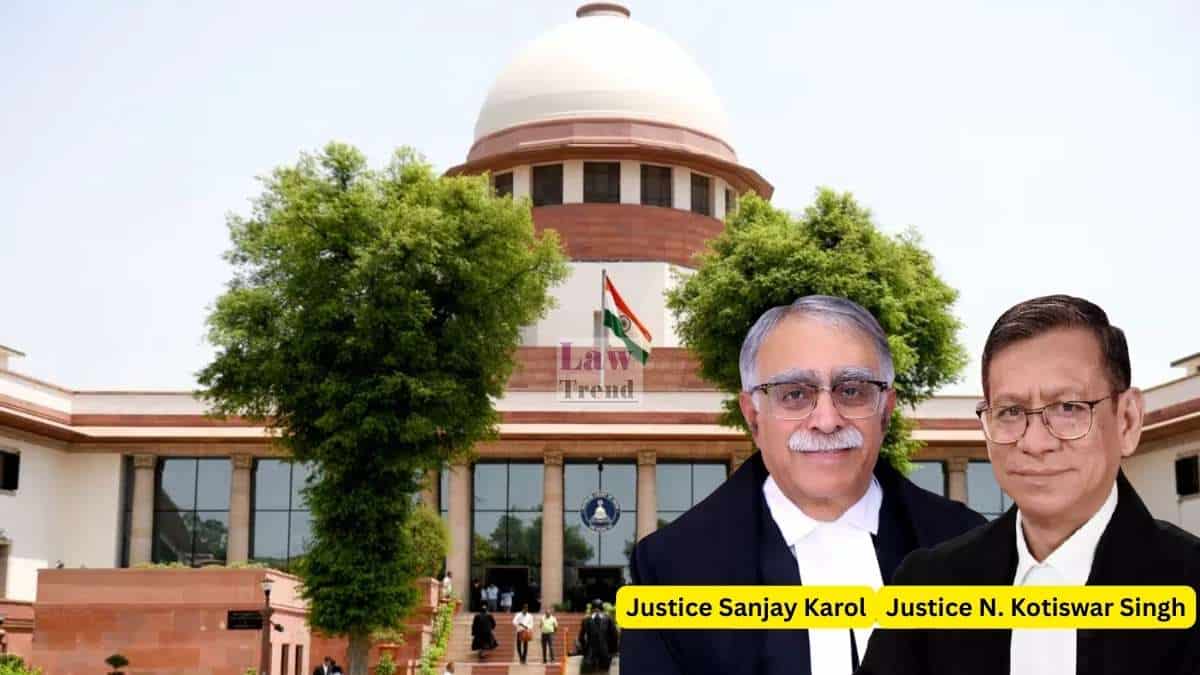

The Supreme Court of India, comprising a Bench of Justice Sanjay Karol and Justice N. Kotiswar Singh, has ruled that Civil Courts possess the jurisdiction to entertain civil disputes concerning partition and succession where all contesting parties are non-tribals, even if the suit property is located within Scheduled Areas. Setting aside a judgment of the Telangana High Court, the Supreme Court held that excluding Civil Court jurisdiction for non-tribal litigants in Scheduled Areas lacks a rational nexus to the constitutional objective of protecting tribal interests and violates Article 14 of the Constitution of India. The Court also held that its previous ruling in Nagarjuna Gramin Bank v. Medi Narayana did not lay down a binding legal precedent on the exclusion of Civil Court jurisdiction.

Background of the Case

The suit originated from a family dispute over property left behind by common ancestor Mukkera Muthaiah, who died in 1979. The plaintiffs—five grandsons of Muthaiah (sons of his predeceased son Hanumanthaiah) and their mother—filed a civil suit on July 6, 1998, seeking partition and separate possession of a one-third share in the suit properties. The defendants were Muthaiah’s younger son, two daughters, and a son-in-law.

The Civil Court (Trial Court) dismissed the plaintiffs’ suit on October 29, 2003, concluding that a family partition had already occurred during Muthaiah and Hanumanthaiah’s lifetimes in 1975–76, with each branch holding distinct possession and paying land revenue separately. The Trial Court also held that the suit was barred by limitation under Article 110 of the Limitation Act.

On appeal, the Principal Senior Civil Judge, Kothagudem, reversed the Trial Court’s judgment on December 1, 2008, holding that the documents relied upon to infer a prior partition were uncertified and unreliable, that the properties remained joint family properties, and that the Civil Court had jurisdiction.

Thereafter, the defendants filed a Second Appeal before the High Court for the State of Telangana. On February 1, 2022, a learned Single Judge of the High Court allowed the appeal and set aside the appellate decree. The High Court’s sole basis was the Supreme Court’s decision in Nagarjuna Gramin Bank v. Medi Narayana, interpreting it as having laid down that from 1972 onwards, the jurisdiction of Civil Courts in Scheduled Areas was illegal and void. The plaintiffs then approached the Supreme Court.

READ ALSO  Important Judgments of Supreme Court on Anticipatory Bail

Arguments of the Parties

Appearing for the appellants, Advocate Amit Pai argued that Nagarjuna Gramin Bank did not constitute a binding legal precedent on the exclusion of Civil Court jurisdiction. He submitted that the observation in Nagarjuna Gramin Bank was not based on a judicial or legal analysis of the Andhra Pradesh Civil Courts Act, 1972, but was merely judicial deference to a policy decision taken by a high-powered executive committee of the State.

On the other hand, Advocate Vikas Bansal (acting as Amicus Curiae) and Advocate Devina Sehgal (representing the State of Telangana) pointed out that the Andhra Pradesh Civil Courts Act, 1972 was brought into force across the State via a Notification dated October 30, 1972, which explicitly excluded Scheduled Areas from its application. Consequently, they contended that Civil Courts established under the 1972 Act had no jurisdiction to entertain suits pertaining to lands situated in Scheduled Areas.

Court’s Analysis

The Supreme Court addressed two primary legal questions: first, whether Nagarjuna Gramin Bank constitutes a binding precedent; and second, whether Civil Courts can adjudicate property disputes in Scheduled Areas when both parties are non-tribals.

1. On Precedent and Ratio Decidendi

To evaluate whether Nagarjuna Gramin Bank laid down a binding principle of law, the Supreme Court analyzed key principles governing judicial precedents. Citing the Privy Council decision in Read v. The Bishop of Lincoln, the Court noted that judges are bound to examine the underlying reasoning of prior decisions. Referencing Abdul Kayoom v. CIT, the Bench emphasized that “each case depends on its own facts, and a close similarity between one case and another is not enough, because even a single significant detail may alter the entire aspect.”

The Court applied the “Inversion Test” or “Wambaugh Test,” as articulated in State of Gujarat v. Utility Users’ Welfare Assn. and further elaborated in Career Institute Educational Society v. Om Shree Thakurji Educational Society (referencing Jayant Verma v. Union of India and Dalbir Singh v. State of Punjab), noting:

“In order that an opinion may have the weight of a precedent, it must be an opinion, the formation of which, is necessary for the decision of a particular case.”

Examining the orders in Nagarjuna Gramin Bank, the Supreme Court found that the Court in that case had not adjudicated or interpreted the statutory provisions of the Andhra Pradesh Civil Courts Act, 1972. Instead, it had merely deferred to the administrative position taken by a State high-powered committee. The Bench concluded that Nagarjuna Gramin Bank did not decide a proposition of law and therefore was not a binding precedent.

2. Constitutional Protection to Tribals vs. Disputes Between Non-Tribals

Tracing the legislative history of Scheduled Areas—including the Scheduled Districts Act, 1874, the Andhra Pradesh Agency Rules, 1924, the Agency Tracts and Land Transfer Act, 1917, and the Government of India Acts of 1919 and 1935—the Court noted that special agency mechanisms were created specifically to protect tribal populations from exploitation by non-tribals and moneylenders.

READ ALSO  Appeal U/Sec 14-A of SC-ST Act Against Order Rejecting Bail Application is Maintainable: Bombay HC

The Bench referred to the landmark decision in Samatha v. State of A.P. and reviewed Constituent Assembly debates featuring members Jaipal Singh, Yudhishthir Mishra, Shibban Lal Saxena, Brajeshwar Prasad, and Jadubans Sahay, highlighting that Fifth Schedule protections under Article 244(1) of the Constitution were designed to preserve tribal land, customs, and autonomy.

However, the Court held that extending this special procedural exclusion to disputes exclusively between non-tribals fails the test of reasonable classification under Article 14 of the Constitution. Referring to tests laid down in State of Madras v. V.G. Row, Chitra Ghosh v. Union of India, and State of Punjab v. Davinder Singh (which cited Ram Krishna Dalmia v. S.R. Tendolkar and D.S. Nakara v. Union of India), the Court observed that a valid classification must have an intelligible differentia with a rational nexus to the object sought to be achieved.

The Court observed:

“When the object sought to be achieved by agency courts continuing in the Scheduled Areas is to protect the tribal people, the tribal property, their customs and practices, what is achieved by subjecting non-tribal people in that area to such special procedure? There is only one answer. Nothing.”

The Court further held:

“While the salutary object of protection of scheduled tribe people and their property is important and deserves to be given due importance, there is no basis for it there to be a blanket exclusion of Civil Courts in as much as, it pertains to civil disputes of succession between exclusively non-tribal parties although the property is situated within scheduled areas.”

“In our view, the application thereof to the parties that are not in any way connected to its purpose would be incorrect use of law.”

Decision of the Court

The Supreme Court allowed the appeal and laid down the following directives:

  1. Jurisdiction Restored: The jurisdiction of Civil Courts stands restored for civil transactions and disputes involving exclusively non-tribal parties, even where the suit property lies within Scheduled Areas.
  2. Tribal Protection Retained: If even one party to the dispute is a tribal residing in Scheduled Areas, the Agency Courts will retain exclusive jurisdiction.
  3. Prospective Application: This ruling applies to all pending cases and future litigations.
  4. Remand to High Court: The Supreme Court set aside the High Court’s judgment dated February 1, 2022, and restored the Second Appeal to the file of the Telangana High Court for fresh determination on merits.
  5. Appearance & Hearing: The parties were directed to appear before the High Court on August 24, 2026, with instructions for an expedited hearing.
READ ALSO  Same Sex Marriage: Live Streaming of Proceedings Has Taken Court to Homes & Hearts of Common Citizens, Says SC

Case Title: Mukkera Venkata Ratnam & Ors. v. Vantasala China Venkateswarlu & Ors.
Case No.: Civil Appeal No. of 2026 (Arising out of SLP (C) Diary No. 21610 of 2022)
Bench: Justice Sanjay Karol, Justice N. Kotiswar Singh
Date: August 06, 2026

Law Trend
Law Trendhttps://lawtrend.in/
Legal News Website Providing Latest Judgments of Supreme Court and High Court

Related Articles

Latest Articles

