

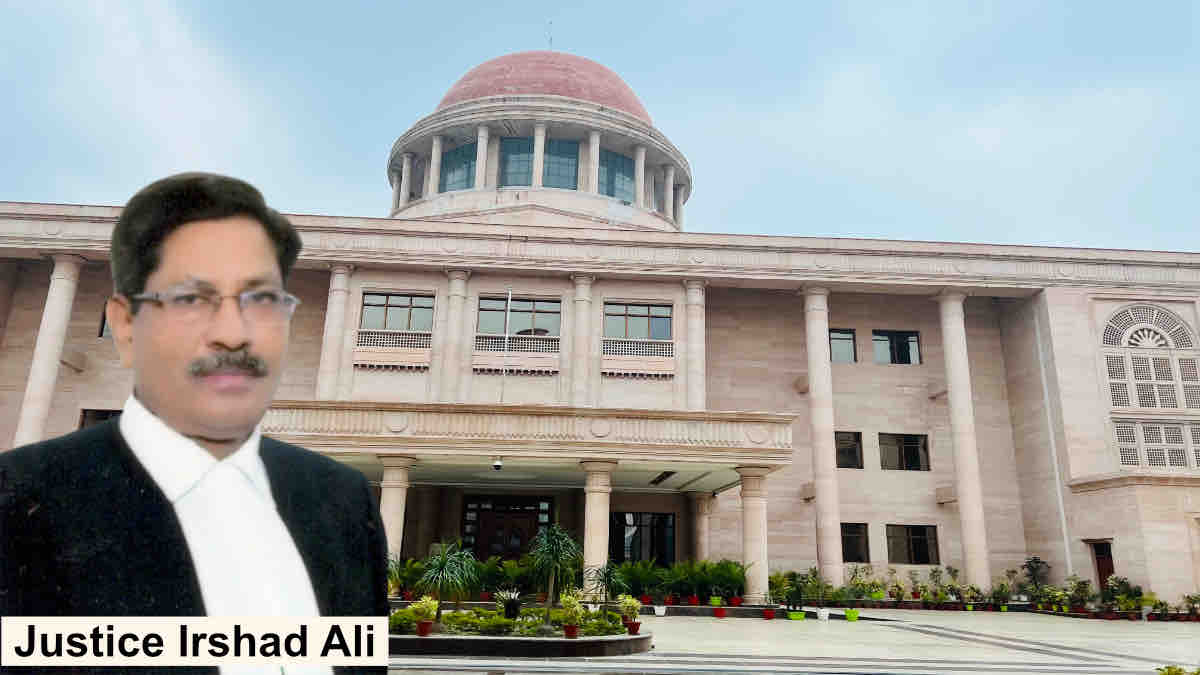
The High Court of Judicature at Allahabad, Lucknow Bench, has dismissed a writ petition filed by the State of Uttar Pradesh challenging an order of the District Judge, Lucknow. The court ruled that judicial orders of civil courts cannot be challenged under Article 226 of the Constitution of India and must instead be challenged under Article 227. Furthermore, the court held that separate writ petitions must be filed when challenging orders arising from different execution cases, even if they were decided by a common judgment.
Background
The dispute originated from two agreements to sell executed on April 6, 1974, between respondent Nos. 2 & 3 and one Sri Roop Chand regarding portions of khasra plot Nos. 416 and 417 in Faizullaganj, Lucknow. Although an advance of ₹30,000 was paid, the land was subsequently acquired by the State Government for a Lucknow Development Authority (LDA) project.
The parties entered arbitration, resulting in a compromise: if the land remained acquired, the respondents would receive their advance back with interest; if released, they would pay a total of ₹21,00,000 to the legal heirs of Sri Roop Chand. Following the release of the land under Section 17 of the U.P. Urban Planning and Development Act, 1973, and the subsequent failure of the heirs to execute the sale deeds, the respondents filed Execution Case Nos. 63 and 64 of 2011.
On November 18, 2013, the District Judge, Lucknow, ruled that stamp duty should be levied based on the market value as of December 20, 2008 (the date of the arbitral award), rather than the current date, noting that the delay was not caused by the decree-holder. The State challenged this determination of market value.
Arguments of the Parties
The learned Additional Chief Standing Counsel (CSC) for the State argued that stamp duty is payable on the market value existing at the time the instrument is registered. The State contended that the District Judge committed a manifest error of law and that a single writ petition was maintainable since the impugned order was a common judgment covering both execution cases.
Conversely, Sri Sudeep Seth, learned Senior Counsel for the respondents, raised two primary preliminary objections:
- Two execution cases decided by a common judgment cannot be challenged through a single writ petition.
- Judicial orders of a civil court are not amenable to writ jurisdiction under Article 226 and can only be challenged under Article 227 of the Constitution.
Court’s Analysis
Justice Irshad Ali examined the procedural validity of the petition. Regarding the challenge to multiple orders in one petition, the court referred to Amit Kumar Gupta and others Vs. State of U.P. (Special Appeal No. 1 of 2020), noting:
“The practice and procedure settled in this Court is that if there are several writ petitions which are decided by a common judgment then if a challenge is to be raised… separate appeals have to be filed.”
On the jurisdictional issue, the court relied on the Supreme Court’s landmark judgment in Radhey Shyam and another Vs. Chhabi Nath and others (2015), which explicitly stated:
“Judicial orders of the civil court are not amenable to writ jurisdiction under Article 226 of the Constitution. Jurisdiction under Article 227 is distinct from jurisdiction under Article 226.”
The court noted that the Deputy Registrar had “conveniently side tracked” the Apex Court’s judgment in Residents Welfare Association, NOIDA Vs. State of U.P. (2009) when initially reporting on the stamp duty.
Decision
The High Court concluded that the writ petition was not maintainable on two grounds: the improper use of Article 226 to challenge a civil court order and the joinder of challenges to two separate execution orders in a single petition.
Justice Irshad Ali ordered:
“The writ petition is dismissed with liberty to the petitioner to file separate writ petitions challenging the orders passed in Execution Case Nos. 63 & 64 of 2011 in exercise of power under Article 227 Constitution of India.”
Case Details:
- Case Title: State of U.P. Thru Prin. Secy. Stamp and Registration Deptt. and Ors. Vs. District Judge Lucknow and Others
- Case No.: WRIT-C No. 1001905 of 2014
- Bench: Justice Irshad Ali
- Date of Judgment: March 23, 2026




