

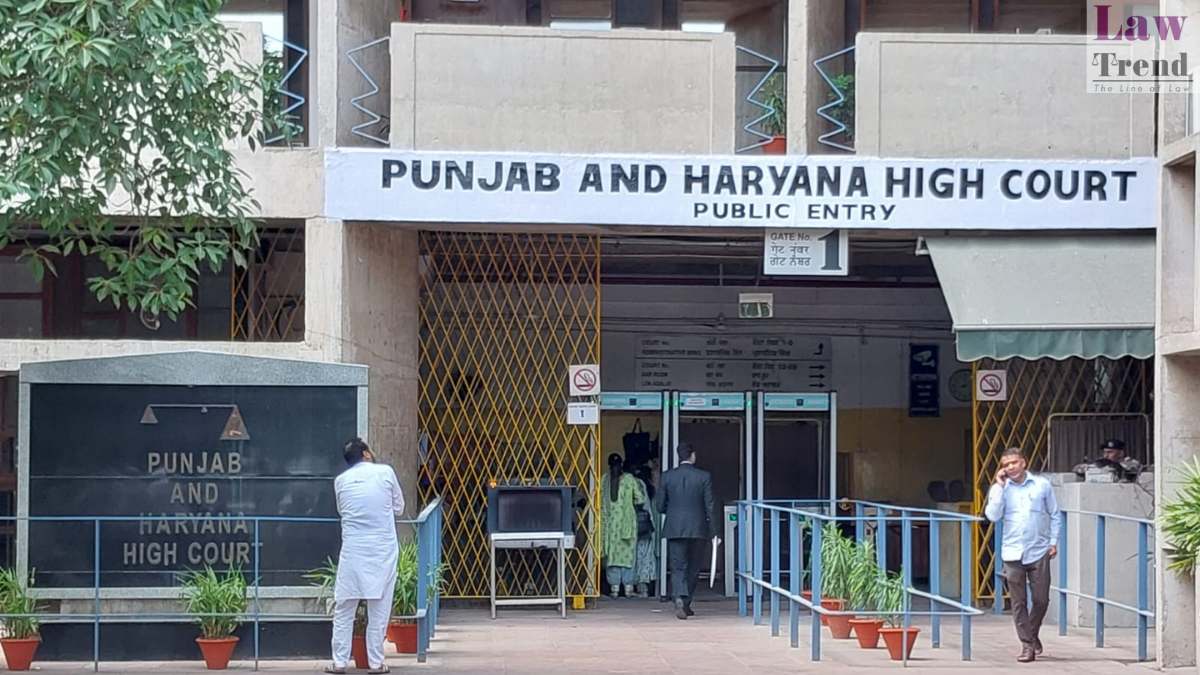
In a major legal development that threatens to disrupt the landlord-tenant landscape in the Union Territory, Chandigarh’s premier legal bodies have jointly approached the Punjab and Haryana High Court to challenge the Central Government’s extension of the Assam Tenancy Act, 2021, to the city.
The joint petition, filed by the Punjab and Haryana High Court Bar Association and the District Bar Association of Chandigarh, warns of an unprecedented legal vacuum. Under the Centre’s May 6, 2026 notification, the East Punjab Urban Rent Restriction Act, 1949—which has governed Chandigarh’s tenancies since November 4, 1972—has been repealed, leaving residents with a new law that is currently non-functional.
The petition came up for hearing before a Division Bench comprising Chief Justice Sheel Nagu and Justice Sanjiv Berry. However, the Bench directed that the matter be listed before the appropriate Division Bench as per the roster. The case is expected to be taken up for hearing on Tuesday or Wednesday.
A System in Limbo: No Rules, No Recourse
A central argument of the petition is that the notification has thrown the local rental market into chaos. Because the 1949 Rent Act has been repealed and the rules for the newly extended Assam Tenancy Act have not yet been framed for Chandigarh, no fresh landlord-tenant disputes can currently be filed or adjudicated.
The petitioners pointed out that even in Assam, where the Act was enacted on September 27, 2021, it took nearly five years—until January 28, 2026—for the rules to be framed. Furthermore, they argue that the notification’s “repeal and savings” clause is defective because while it protects pending litigation, it fails to clarify the legal status of existing tenancies.
Separation of Powers Under Threat
Represented by senior advocate Chetan Mittal, assisted by advocates Shifali Goyal and Ritvik Garg, the bar associations are raising serious constitutional objections.
A primary point of contention is the transfer of judicial powers to executive officers. Under the newly introduced Assam Tenancy Act:
- The Tehsildar is designated as the Rent Authority (Section 30).
- The Additional Deputy Commissioner (ADC) is appointed as the Appellate Authority/Rent Court (Section 33).
This is a stark departure from the previous system, where disputes were handled by judicial officers—specifically, the Sub Judge First Class acting as the Rent Controller and the District Judge serving as the Appellate Authority.
According to the petitioners, this shift violates settled constitutional principles regarding the separation of powers between the executive and the judiciary. They argue that because proceedings under the new Act are explicitly defined as “judicial proceedings” and vest powers under the Code of Civil Procedure, these adjudicatory functions must be exercised exclusively by judges possessing a judicial mind.
Questions of Legislative Authority
The Bar is also challenging the Centre’s legal authority to issue the notification in the first place.
The Centre invoked Section 87 of the Punjab Reorganisation Act, 1966, which allows it to extend Punjab-applicable laws to Chandigarh. However, the petitioners argue that this provision does not empower the Centre to repeal, amend, or enact laws that directly conflict with existing laws already in force in the Union Territory.
To support their argument that the notification is unconstitutional, the petitioners are relying on landmark Supreme Court rulings, including:
- The Constitution Bench judgment in Constitution of India and Delhi Laws Act (1912) [1951 AIR Supreme Court 332]
- Ramesh Birich and Others v Union of India and Others [1989 RCR (Rent) 79], which specifically pertains to Chandigarh’s Rent Act.
Incompatible Frameworks and “Harsh” Penalties
Beyond the constitutional questions, the petitioners argue that the Assam Tenancy Act, 2021, is fundamentally incompatible with Chandigarh’s unique urban planning laws. The definitions and exemptions in the Assam Act—particularly regarding industrial premises, hotels, lodgings, inns, and dharamshalas—do not align with Chandigarh’s local development regulations, where building use is determined by complex zoning laws rather than simple user-based classifications.
The petition also accuses the legislation of reflecting a “total non-application of mind” regarding tenant protection. Traditional rent acts are beneficial legislations designed to protect tenants from arbitrary actions. In contrast, the new framework allows landlords to seek evictions on vague grounds and imposes severe penalties on tenants who fail to vacate. Under the new provisions, tenants could be liable to pay double the rent for the first two months of overstaying, and four times the rent thereafter—terms the petitioners label as “too harsh and penal.”
Ignored Objections
Finally, the Bar Associations claim the Centre bypassed the democratic process. Although objections were formally invited under the General Clauses Act, 1897, and the Bar submitted detailed written objections, they were allegedly ignored.
The petitioners noted that while a government communication on May 14, 2025, confirmed their objections had been forwarded, the final notification was pushed through on May 6, 2026, “without hearing or addressing even a single objection.”
With the local rental market temporarily frozen and major constitutional questions on the table, all eyes are now on the High Court’s upcoming roster bench hearing.




