

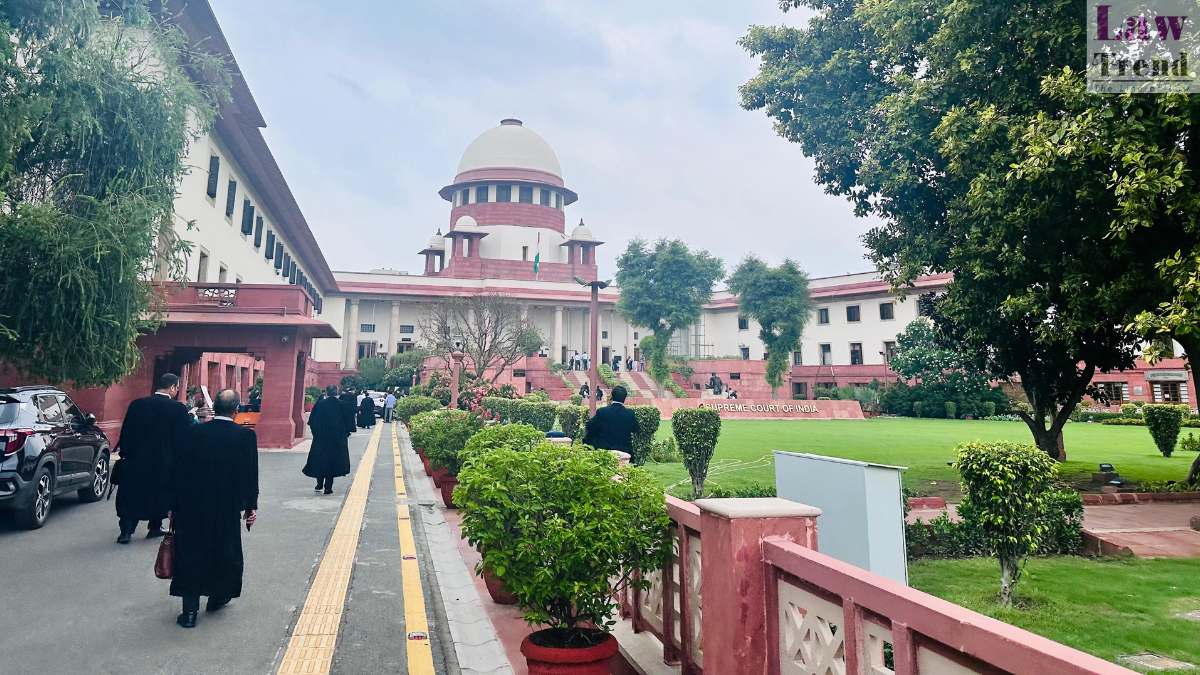
In a significant legal development, the Central Government on Wednesday told the Supreme Court that landmark judgements decriminalizing adultery and same-sex consensual relationships were based on a “subjective” application of “constitutional morality” and should be declared as “not a good law.”
The submission was made before a nine-judge Constitution bench, headed by Chief Justice of India Surya Kant, which is currently hearing petitions related to discrimination against women at religious places, including the Sabarimala temple. The bench is tasked with defining the ambit of religious freedom and the scope of judicial review under Articles 25 and 26 of the Constitution.
Solicitor General Tushar Mehta, appearing for the Centre, argued that “constitutional morality” is a sentiment rather than a concrete doctrine for testing legislation. He contended that in a democratic system, the “majoritarian view” typically prevails in law-making, and defining morality against this backdrop is problematic.
“The observations in the case of Navtej Singh Johar v. Union of India, have elevated the concept of ‘constitutional morality’ to being a test for judicial review of legislation,” Mehta stated. “It is submitted that the same is alien to the concept of separation of powers and the doctrine of checks and balances.”
The Solicitor General further claimed that using this concept as a standalone test for judicial review “militates against the mandate of Article 13,” which ensures laws do not violate fundamental rights.
The Centre’s focus was largely on two 2018 verdicts:
- Joseph Shine v. Union of India: Which struck down Section 497 of the IPC (Adultery).
- Navtej Singh Johar v. Union of India: Which partially struck down Section 377 of the IPC (Homosexuality).
Mehta argued that the ruling in the Joseph Shine case proceeded on a premise that was “against the society’s morality” and even “against constitutional morality.” While the Centre clarified it was not arguing for the reinstatement of the adultery law itself, it urged the court to declare the reasoning and the law established in that case as invalid.
The Solicitor General sharply criticized the Supreme Court’s reliance on foreign law journals, podcasts, and academic writings in previous judgements. He specifically pointed to the citation of American legal scholars and Indian academics in the Joseph Shine verdict.
“The courts should not base binding law on ‘individual and subjective views’ drawn from selective academic writings,” Mehta argued, suggesting that such citations should not hold the status of binding law under Article 141 of the Constitution.
Chief Justice Surya Kant also questioned the reliance on certain scholars cited in the adultery judgement, asking, “Who is this Segal? He has almost been referred here as if he is the second Ambedkar?”
The nine-judge bench is currently addressing seven specific questions regarding religious freedom. These questions arose after a 2019 reference order in the Sabarimala case, which expanded the scope of the inquiry to include practices like female genital mutilation in the Dawoodi Bohra community and the entry of Parsi women into Fire Temples.
The bench includes Justices B.V. Nagarathna, M.M. Sundresh, Ahsanuddin Amanullah, Aravind Kumar, Augustine George Masih, Prasanna B. Varale, R. Mahadevan, and Joymalya Bagchi.




