

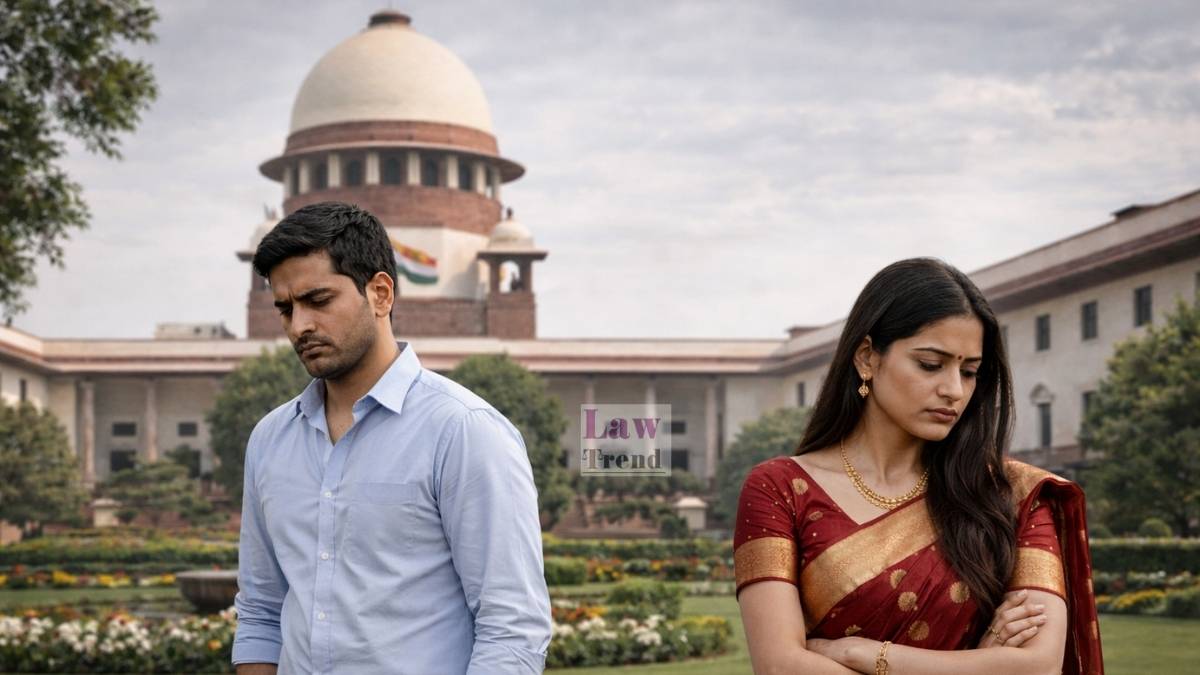
The Supreme Court of India has exercised its extraordinary powers under Article 142(1) of the Constitution to dissolve a marriage on the grounds of “irretrievable breakdown,” while quashing Domestic Violence (DV) proceedings initiated by a wife who had resiled from a mediated settlement agreement. A Bench comprising Justices Vijay Bishnoi and Rajesh Bindal observed that any deviation from terms arrived at in mediation harbors an attack to the foundational basis of the entire mediation process.
Legal Issue
The primary legal issues before the Court were whether the proceedings initiated by the Respondent-Wife under the DV Act should be quashed in light of a mediated settlement, and whether the Court could exercise its powers under Article 142(1) to grant a decree of divorce on the ground of irretrievable breakdown of marriage. The Supreme Court allowed the appeal, set aside the Delhi High Court’s interim order, quashed the DV complaint, and dissolved the marriage subject to specific financial and property conditions.
Factual Background
The Appellant-Husband and Respondent-Wife were married on February 19, 2000. Matrimonial disputes led to the husband filing a Divorce Petition in 2023. On May 16, 2024, the parties entered into a Settlement Agreement at the Delhi Mediation Centre, agreeing to dissolve their marriage by mutual consent. Under the agreement, the husband was to pay ₹1.50 crore in two installments and ₹14 lakh for a car. He also returned specific jewellery. In exchange, the wife was to transfer ₹2,52,38,794 to the husband to validate business accounts and relinquish claims to several properties and policies.
While the First Motion was allowed and the husband paid the first installment of ₹75 lakh plus ₹14 lakh for the car, the wife subsequently withdrew her consent for the mutual divorce and refused to sign the Second Motion. She then filed a complaint under Section 12 of the Protection of Women from Domestic Violence Act, 2005. The Delhi High Court, via an impugned order dated January 7, 2026, allowed the DV proceedings to continue subject to the wife depositing ₹89 lakh with the Registrar General.
Arguments of the Parties
For the Appellant-Husband: The husband’s counsel submitted that the wife had admittedly received ₹89 lakh and her jewellery but with “malafide intentions” refused to proceed with the Second Motion to extract a more “financially lucrative settlement.” He argued that her conduct amounted to an abuse of the process of law. Reliance was placed on Ruchi Agarwal v. Amit Kumar Agarwal (2005) to argue that criminal proceedings filed to harass should be quashed.
For the Respondent-Wife: The wife contended that the husband had orally assured her of returning jewellery worth ₹120 crore and gold biscuits worth ₹50 crore outside the Settlement Agreement, which he later refused to do. She claimed she was told that including these in the agreement would alert the Income Tax Department. She argued that consent for mutual divorce must continue until the passing of the final decree, citing Sureshta Devi v. Om Prakash (1991).
Court’s Analysis
The Court expressed strong disapproval of the wife’s claim regarding oral assurances made to evade taxes, stating, “We are appalled at the sheer audacity of such a submission being advanced before a court of law and deplore the evident disregard exhibited towards the legal system.” The Bench noted that the wife, a mature and educated woman assisted by an advocate, signed the agreement without pressing for these conditions.
On the sanctity of mediation, the Court observed:
“Any deviation from the terms of the settlement arrived in mediation and later confirmed by the Court should be dealt with strictly as such deviation harbors an attack to the foundational basis of the entire process of mediation.”
Regarding the DV proceedings, the Court noted the absence of specific allegations of violence and described the complaint as an “afterthought” and “premeditated,” filed only after she resiled from the settlement. The Bench stated:
“We cannot allow such emotions to take a drastic turn in as much as allowing the bursts of emotions to form the basis of criminal prosecution. Such criminal prosecution, if allowed, would lead to an abuse of law and cause harassment.”
Decision
The Court concluded that the marriage had irretrievably broken down and exercised its powers under Article 142(1). The following directions were issued:
- The DV proceedings (Complaint No. 3186/2025) are quashed and the High Court order is set aside.
- The marriage is dissolved subject to the husband paying the remaining ₹70,22,871 (after PPF adjustment) within two weeks.
- The parties must appear before the Registrar to execute relinquishment deeds for properties (Mascot & Neo Town) and shares within four weeks.
- The ₹89 lakh deposited by the wife before the High Court shall be returned to her with interest.
- All other civil and criminal proceedings between the parties stand closed and quashed, with a complete bar on future litigation.
Case Details:
- Case Title: Dhananjay Rathi v. Ruchika Rathi
- Case No.: Criminal Appeal No. 1924 of 2026
- Bench: Justices Vijay Bishnoi and Rajesh Bindal
- Date: April 13, 2026




