

‘Bigger Players Must Play by Greener Rules’: SC Affirms NGT’s Power to Use Project Cost for Environmental Fines
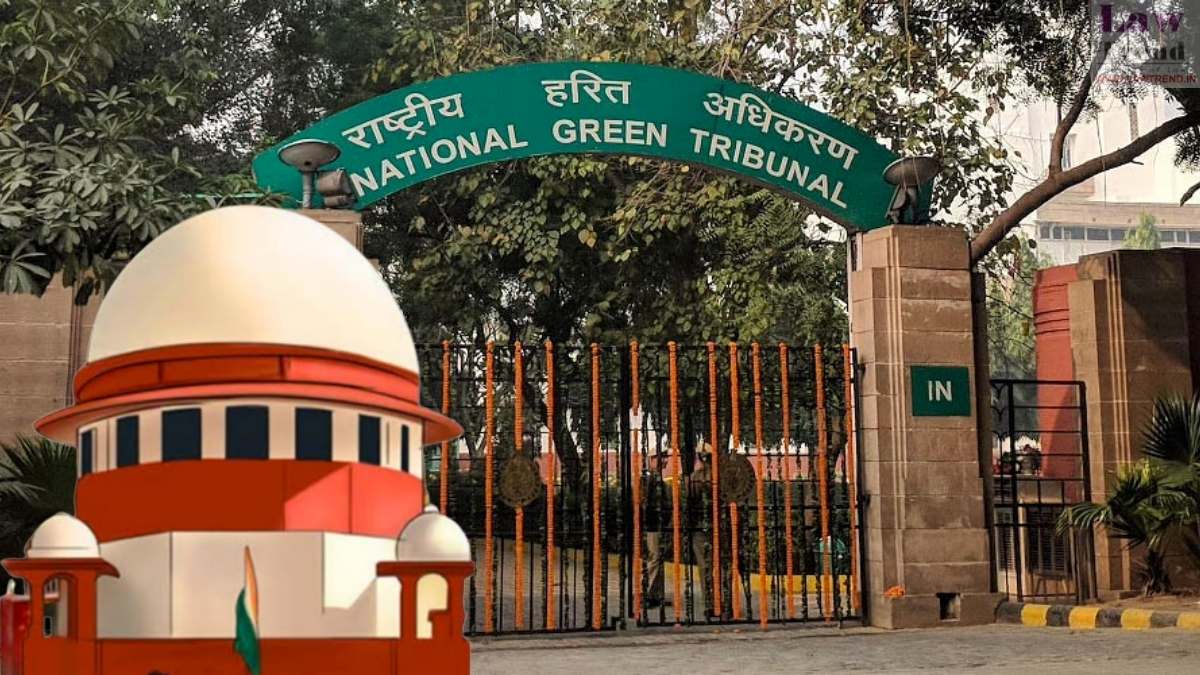

The Supreme Court of India has affirmed that the National Green Tribunal (NGT) is competent to adopt a project proponent’s turnover or total project cost as a relevant yardstick for computing environmental compensation. The Court held that in the absence of a legislatively prescribed formula, the NGT possesses the discretion to mould relief guided by the ‘polluter pays’ principle to ensure compensation is neither illusory nor disproportionate to the scale of the violation.

A Bench comprising Justice Dipankar Datta and Justice Vijay Bishnoi dismissed the appeals filed by real estate developers M/s. Rhythm County and M/s. Key Stone Properties, who had challenged NGT orders directing them to pay ₹5 crore and approximately ₹4.47 crore, respectively, for environmental violations.

Background of the Cases

The controversy arose from two separate projects in Pune. In the lead appeal, M/s. Rhythm County (RHYTHM) was found by the NGT to have carried out construction beyond sanctioned limits and without obtaining mandatory Consent-to-Establish (CTE) under the Water (Prevention and Control of Pollution) Act, 1974, and the Air (Prevention and Control of Pollution) Act, 1981. Despite a stop-work direction from the Maharashtra Pollution Control Board (MPCB) in July 2020, construction activity reportedly continued.

In the connected appeal, M/s. Key Stone Properties (KEYSTONE) had applied for post-facto Environmental Clearance (EC) under a violation regularisation window. While the NGT accepted the validity of this EC, it found distinct violations, including prolonged construction without CTE from 2013 to 2020, continuing work despite a closure notice, and handing over possession to occupants without a valid Consent-to-Operate (CTO).

Arguments of the Parties

For the Appellants: Senior Counsel representing the developers argued that the NGT erred by applying a Central Pollution Control Board (CPCB) formula intended for highly polluting industrial units to residential projects. They contended that:

  • The imposition of liability must have clear statutory moorings and cannot be based on “interpretative convenience.”
  • Turnover or project cost bears no rational nexus to actual environmental damage.
  • The NGT “outsourced” its adjudicatory function by mechanically adopting Joint Committee reports.
  • Reliance was placed on DPCC v. Lodhi Property Co. Ltd. (2025) to argue that the CPCB formula lacks legal sanctity and requires incorporation into statutory rules before application.
READ ALSO  Provision Of Section 125 CrPC Not Intended to Create 'Army of Idle People Waiting for Maintenance': Madhya Pradesh High Court

For the Respondents: Additional Solicitor General Aishwarya Bhati, appearing for the Union of India, submitted that the violations were substantive departures from mandatory safeguards. She argued that the NGT’s orders were justified under the ‘polluter pays’ principle and reflected the scale and impact of the offending activities.

Court’s Analysis and Observations

The Supreme Court framed the primary issue as whether the NGT could enhance compensation based on project cost in the absence of a legislatively prescribed framework.

1. NGT’s Discretionary Powers The Court noted that Section 15 and Section 20 of the National Green Tribunal Act, 2010, confer “wide, flexible, and principle-oriented” powers. The Bench observed:

“The expression ‘as the Tribunal may think fit’ in Section 15 is indicative of a conscious legislative choice to repose discretion in the NGT to mould relief in a manner commensurate with the nature and gravity of environmental harm.”

READ ALSO  Integrity is the Foundation of Judicial Service: Allahabad High Court Upholds Compulsory Retirement of Judicial Officer

2. Relevance of Turnover and Project Cost The Bench rejected the argument that turnover is an irrelevant metric, stating that larger operations naturally have a bigger environmental footprint:

“Linking scale to impact sends a message that bigger players need to play by greener rules… to contend that turnover can never form a relevant factor in quantifying compensation to match the magnitude of harm is fallacious.”

3. Judicial Precedents The Court relied heavily on its earlier decision in M/s. Goel Ganga Developers India Pvt. Ltd. v. Union of India (2018), where it was held that damages could generally extend up to 5% of the total project cost. The Court noted that the ₹5 crore penalty on RHYTHM worked out to only 1.49% of its ₹335 crore project cost, which could not be termed arbitrary.

Regarding the conflict between different coordinate bench decisions, the Court clarified:

“Deepak Nitrite Ltd. (2004) and Research Foundation for Science (2005) are decisions of coordinate Benches… Research Foundation merely distinguished Deepak Nitrite and did not overrule it.”

4. The CPCB Formula as a Tool Addressing the criticism of the CPCB formula, the Court held that while the formula is not a “rigid or exhaustive code,” it serves as a “facilitative and indicative tool.” The Bench emphasized that the NGT is not confined to narrow adversarial contours but has a mandate for restitution and corrective intervention.

READ ALSO  ADR Moves to Supreme Court With Contempt Plea Over SBI's Failure to Disclose Electoral Bonds Data

Decision of the Court

The Supreme Court concluded that the NGT had applied its independent mind to the findings of the Joint Committees and provided due opportunity to the parties.

The Court summarized its findings:

  • The NGT is not divested of authority to employ project turnover as a yardstick.
  • Environmental compensation must be “rational, proportionate and reasoned.”
  • The CPCB framework is a permissible starting point for expert-driven assessments.

Finding no ground to interfere with the computation of compensation, the Supreme Court dismissed both appeals. However, it extended the time for the developers to pay the compensation amounts by three months from the date of the judgment.

Case Details:

  • Case Name: M/s. Rhythm County v. Satish Sanjay Hegde & Ors. (with connected appeal)
  • Case Number: Civil Appeal No. 7187 of 2022
  • Bench: Justice Dipankar Datta and Justice Vijay Bishnoi

Law Trend
Law Trendhttps://lawtrend.in/
Legal News Website Providing Latest Judgments of Supreme Court and High Court

Related Articles

Latest Articles

