

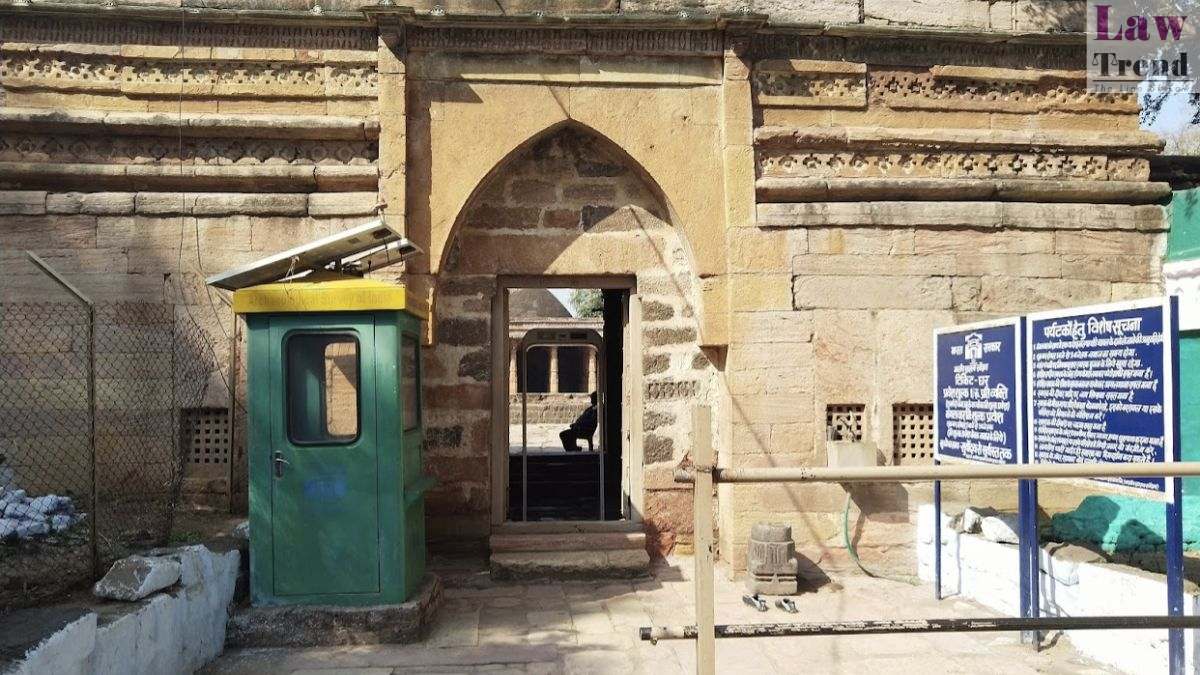
In a significant development during the ongoing legal battle over the Bhojshala complex in Dhar, a petitioner argued before the Madhya Pradesh High Court on Wednesday that the structure’s design strictly adheres to the architectural mandates of the 11th-century manual, Samarangana Sutradhara. The petitioner contends that this evidence, coupled with historical records, confirms the site’s original identity as a Saraswati temple and Sanskrit study center, necessitating exclusive worship rights for Hindus.
The arguments were presented before the Indore bench of the High Court, comprising Justice Vijay Kumar Shukla and Justice Alok Awasthi, as part of a series of hearings involving four petitions and one writ appeal contesting the religious nature of the protected monument.
Advocate Manish Gupta, representing petitioner Kuldeep Tiwari, centered his arguments on the Samarangana Sutradhara, a celebrated treatise on architecture written by the 11th-century Parmar King Raja Bhoj. The book details specific standards for the construction of temples, palaces, and towns.
Gupta asserted that the Archaeological Survey of India’s (ASI) recent scientific survey report validates these architectural links. He pointed out that the foundation stone blocks and the bricks used in the central havankund (sacred fire pit) originate from the same kiln, suggesting they were part of the original construction.
“The havankund was built according to the standards set by Raja Bhoj in his book. Similarly, the entrance and the sanctum sanctorum of the complex align perfectly with these 11th-century specifications,” Gupta stated during the hearing.
Referring to the complex as Saraswati Kanthabharana or Sharda Sadan, the petitioner argued that historical texts and the 1908 Government Gazette consistently identify the site as a center of learning and worship for Hindus.
The legal crux of the argument rests on the principle of religious continuity. “According to legal provisions, once a temple is established at a place, it remains a temple forever,” Gupta argued, citing the Supreme Court’s landmark judgment in the Ram Janmabhoomi-Babri Masjid case regarding the legal recognition of authentic historical literature.
The Hindu side further challenged the Muslim community’s claim to the site, known to them as the Kamal Maula Mosque. The petitioner argued that under Islamic teachings, a mosque cannot be established by forcibly occupying an existing structure. Consequently, the petitioner has urged the court to grant Hindus the sole right to worship at the complex, which is currently an ASI-protected site.
The court has been hearing these petitions regularly since April 6, with the arguments of the Hindu petitioners being recorded first. The Muslim side is expected to present its rebuttal in subsequent sessions.


