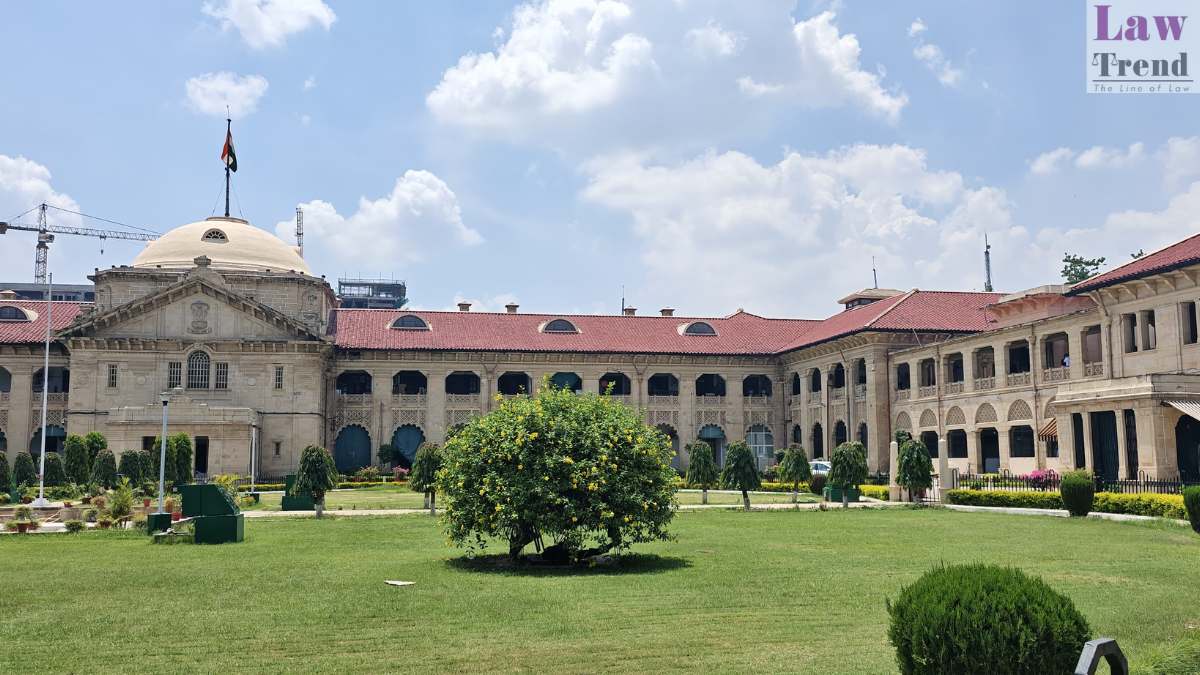
The Allahabad High Court has set aside an order of the Uttar Pradesh government that restricted the number of people offering prayers at a mosque in Sambhal district on law-and-order grounds. The court observed that maintaining peace and ensuring citizens can worship at designated places is the responsibility of the State, adding that if local authorities feel incapable of enforcing the rule of law, they should resign or seek transfer.
The matter came before a bench of Justices Atul Sreedharan and Siddharth Nandan while hearing a petition filed by Munazir Khan from Sambhal district.
The petitioner alleged that he and others were prevented from offering prayers during the month of Ramzan on Gata No. 291, a property where, according to him, a mosque exists.
The Uttar Pradesh authorities had permitted prayers at the location but restricted the gathering to 20 worshippers, citing concerns about a possible law-and-order situation in the area.
During the hearing, the State argued that the limitation was imposed due to apprehensions about maintaining public order.
However, the High Court emphasized that it is the responsibility of the State to ensure that members of every community are able to worship peacefully at designated places of worship.
The bench observed:
“It is duty of the State to ensure that every community is able to offer worship peacefully in the designated place of worship and if it is a private property as already been held by the court earlier to perform worship without any permission from the State.”
The court also referred to its earlier rulings, stating that State permission becomes necessary only when religious activities are proposed on public land or when such activities spill over into public spaces.
The order noted:
“This court has already settled that it is only where prayers or religious functions have to be held on public land or spill over the public property that the involvement of the state is essential and permission must be sought.”
The State, meanwhile, contested the petitioner’s claim over the property. It argued that revenue records list the land under the names of Mohan Singh and Bhooraj Singh, both sons of Sukhi Singh, raising a dispute regarding ownership of Gata No. 291.
Despite the State’s justification for limiting the number of worshippers, the court strongly criticised the reasoning based on law-and-order concerns.
The bench stated:
“It is the duty of the State to ensure that the rule of law prevails under every circumstance. If the local authorities i.e. Superintendent of Police and Collector feel that the law and order situation could arise because of which they want to limit the number of worshippers within the premises, they should either resign from their post or seek transfer outside Sambhal.”
The court has now listed the matter for further hearing on March 16.