

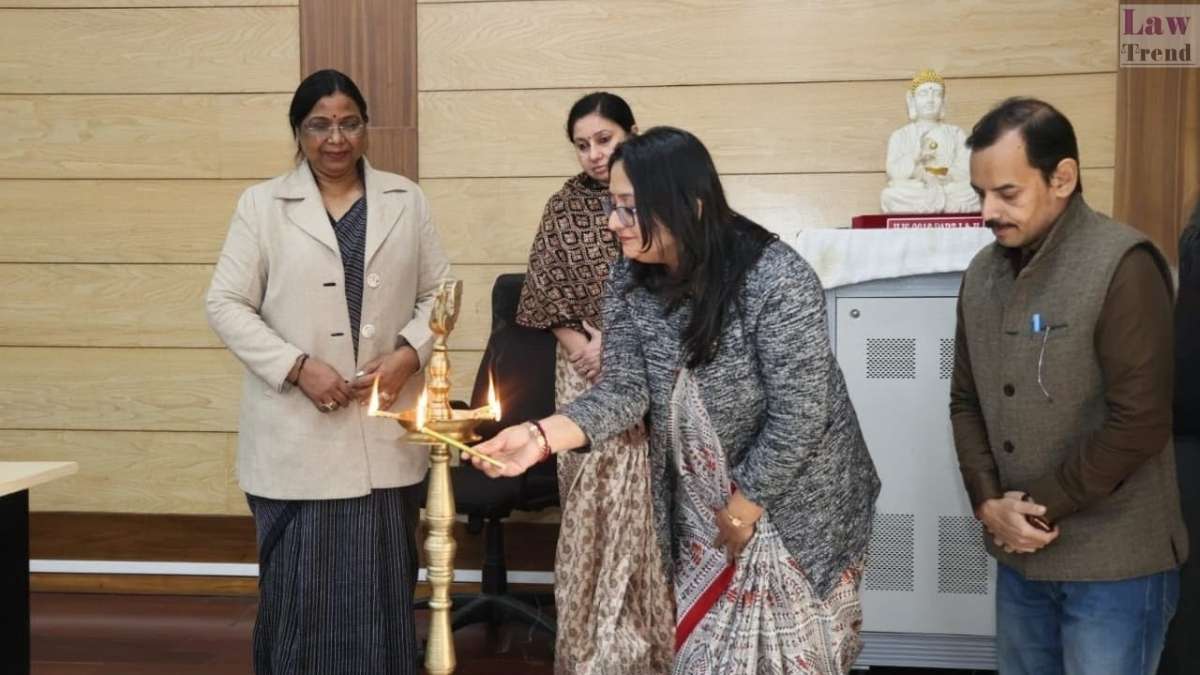
A one-day workshop on “Gender Sensitization” was organized by the Hon’ble Committee for Sensitization of Family Court Matters, High Court of Judicature at Allahabad, on 7th December, 2025, at the Judicial Training & Research Institute, U.P. The workshop brought together Family Court Counsellors from various districts of Uttar Pradesh to engage in an interactive and participative learning programme.
The objective of the workshop was to familiarize participants with the concept of gender, sensitize them to gender stereotypes, and enable them to recognize the workings of gender both in professional settings and personal spaces. The workshop aimed to foster reflective thinking and promote practices that ensure equality and fairness in family court work.
Director, JTRI and GenSen Committee, Lucknow University lighting the lamp
The inaugural session of the workshop was presided by Ms. Rekha Agnihotri, Director, Judicial Training & Research Institute, U.P. She observed that gender sensitivity is essential for fair counselling and effective resolution of matrimonial disputes, as counsellors often serve as the first point of support for families in distress. She highlighted that recognizing stereotypes and unconscious biases is crucial for ensuring dignity, empathy, and equality in the functioning of family courts. She expressed confidence that the workshop would enable participants to reflect meaningfully on these issues and integrate gender-aware practices into their daily professional roles.
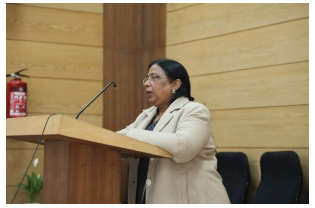
Km. Rekha Agnohotri, Director, Judicial Training & Research Institute addressing the participants
The sessions were conducted by Prof. Roli Misra, Dr. Prashant Shukla, and Dr. Sonali Roy Choudhury from the Gender Sensitization (GenSen) Cell, University of Lucknow. The module was designed to be discussion-oriented and interactive, enabling participants to reflect on their own perceptions and challenge ingrained biases.
Prof. Roli Misra, in her session on “Gender in Society and Stereotypes,” explored how gender roles and expectations are socially constructed and reinforced through cultural, institutional, and interpersonal practices. The session highlighted common stereotypes, their impact on professional and personal spaces, and strategies to recognize and challenge unconscious biases. Participants actively engaged in discussions, reflecting on their own perceptions and the ways societal norms influence decision-making and interactions in Family Courts.
Dr. Prashant Shukla conducted a thought-provoking session on “Gender Sensitization in Ancient India,” focusing on the historical origins and systemic impact of patriarchy. The discussion examined how patriarchal norms have evolved over time and continue to shape social, cultural, and legal attitudes toward gender. Participants analyzed the enduring effects of these structures in contemporary society, emphasizing the importance of awareness and critical reflection in addressing gender biases in professional practice.
Dr. Sonali Roy Choudhury’s session focused on “The Nature of Matrimonial Disputes and their Recourse through a Legal Lens.” She provided an in-depth understanding of the types of disputes commonly encountered in family courts, the underlying social and gender dynamics, and the legal remedies available under existing statutes. The session offered practical insights for counselling and adjudication, equipping participants with the knowledge and sensitivity required to handle matrimonial matters with fairness, empathy, and a gender-aware perspective.
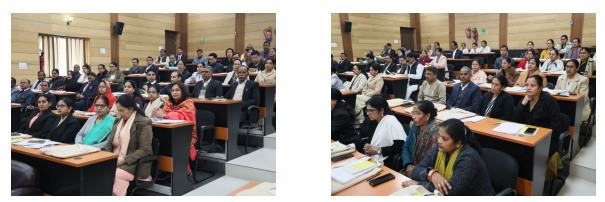
Family Court Counsellors attending the Workshop
The workshop concluded with the valedictory session and distribution of certificates of participation.




