The Delhi High Court has rejected a plaint in a suit for partition and declaration, holding that documents such as an Agreement to Sell (ATS), General Power of Attorney (GPA), and Receipt do not confer any right, title, or interest in immovable property.
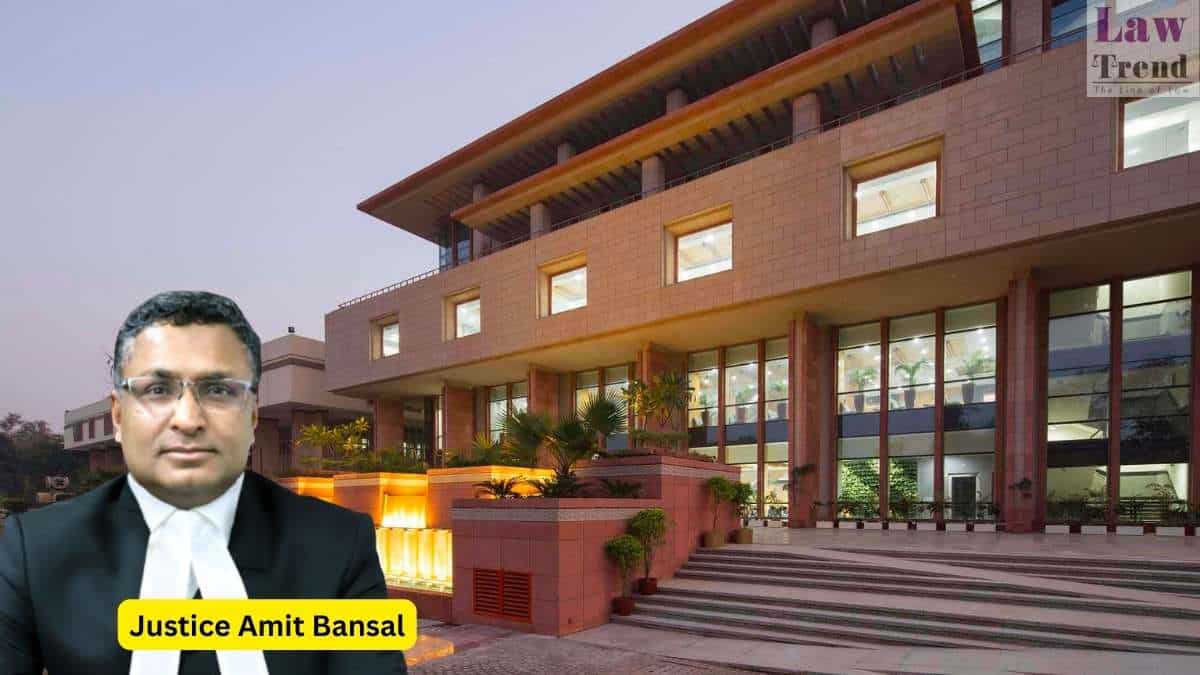
Justice Amit Bansal allowed the plea for rejection of the plaint, observing that the suit was “manifestly vexatious” and failed to disclose a cause of action as the plaintiffs’ claim was based solely on unregistered documents, while a registered sale deed existed in favor of the defendants’ predecessor.
Background of the Case
The plaintiffs, the legal heirs of Late Sh. Dinesh Kumar Bhatia, filed the suit (CS(OS) 141/2022) against the legal heirs of Late Sh. Amrish Kumar Bhatia. The dispute pertained to a property admeasuring 1 Bigha, 2 Biswas in Village Karawal Nagar, Delhi.
The plaintiffs claimed that their predecessor, Dinesh Kumar Bhatia, had purchased the property jointly with his brother, Amrish Kumar Bhatia (the defendants’ predecessor), based on an Agreement to Sell, Receipt, and GPA dated April 7, 1981. They sought a decree declaring them as 50% joint owners and a partition of the property. They further alleged that in October 2021, the defendants refused to partition the property.
Following an amendment to the plaint, the plaintiffs also sought a declaration for the cancellation of a registered Sale Deed dated January 2, 1982, executed in favor of Late Sh. Amrish Kumar Bhatia.
Arguments of the Parties
The counsel for the defendants argued that the plaint was liable to be rejected under Order VII Rule 11 (a) and (d) of the Code of Civil Procedure (CPC) as it did not disclose a cause of action and was barred by limitation.
The defendants contended that:
- The documents relied upon by the plaintiffs (ATS, GPA, and Receipt) do not confer any title, citing the Supreme Court’s judgment in Suraj Lamp & Industries (P) Ltd. v. State of Haryana & Anr..
- To enforce rights under an ATS, the plaintiffs should have filed a suit for specific performance, which they failed to do.
- The registered sale deed dated January 2, 1982, acted as notice to all, and the challenge raised after more than 40 years was time-barred.
The plaintiffs countered that the sale deed was never disclosed to them or their predecessor. They argued that the matter required a trial to decide the rights and shares of the parties, relying on the Supreme Court’s decision in Vikrant Kapila v. Pankaja Panda.
Court’s Analysis and Observations
Justice Bansal examined whether the unregistered documents relied upon by the plaintiffs could form the basis of a claim for title.
Referring to the landmark judgment in Suraj Lamp & Industries (P) Ltd., the Court reiterated:
“In the absence of a deed of conveyance (duly stamped and registered as required by law), no right, title or interest in an immovable property can be transferred.”
The Court also relied on the recent Supreme Court judgment in Ramesh Chand v. Suresh Chand (2025), which held that a General Power of Attorney does not ipso facto constitute an instrument of transfer of immovable property.
The High Court observed:
“From a reading of the aforesaid extracts from the judgments of the Supreme Court, it is abundantly clear that a title to an immovable property cannot be claimed on the basis of an Agreement to Sell, a General Power of Attorney and a Receipt. The title can only be conveyed through a registered conveyance deed/sale deed.”
The Court noted that the plaintiffs had not claimed specific performance nor impleaded the vendor. Furthermore, the predecessor of the plaintiffs, who was alive until 1985, never challenged the 1982 sale deed during his lifetime.
Applying the principles laid down in RBANMS Educational Institution v. B. Gunashekar (2025), the Court held that unless a sale deed is executed, a purchaser has no right except to seek specific performance.
On the scope of Order VII Rule 11 CPC, the Court cited Dahiben v. Arvindbhai Kalyanji Bhanusali, emphasizing that the power to terminate a civil action is mandatory if the plaint fails to disclose a cause of action.
“If on a meaningful reading of the plaint, it is found that the suit is manifestly vexatious and without any merit, and does not disclose a right to sue, the court would be justified in exercising the power under Order 7 Rule 11 CPC.”
Justice Bansal further referred to a Division Bench judgment of the Delhi High Court in Mania Ghai v. Nishant Chander, which held that Courts can suo moto reject a plaint when it is apparent on the face of the record that the suit lacks a cause of action.
Decision
The Court concluded that the plaint did not disclose a cause of action as it was based on documents that do not create any right, title, or interest in the property.
“The plaintiffs have tried to create a cause of action by clever drafting. Continuation of the present suit would result in a waste of judicial time of the Court.”
Consequently, the Court rejected the plaint under Order VII Rule 11(a) of the CPC.
Case Details:
- Case Title: Neelam Bhatia and Ors vs. Ritu Bhatia and Ors
- Case Number: CS(OS) 141/2022
- Coram: Justice Amit Bansal