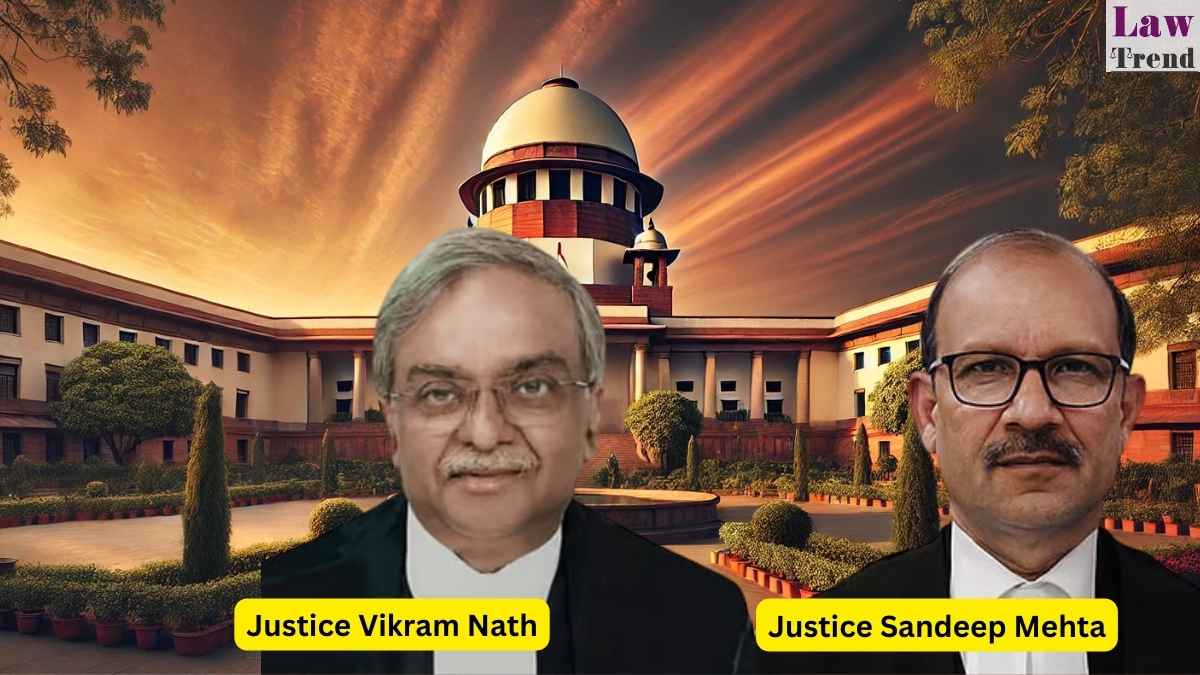
The Supreme Court of India, in the case of Gobind Singh and Ors. v. Union of India and Ors., has affirmed the High Court of Madhya Pradesh’s decision to set aside a decree of title in favor of private claimants over land situated within the Morar Cantonment. The Bench, comprising Justice Vikram Nath and Justice Sandeep Mehta, held that an appellate court is not a forum to fill gaps in a case through additional evidence when the primary claim of ownership is based on a decree obtained without impleading the true owner.
Case Background
The dispute pertained to land bearing Survey No. 2029, admeasuring 8 Bighas and 10 Biswas in Gwalior. The appellants (plaintiffs) filed a civil suit in 1989 seeking a declaration of title and permanent injunction against the Union of India, claiming the land was ancestral property in their continuous possession for fifty years.
In 1996, the Trial Court (Vth Additional District Judge, Gwalior) decreed the suit in favor of the plaintiffs. The Trial Court relied heavily on a previous decree dated July 9, 1984, which had been passed in favor of the plaintiffs’ predecessors against the State of Madhya Pradesh.
However, the Union of India challenged this before the High Court of Madhya Pradesh. The High Court set aside the Trial Court’s judgment, prompting the plaintiffs to file a review petition and an application under Order XLI Rule 27 of the Code of Civil Procedure (CPC) to introduce certified copies of the General Land Register (GLR) as additional evidence. The High Court dismissed both the review and the application for additional evidence in 2011.
Arguments of the Parties
For the Appellants: Senior Counsel Shri Anupam Lal Dass argued that the High Court erred by deciding the appeal on merits in 2009 without first adjudicating the application for additional evidence. He contended that the predecessors had already secured a title declaration against the State which had attained finality, and that long-term possession had perfected their title via adverse possession.
For the Respondents (Union of India): Senior Counsel Shri V. Chitambresh contended that the Morar Cantonment land vested in the Union Government in 1953. He argued that the 1984 ex-parte decree against the State of MP was not binding on the Union of India, as the Union was never impleaded. He further asserted that the application for additional evidence did not meet the strict parameters of Order XLI Rule 27 CPC.
Court’s Analysis and Observations
The Supreme Court focused on two primary legal issues: the procedural handling of additional evidence and the validity of a title claim based on an ex-parte decree against the wrong party.
On Order XLI Rule 27 CPC: The Court emphasized that parties are not entitled to produce additional evidence in an appellate court as a matter of right. Citing Union of India v. Ibrahim Uddin (2012) and State of Karnataka v. K.C. Subramanya (2014), the Court noted:
“Rule 27, being couched in negative terms, makes it abundantly clear that parties to an appeal are not entitled to adduce additional evidence… save and except in the circumstances expressly enumerated therein.”
The Court clarified that additional evidence is only permissible to remove a “lacuna” that prevents the court from pronouncing a satisfactory judgment, not to allow a party to improve their case at their “sweet will.”
On the Merits and Conduct: The Court found that the plaintiffs’ claim was “fundamentally flawed.” The 1984 decree was non-est against the Union of India because they were not a party to it. The Court observed:
“The attempt to secure a decree behind the back of the true owner is a circumstance that cannot be lightly brushed aside.”
The Bench also noted with “disapproval” the conduct of the litigants, pointing out that one of the appellants was employed in the Commissioner’s office at the time of the expeditious mutation of revenue entries following the ex-parte decree.
On Adverse Possession: Regarding the claim of adverse possession, the Court affirmed the High Court’s finding:
“Their [the plaintiffs’] could not be any perfection of rights by adverse possession against the State/Union howsoever long may be the possession.”
The Decision
The Supreme Court concluded that even if the GLR entries were accepted as additional evidence, they would not impact the outcome because the plaintiffs failed to produce independent, cogent title deeds.
“Once the trial had concluded and the decree was under challenge in appeal, the appellants could not be permitted to fill the gaps in their case by seeking to adduce further material to fortify a claim that was fundamentally flawed,” the judgment stated.
The Court affirmed the High Court’s judgments dated August 12, 2009, and March 15, 2011, and dismissed the appeals.
Case Details:
- Case Title: Gobind Singh and Ors. Versus Union of India and Ors.
- Case No: Civil Appeal Nos. 5168-5169 of 2011
- Bench: Justice Vikram Nath and Justice Sandeep Mehta
- Date : March 09, 2026