

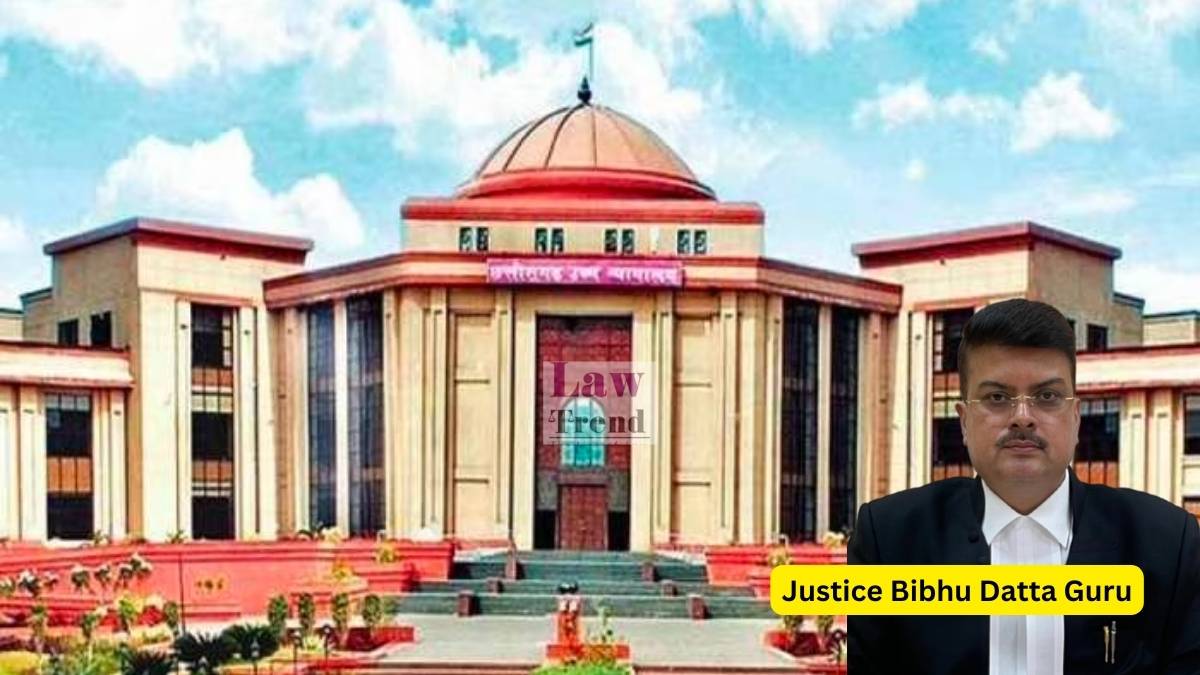
The High Court of Chhattisgarh has rejected the regular bail plea of former Chhattisgarh Public Service Commission (CGPSC) Chairman Taman Singh Sonwani in a money laundering case arising from the alleged 2020 and 2021 CGPSC examination scam, ruling that the medical exception under the proviso to Section 45(1) of the Prevention of Money Laundering Act, 2002 (PMLA) cannot be invoked without evidence of a life-threatening ailment or inadequate custodial treatment. Justice Bibhu Datta Guru held that the statutory twin conditions under Section 45 of the PMLA were not met, as the material on record prima facie connected the former public official to the generation, routing, and laundering of proceeds of crime.
Background of the Case
The proceedings stem from alleged irregularities in the CGPSC State Service Examinations conducted during 2020 and 2021. The Anti-Corruption Bureau/Economic Offences Wing (EOW/ACB), Raipur, initially registered FIR No. 05/2024 on February 7, 2024, under Sections 120-B and 420 of the Indian Penal Code, 1860, along with Sections 7, 7A, and 12 of the Prevention of Corruption Act, 1988. The Central Bureau of Investigation (CBI) took over the probe, registering RC No. RC1242024A0004 on July 9, 2024, and filed a charge-sheet on January 16, 2025, followed by supplementary charge-sheets on September 26, 2025, and December 31, 2025.
Based on the predicate scheduled offences, the Directorate of Enforcement (ED), Raipur Zonal Office, registered ECIR No. ECIR/RPZO/01/2024 on March 27, 2024, for the offence of money laundering under Section 3, punishable under Section 4 of the PMLA. The 65-year-old applicant, who served as the Chairman of the CGPSC during the relevant period, was arrested by the ED in July 2026. His regular bail application was initially rejected by the Special Court (PMLA), Raipur, on August 20, 2026, leading to the present application before the High Court under Section 483 of the Bharatiya Nagarik Suraksha Sanhita, 2023 (BNSS).
The prosecution alleged that the recruitment process was manipulated through an amendment introduced on July 14, 2021, which deleted the word “nephew” from the definition of “family” under the recruitment rules, allegedly facilitating the selection of the applicant’s nephews, Nitesh Sonwani and Sahil Sonwani, as Deputy Collector and Deputy Superintendent of Police, respectively.
The ED further alleged that Rs 45,00,000 was transferred by M/s Shri Bajrang Power and Ispat Ltd., through its Director Shravan Kumar Goyal, under the guise of Corporate Social Responsibility (CSR) contributions for a project titled ‘Kala Mahavidyalaya’ run by Gramin Vikas Samiti. The agency stated that this sum represented illegal gratification for leaking question papers to secure the selection of Goyal’s son, Shashank Goyal, and daughter-in-law, Bhumika Katiyar, as Deputy Collectors. In addition, the ED alleged that Gramin Vikas Samiti, controlled by the applicant’s family, collected approximately Rs 3 crore from more than 33 candidates through intermediaries in exchange for Preliminary and Main Examination question papers. The total proceeds of crime identified by the ED stood at approximately Rs 3.45 crore. A search under Section 17 of the PMLA on June 3, 2026, resulted in the seizure of documents, digital material, and cash amounting to Rs 8,45,000, followed by a Provisional Attachment Order on September 21, 2026, and the filing of a prosecution complaint on September 22, 2026, against the applicant and six other accused persons.
Arguments of the Parties
Appearing for the applicant, Senior Advocate Sunil Otwani argued that the allegations are founded substantially on documentary material already collected by the investigating agencies. It was submitted that the CBI had completed and filed its charge-sheet and supplementary charge-sheets long before the applicant’s arrest under the PMLA, and that no post-arrest recoveries were made. The applicant emphasized that he has no other criminal antecedents and argued that the delayed arrest in an ongoing probe did not justify continued detention.
The applicant further invoked the principle of parity, relying on Supreme Court orders dated October 29, 2025, which granted bail to co-accused Shashank Goyal, Bhumika Katiyar, Nitesh Sonwani, and Sahil Sonwani. On medical grounds, the defense submitted that the applicant had suffered loss of consciousness and bradycardia on August 19, 2026, requiring the implantation of a temporary pacemaker on August 20, 2026, at Pt. Jawaharlal Nehru Memorial Medical College and Dr. B.R.A.M. Hospital, Raipur. Pointing to advice recommending permanent pacemaker implantation, counsel urged the court to invoke the “sick or infirm” proviso to Section 45(1) of the PMLA.
Opposing the plea, counsel for the Directorate of Enforcement, Dr. Saurabh Pande, contended that the applicant played an active and specific role in manipulating recruitment rules, leaking question papers, and laundering proceeds through Gramin Vikas Samiti. The agency pointed out that the Samiti was de facto controlled by the applicant, with his wife as President, his brother as Secretary, and CGPSC Deputy Controller of Examinations Lalit Ganvir as Treasurer, who operated the bank account under the applicant’s directions. The ED submitted that the applicant gave evasive answers during his Section 50 PMLA statements and tried to shift blame onto his family members.
On parity, the ED argued that the applicant’s role as the Chairman who orchestrated the conspiracy and routed proceeds was materially distinguishable from that of the beneficiaries who received leaked papers. Responding to the medical condition, the ED submitted that adequate medical care—including permanent pacemaker implantation—can be provided in judicial custody at specialized government facilities such as Pt. J.N.M. Medical College and Dr. B.R.A.M. Hospital, Raipur, or through referral to AIIMS, Raipur. The ED also brought on record an order dated September 29, 2026, passed by the Superintendent of Central Jail, Raipur, dismissing three jail personnel following an inquiry into lapses during the applicant’s hospital escort and an unauthorized meeting that circulated on social media, raising apprehensions of witness tampering.
The Court’s Analysis and Case Laws
Addressing the statutory threshold under Section 45 of the PMLA, the court observed that where the Public Prosecutor opposes bail, the court must be satisfied that there are reasonable grounds for believing that the accused is not guilty and is not likely to commit any offence while on bail.
Referring to the Supreme Court’s ruling in Vijay Madanlal Choudhary v. Union of India, (2022) 10 SCC 386, the bench noted:
“401. We are in agreement with the observation made by the Court in Ranjitsing Brahmajeetsing Sharma [(2005) 5 SCC 294]. The Court while dealing with the application for grant of bail need not delve deep into the merits of the case and only a view of the Court based on available material on record is required. The Court will not weigh the evidence to find the guilt of the accused which is, of course, the work of Trial Court. The Court is only required to place its view based on probability on the basis of reasonable material collected during investigation and the said view will not be taken into consideration by the Trial Court in recording its finding of the guilt or acquittal during trial which is based on the evidence adduced during the trial. As explained by this Court in Nimmagadda Prasad [(2013) 7 SCC 466], the words used in Section 45 of the 2002 Act are ‘reasonable grounds for believing’ which means the Court has to see only if there is a genuine case against the accused and the prosecution is not required to prove the charge beyond reasonable doubt.”
The court also cited Satish Jaggi v. State of Chhattisgarh, (2007) 11 SCC 195, highlighting that at the bail stage, courts cannot evaluate the credibility of prosecution witnesses. Further referencing the Delhi High Court’s decision in Sanjay Jain v. Enforcement Directorate, the court reiterated that a meticulous evaluation of evidence is not permissible at this stage. On the gravity of financial crimes, the court cited Y.S. Jagan Mohan Reddy v. CBI, (2013) 7 SCC 439:
“34. Economic offences constitute a class apart and need to be visited with a different approach in the matter of bail. The economic offences having deep-rooted conspiracies and involving huge loss of public funds need to be viewed seriously and offences affecting the considered economy of the country as a whole and thereby posing serious threat to the financial health of the country.”
Justice Guru rejected the applicant’s plea of parity with the candidates who received bail, noting that the principle cannot be applied mechanically when the applicant’s role as the Chairman who orchestrated the rule changes and financial routing is fundamentally distinct from that of the recipients. The court also observed that the completion of the CBI investigation into the predicate offence does not terminate or circumscribe the independent investigation under the PMLA.
Evaluating the medical ground under the proviso to Section 45(1) of the PMLA, the court referred to the Delhi High Court’s analysis in Kewal Krishan Kumar v. Enforcement Directorate, 2023 SCC OnLine Del 1547 (which discussed the Supreme Court rulings in Pawan alias Tamatar v. Ramprakash Pandey and Mahendra Manilal Shah), and the Supreme Court decision in State of Uttar Pradesh v. Gayatri Prasad Prajapati, (2022) 15 SCC 515. The court affirmed that the medical exception requires a finding that the treatment available in custody is inadequate:
“A combined reading of the PMLA Objects and Reasons, Finance Bill, 2018, the 268th LCI Report and above mentioned precedents indicates that the proviso to Section 45(1) PMLA is a relaxation for sick or infirm persons provided their sickness or infirmity is so grave that it is life endangering and cannot be treated by jail hospitals.”
The court observed that no medical material was presented to demonstrate that the applicant currently suffers from an unmanageable or life-threatening condition that cannot be addressed under custody at state facilities or AIIMS, Raipur.
The Decision
Holding that the applicant failed to meet the twin conditions or establish an exception under the proviso, the High Court held:
“Having considered the rival submissions made by the respective parties and also from the material produced in the present case, it is not acceptable that the present applicant did not know about the transactions. Denial by the accused itself is not sufficient to consider prima facie that there is no mens rea of the applicant for the said offence under the PMLA 2002.”
“As has been discussed hereinabove, it cannot be said that there is no involvement of the applicant in the offence in question. Considering the role of the applicant in the ensuing money laundering case of proceeds of crime, it is found that there is sufficient evidence collected by the ED/respondent to prima facie show the involvement of the applicant in the offence of money laundering. It is an organized crime having various facets of its complexion, therefore, further considering the provisions of Section 45 of the PMLA, 2002 this Court is satisfied that there is reasonable ground for believing that the applicant is involved in the offence and he is likely to commit any other offence while on bail.”
Finding no merit in the application, the court dismissed the petition for regular bail under Section 483 of the BNSS read with Section 45 of the PMLA.
Case Details:
Case Title: Taman Singh Sonwani v. Directorate of Enforcement
Case No.: MCRC No. 8189 of 2026
Bench: Justice Bibhu Datta Guru
Date: October 16, 2026




