

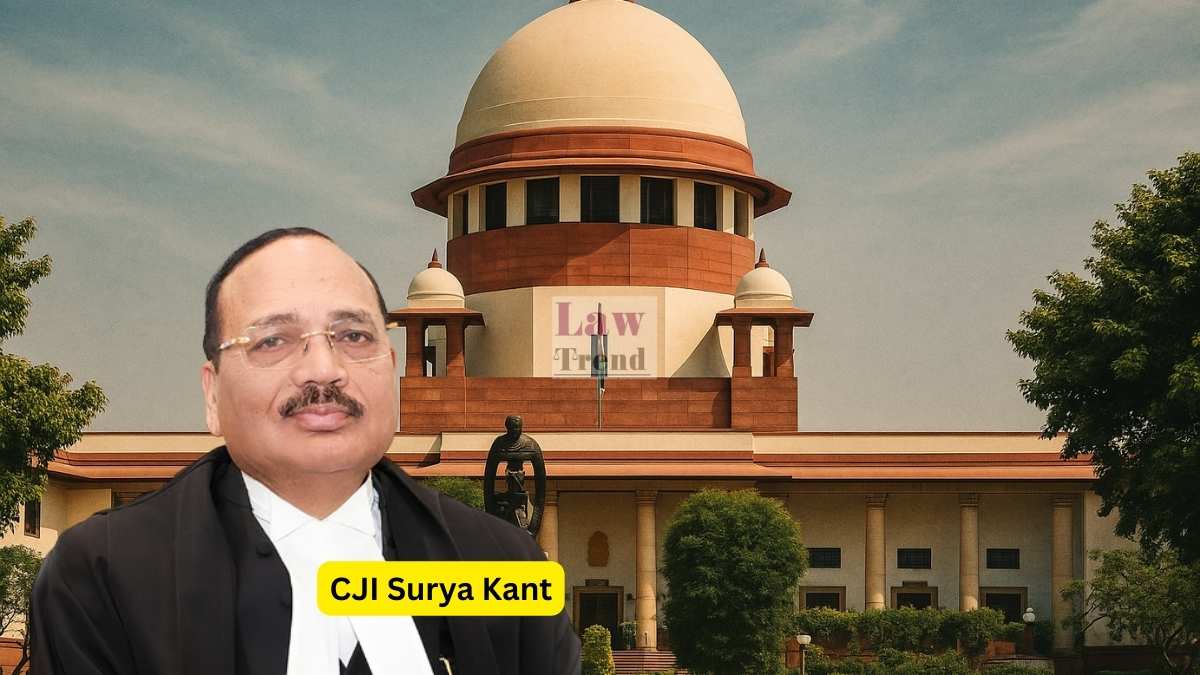
Chief Justice of India Surya Kant on Thursday emphasised that access to the Supreme Court must be governed by uniform procedures rather than the stature or influence of individuals, asserting that the era of preferential hearings for privileged lawyers and litigants is over.
Addressing a Constitution Day function organised by the Supreme Court and attended by President Droupadi Murmu, the CJI stressed the need to transform the apex court into a people’s court where every citizen enjoys equal access to justice.
Equal Treatment for Lawyers and Litigants
The Chief Justice said that eminent lawyers must stand on the same footing as advocates practising in small towns and remain subject to identical procedural requirements, listing schedules and rules.
Acknowledging the historical perception of the Supreme Court as an institution more accessible to the privileged, CJI Kant said that urgent hearings had sometimes appeared to depend on the standing of the person seeking them rather than the urgency of the matter.
He noted that while affluent litigants could approach the apex court even at the initial stages of a dispute, many citizens requiring judicial intervention struggled to access the institution.
The CJI credited the efforts of several judges in eliminating such disparities and making the Supreme Court more accessible to ordinary citizens.
Priority Listing for Vulnerable Litigants
Highlighting recent procedural reforms, CJI Kant said fresh matters are now listed automatically, eliminating the need for lawyers to make oral requests for listing. Matters concerning personal liberty or urgent interim relief are required to reach a Bench within two working days.
He also highlighted the priority listing mechanism introduced for vulnerable sections, including:
- Persons with disabilities
- Survivors of acid attacks
- Senior citizens above 80 years of age
- Families below the poverty line
- Litigants receiving legal aid
The Chief Justice said these priorities operate under predetermined and uniformly applicable criteria, ensuring transparency and preventing undue favour in the listing of cases.
Technology to Remove Barriers to Justice
CJI Kant highlighted the role of technology in improving judicial accessibility across the country.
He said video conferencing has enabled lawyers practising in distant regions to argue before the Supreme Court without travelling to Delhi. Live streaming of Constitution Bench proceedings and AI-powered translation of judgements have further expanded public access to the judicial process.
He also referred to the launch of the One Case, One Data initiative, which enables case records to be traced from the taluka court to the Supreme Court, along with an AI-powered assistant to help litigants navigate court procedures.
Public Interest Litigation Expanded Access to Courts
Recalling the evolution of public interest litigation more than four decades ago, the CJI said the Supreme Court had expanded access to justice by treating letters and even postcards concerning public causes as petitions.
He cited an instance where a letter written on behalf of bonded labourers working in stone quarries in Faridabad secured their freedom.
While acknowledging instances of misuse of public interest jurisdiction, he said its evolution demonstrated the importance of keeping judicial institutions accessible to citizens.
The Chief Justice emphasised that access to justice begins even before a matter reaches a courtroom, from the moment a person first seeks legal assistance.
He acknowledged that considerable work remains to ensure that ordinary litigants feel as comfortable approaching the Supreme Court as its most prominent advocates. He reiterated that the institution belongs to every citizen, irrespective of their social or economic standing.
Justice Vikram Nath, while welcoming the guests, underlined the judiciary’s responsibility to ensure that the Constitution remains a source of protection and strength for every citizen.
Attorney General R Venkataramani, Bar Council of India Chairman Manan Kumar Mishra and Supreme Court Bar Association President Pradeep Kumar Rai also addressed the gathering.


