

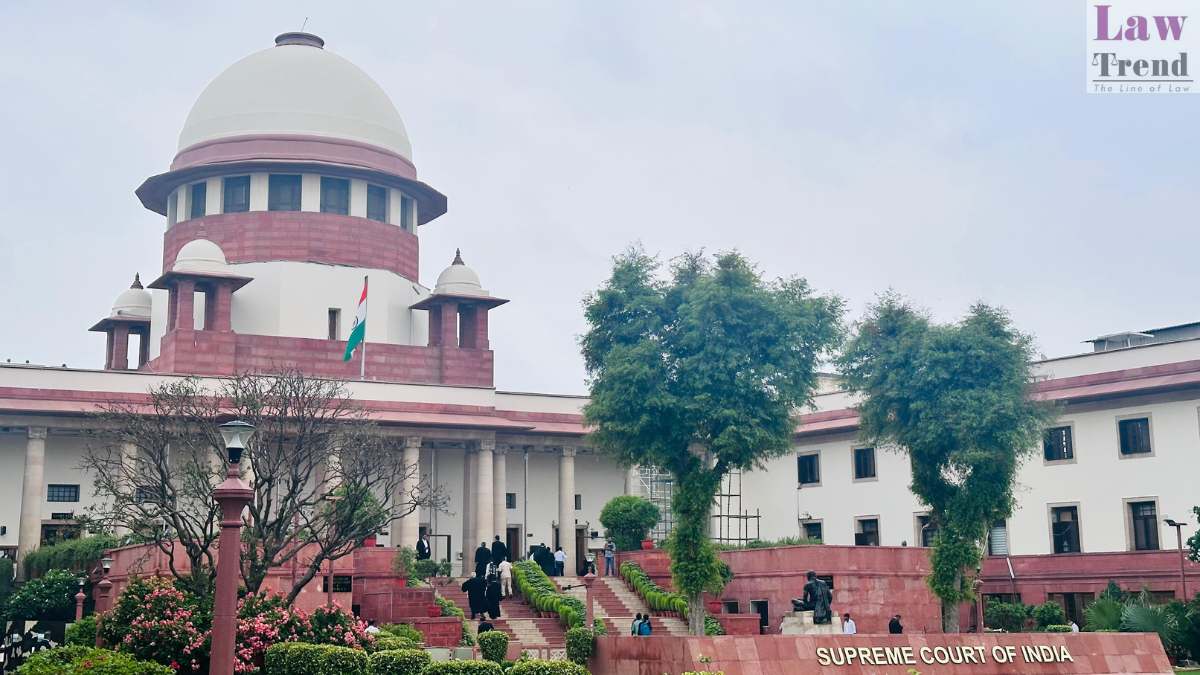
The Supreme Court has held that a Magistrate cannot take cognizance on a protest petition and summon a person to face trial without first following the procedure for complaint cases under Chapter XV of the Code of Criminal Procedure. On this ground, it quashed murder proceedings against a woman whom the police had not charged.
A Bench of Justice Prashant Kumar Mishra and Justice Shree Chandrashekhar allowed the appeal of Deepti Singh. The Bench set aside an Allahabad High Court order that had refused to quash the Chief Judicial Magistrate’s cognizance order dated 25 March 2025.
Background
Crime No. 487 of 2022 was registered on 19 June 2022 under Sections 302, 352 and 504 IPC. The informant, Pratima Singh, alleged that her brother, Abhishek Singh alias Mohit, was assaulted by the appellant, her husband Gaurav Singh and an unknown person after a dispute over drainage. He died on the spot.
The post-mortem doctors could not ascertain the cause of death. A later expert opinion attributed it to post-traumatic cardio-pulmonary thrombo-embolism. After the investigation was moved to the Crime Branch in Mahoba, a chargesheet was filed against Gaurav Singh only, under Sections 323, 504 and 506 IPC. It recorded that the appellant’s involvement was not established.
About a year later, the informant filed a protest petition alleging an unfair investigation. The Chief Judicial Magistrate, Banda, then took cognizance under Sections 302, 201, 218, 504 read with Sections 34 and 120B IPC. He summoned the appellant and her husband, along with two doctors and several police officers. The High Court dismissed the appellant’s application under Section 528 of the BNSS. It said disputed questions of fact could not be decided at that stage.
Arguments
Counsel Aarushi Singh, appearing for the appellant, argued that the Magistrate cannot add a new offence when taking cognizance on a police report. She said the Magistrate had not followed the procedure for complaint cases on the protest petition, and had summoned the appellant on mere ipse dixit. She clarified that she did not dispute the Magistrate’s power to take cognizance. Her point was that the Magistrate cannot rely on the investigation report to take cognizance on a protest petition.
State counsel Akshay Amritanshu and counsel Ajay Pal, appearing for the informant (respondent No. 2), argued that the Magistrate has the power to take cognizance on a police report or a protest petition. The respondents also argued that the appellant could raise all her grounds in a discharge petition, as the High Court had permitted.
Supreme Court’s Findings
The Court said the Magistrate had followed a procedure not found in the Code. It noted that he had spent seventy typed pages finding fault with the investigation. It held that “a defective investigation is not a ground for taking cognizance on a complaint which does not provide sufficient evidence to proceed further in the matter.” Where a police report contains no material against an accused, the Court said, the only option open to the Magistrate is to direct further investigation if he thinks it necessary.
Describing the order, the Bench remarked: “In our opinion the order taking cognizance passed by the Chief Judicial Magistrate is an astonishing exercise of power by him.” It added: “Apparently, it was a sheer waste of judicial time to write a Seventy-page cognizance order.” Relying on R.R. Chari v. State of Uttar Pradesh and Kanti Bhadra Shah v. State of W.B., the Court reiterated that “an order taking cognizance need not be a reasoned order, leave alone an elaborate order.”
The Court explained that a Magistrate may treat a protest petition as a complaint under Section 2(d) CrPC. However, the petition must contain a specific allegation against the accused and a list of witnesses. “Merely summing up the objections to investigation carried by the police does not take the form of a complaint as defined under section 2(d) of the Code of Criminal Procedure,” the Bench said. It added that “The Magistrate is not a machine making pro forma orders issuing process.”
It found that the cognizance order showed no compliance with the mandatory procedures under Sections 200 to 204 CrPC. The order also gave no hint that the protest petition met the requirements of a complaint.
On the High Court’s approach, the Bench said the High Court had proceeded on a wrong premise and had not examined the Magistrate’s procedure. It held that “it was the duty of the High Court to call for the records and set the procedure right.” The Court declined to send the appellant to seek discharge. It held that the summoning order “suffers from serious procedural irregularities which vitiate the entire proceedings against her.”
Outcome
The Supreme Court allowed the appeal and set aside the High Court’s order dated 18 February 2026. As far as the appellant is concerned, it set aside the cognizance order of 25 March 2025 and quashed the entire criminal proceedings in Case No. 844/12/2023.
Case Title: Deepti Singh v. State of U.P. & Anr.
Case No.: Criminal Appeal No. ___ of 2026 (arising out of SLP (Crl.) No. 5478 of 2026)
Bench: Justice Prashant Kumar Mishra and Justice Shree Chandrashekhar
Date: 25 November 2026


