

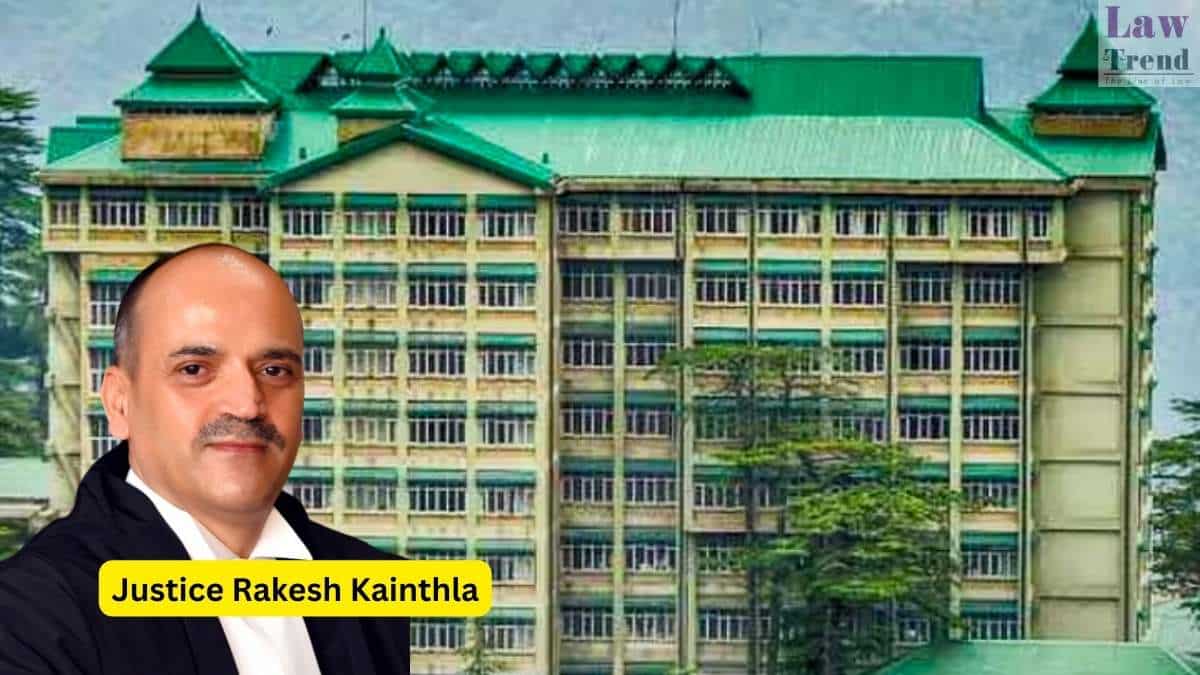
The Himachal Pradesh High Court has held that a complainant in a cheque bounce case does not have to prove his financial capacity to lend the money unless the accused challenges it in his reply to the legal notice. Justice Rakesh Kainthla dismissed a criminal revision and upheld the conviction of the accused under Section 138 of the Negotiable Instruments Act, together with a six-month sentence and ₹3,30,000 in compensation.
Background
The complainant said he and the accused were partners and that he used to help the accused financially. Between November 2020 and May 2021, he paid the accused ₹5,00,000 to help run his business. According to the complaint, the accused repaid ₹2,20,000 by May 2023 and issued a cheque for ₹2,80,000 for the balance. The cheque was dishonoured for “insufficient funds”, and the accused did not pay despite receiving a legal notice.
In his statement under Section 313 CrPC, the accused said he had issued the cheque as security. He admitted his signature on it, that it was dishonoured for insufficient funds and that he had received the notice. He led no defence evidence.
On February 21, 2025, the Judicial Magistrate First Class (2), Nalagarh, convicted him. On February 27, 2025, the magistrate sentenced him to six months’ simple imprisonment and ordered ₹3,30,000 in compensation, with one month’s simple imprisonment in default. The Additional Sessions Judge, Nalagarh, upheld this on April 17, 2026.
Arguments
Counsel Ram Krishan Sharma, appearing for the accused, argued that the complainant had not proved the partnership or his financial capacity to lend the money. He submitted that the complainant’s evidence was recorded in the accused’s absence, that his previous counsel had put suggestions to the complainant without authority, and that the accused was not given a proper opportunity to lead defence evidence. He also called the sentence excessive. No one appeared for the complainant.
Himachal Pradesh High Court on Financial Capacity
The Court held that since the accused admitted issuing the cheque and signing it, the presumption under Sections 118 and 139 of the NI Act arose, and the burden shifted to him. It found that he had not stepped into the witness box and had relied only on his Section 313 statement, “which is not sufficient.”
Relying on Uttam Ram vs. Devinder Singh Hudan and Ashok Singh vs. State of U.P., the Court held that “the complainant’s version cannot be doubted because he had not produced any evidence to prove the advancing of the loan to the accused.”
On financial capacity, the Court noted that the accused admitted receiving the legal notice but never replied to dispute the complainant’s means. Citing Tedhi Singh vs. Narayan Dass Mahant and Kuntegowda vs. Thurubaiah, it held that “the submission regarding the lack of the complainant’s financial capacity to lend money cannot be accepted in the absence of the reply to the notice.”
The Court rejected the other grounds as well:
- Evidence recorded in his absence: there was no violation of Section 273 CrPC, because the accused had been exempted from personal appearance on January 20, 2025.
- Defence evidence: no witness was present and no steps were taken on the date fixed, so the trial court could not be faulted for closing the defence evidence.
- His previous counsel’s suggestions: “If the accused is aggrieved by the act of the learned counsel acting beyond the authority, his remedy lies elsewhere and not before this Court.” The Court added that the plea had not been raised before the appellate court and was a “plea of desperation”.
On sentence, the Court cited Bir Singh vs. Mukesh Kumar on the deterrent purpose of Section 138 and held that six months’ imprisonment was not excessive. Relying on Kalamani Tex vs. P. Balasubramanian, it found the ₹3,30,000 compensation on a ₹2,80,000 cheque reasonable, since the complainant lost interest and had to engage counsel. Citing K.A. Abbas vs. Sabu Joseph and R. Mohan vs. A.K. Vijaya Kumar, it held that a default sentence of imprisonment for non-payment of compensation is permissible.
Outcome
The High Court found no infirmity in the judgments of the courts below and dismissed the revision. Any pending applications were also disposed of.
Case Title: Inder Lal vs. Shiv Sharma
Case No.: Cr. Revision No. 432 of 2026
Bench: Justice Rakesh Kainthla
Date: November 23, 2026


