

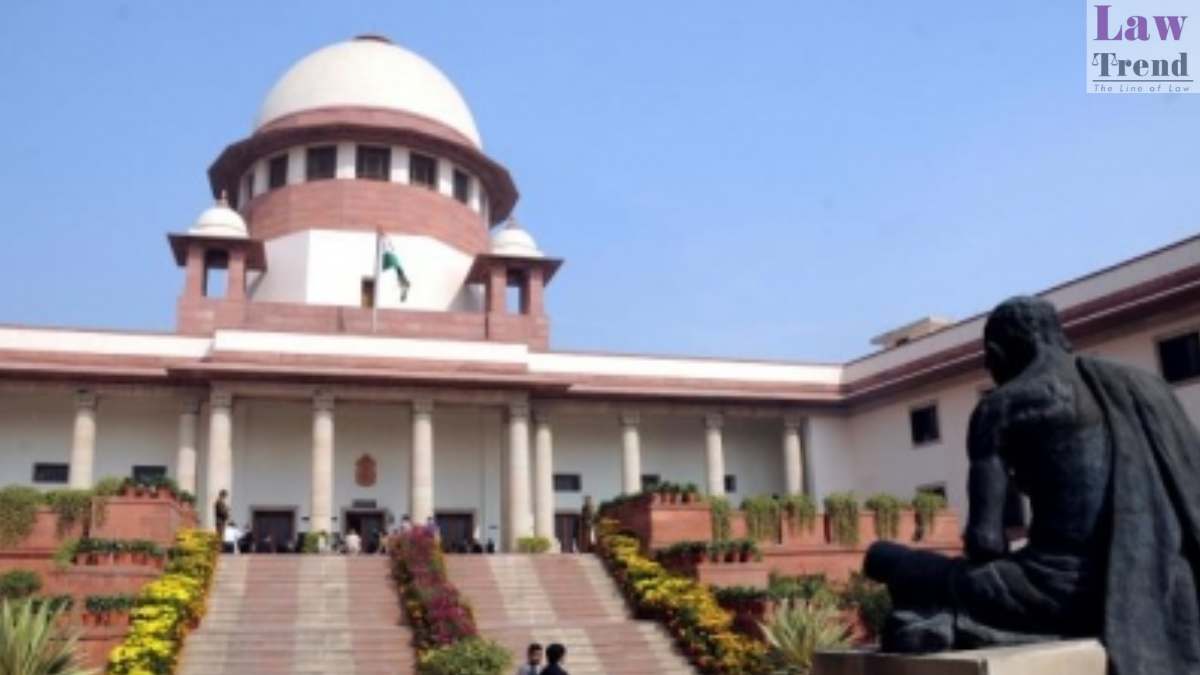
The Supreme Court has held that its general direction to remove unauthorised encroachments from National Highways does not decide whether any particular structure is an encroachment. It said the National Highways Authority of India (NHAI) cannot treat that direction as a substitute for the procedure under the Control of National Highways (Land and Traffic) Act, 2002.
A Bench of Justice Vikram Nath and Justice Aparesh Kumar Singh sent a batch of landowners’ applications against proposed demolitions to the jurisdictional High Courts. Until those courts decide, NHAI and other authorities cannot take any coercive action against the disputed structures.
Background: Phalodi Accident Suo Motu Case
The Court began the suo motu proceedings over road safety on National Highways after road accidents at Phalodi, Rajasthan, and other places. On 13 April 2026, it issued interim directions. These banned any new dhaba, eatery or commercial structure within the Right of Way of a National Highway. District Magistrates were told to remove unauthorised structures within 60 days, “in terms of the CNH Act procedure and SOP dated 07.08.2025.” District Highway Safety Task Forces were also to be set up.
NHAI and other authorities then started action against structures they said were encroachments. Several people, mostly from Valsad and Navsari districts in Gujarat, applied for clarification of the April order and interim protection. They included Prakashbhai Manharlal Shah, Patel Nileshbhai Pravinbhai, Arihant Petroleum, Hatim Sirajbhai Lokhandwala and Ramanbhai Dhirubhai Patel. Some had first gone to the Gujarat High Court and were given liberty to seek clarification from the Supreme Court. The Court ordered status quo on 8 September, 22 September and 6 October 2026.
Arguments: Landowners’ Rights vs Highway Safety
A set of applicants represented through Advocate-on-Record T. Harish Kumar challenged notices concerning properties in Navsari. They argued that the demolition was going ahead without properly determining their rights or following the statutory procedure. In the alternative, they asked that their land be acquired and compensation paid.
Counsel for the applicants argued that the structures stood on land the applicants lawfully owned or occupied. They disputed NHAI’s measurements and demarcation, and argued that the April directions did not allow demolition without following the procedure prescribed by law.
NHAI said it was acting under directions 4(b), 4(c) and 4(e) of the April order. It said notices had been issued under the 2002 Act and its measurements showed the structures fell within the Right of Way. It also argued that disputes over ownership and boundaries raise questions of fact that the competent court should decide.
Court’s Findings on Supreme Court’s Encroachment Directions
The Bench said its earlier directions dealt with highway safety as a whole and did not examine the rights of any individual. It observed, “The question whether a particular structure constitutes an unauthorised encroachment was neither examined nor adjudicated upon by this Court.”
It drew a clear line between the two exercises: “The distinction between a general direction to remove encroachments and the determination of whether a particular property constitutes an encroachment is of considerable significance. The former cannot, by itself, be treated as a conclusive adjudication of the latter.”
The Court referred to Section 26 of the 2002 Act. Sub-sections (2) to (6) of that section require notice, a chance to make a representation and consideration of the cause shown. The Court relied on Gyan Prakash v. Union of India, which emphasised that this procedure is essential for natural justice. It said that any power to remove encroachments without notice under sub-sections (7) and (8) must be examined against the statutory conditions. It added, “The directions issued by this Court cannot be invoked as an independent justification for dispensing with the requirements of the statute.”
The Bench said a mere claim of ownership cannot stop lawful action. It then added, “Equally, the mere assertion by the authorities that a particular structure falls within the Right of Way cannot be treated as a substitute for the determination required under law, where the very basis of such assertion is disputed.”
Outcome
The Court sent the applicants to the jurisdictional High Courts and did not express any view on the merits. Interim protection already granted will continue. Where none was granted, NHAI is barred from demolition or coercive action under the challenged notices until the High Courts decide. The High Courts were asked to decide the cases as expeditiously as possible.
The Bench clarified that the protection covers only the structures involved in these applications and “shall not create any equity in favour of the applicants or authorise any fresh construction or encroachment.” The 13 April 2026 directions remain in force. The remaining applications stay pending.
Case Title: In Re: Phalodi Accident v. National Highways Authority of India & Ors.
Case No.: Suo Moto Writ Petition (Civil) No. 9/2025 with W.P.(C) No. 1100/2025 and W.P.(C) No. 1272/2019
Bench: Justice Vikram Nath and Justice Aparesh Kumar Singh
Date: November 18, 2026


