

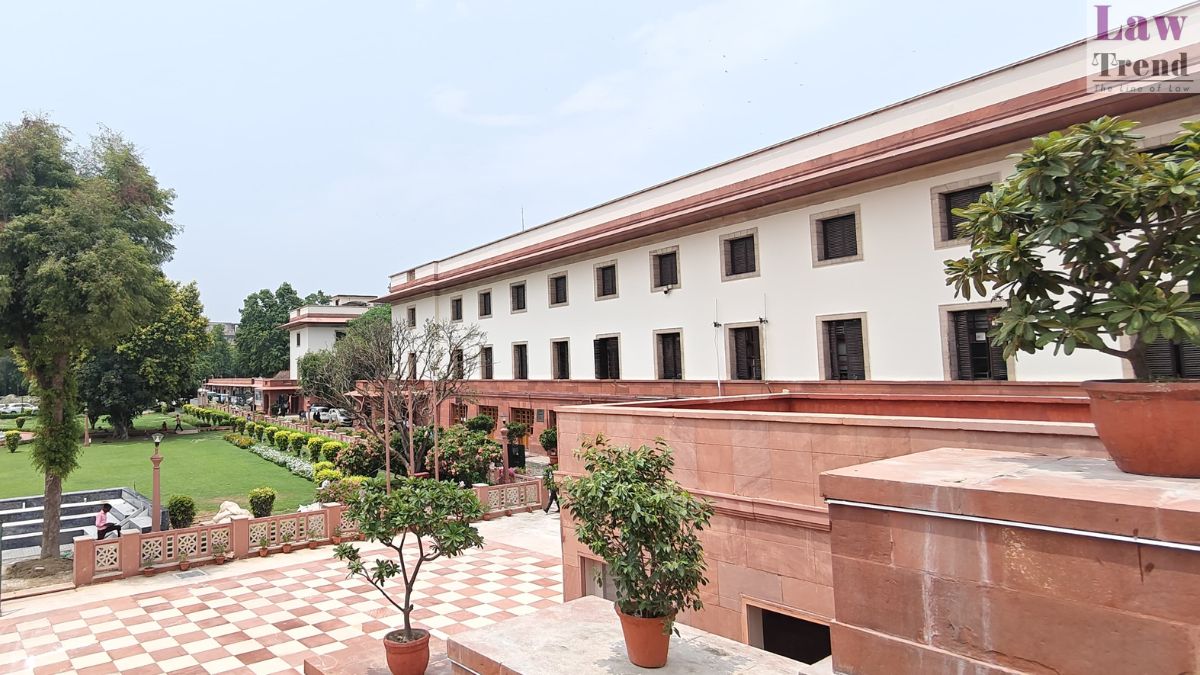
The Supreme Court has held that a claim for interest on delayed payment of salary and consequential service benefits constitutes a separate cause of action when the delay arises during judicial proceedings. Such a claim cannot be rejected merely because interest was not sought in the original litigation. Exercising its powers under Article 142 of the Constitution, the Court directed Central Bank of India to pay ₹5 lakh to a retired employee who had spent decades pursuing his service-related claims.
A Bench of Justice Dipankar Datta and Justice Sheel Nagu, in its judgement dated November 18, 2026, granted relief to Ashok Kumar, a former Central Bank of India employee, despite finding that he had pursued an incorrect procedural remedy for claiming interest.
The Court observed that although Kumar was entitled to pursue interest on delayed payments, the High Court had wrongly rejected his substantive claim without examining its merits.
Interest Claim Based on Subsequent Cause of Action
The dispute originated in disciplinary proceedings initiated against Kumar following allegations of financial irregularities.
Kumar joined Central Bank of India on March 1, 1969, and was suspended in November 1978. A criminal case was registered against him under several provisions of the Indian Penal Code. He was acquitted on July 15, 1983, and his acquittal attained finality after the Punjab and Haryana High Court dismissed the challenges in May 1991.
Meanwhile, the Bank initiated departmental proceedings in May 1990. Kumar challenged these proceedings before the High Court, which quashed the departmental enquiry on October 12, 2007, and granted him consequential service benefits.
The Bank’s challenges were unsuccessful, with the Supreme Court dismissing its special leave petition on July 26, 2011.
Following contempt proceedings initiated by Kumar, the Bank released ₹37,07,445.61 in December 2011 and subsequently paid ₹4,89,198 towards provident fund dues.
Kumar then filed another writ petition in 2015 seeking compound interest at 18% annually on delayed salary payments, along with further interest at 24% on the accumulated interest.
The High Court dismissed this petition in December 2023, reasoning that Kumar had not claimed interest in his original proceedings.
He subsequently filed a miscellaneous application in his earlier writ petition, which was dismissed by the Single Judge. The Division Bench upheld that dismissal in May 2024, relying on the principles of finality, constructive res judicata and estoppel.
Res Judicata Cannot Bar Claims That Arise Subsequently
Examining the dispute, the Supreme Court distinguished the original challenge to disciplinary proceedings from the later claim for interest.
The Bench held that when Kumar instituted his first writ petition in June 1991, he could not have anticipated the prolonged litigation or the subsequent delay in receiving his financial benefits.
It explained:
“A claim based on a subsequent cause of action cannot be barred by a judgment on a prior cause of action.”
The Court clarified that the principles of res judicata and the restriction under Order II Rule 2 of the Code of Civil Procedure apply only to claims that could have been raised when the original proceedings were instituted.
The entitlement to interest, the period of delay attributable to the parties and the applicable rate required independent adjudication.
The Court consequently found that Kumar had correctly instituted a fresh writ petition seeking interest, but the High Court had dismissed it on an untenable ground.
Miscellaneous Application Cannot Be Used to Seek Fresh Substantive Relief
The Supreme Court nevertheless agreed with the High Court’s dismissal of Kumar’s subsequent miscellaneous application.
It held that an application filed in a finally decided writ petition has a limited procedural scope and cannot become an independent proceeding for adjudicating a new cause of action.
The judgement stated:
“It is procedural, not substantive, and cannot be used as a vehicle to agitate, on merits, a subsequent or independent cause of action.”
Such applications may address clerical mistakes, ambiguities in operative directions or matters concerning implementation, but ordinarily cannot reopen substantive disputes.
The Bench explained that Kumar should have challenged the December 2023 dismissal of his fresh writ petition through an intra-court appeal instead of filing a miscellaneous application in the original proceedings.
Senior Advocate R. Basant, appearing for Central Bank of India, argued that Kumar had several opportunities to seek interest during the earlier litigation but had failed to do so.
The Court also heard Kumar, who appeared in person, and Advocate Gopal Jha, who assisted as amicus curiae.
Supreme Court Invokes Article 142 to Grant ₹5 Lakh
Despite finding the miscellaneous application procedurally unsustainable, the Supreme Court considered the exceptional circumstances surrounding Kumar’s prolonged litigation.
The Bench observed that Kumar had spent approximately twelve years contesting criminal proceedings and more than three decades pursuing writ litigation. He had remained away from active service during the period of suspension and retired on March 31, 2009.
Referring to the principle that an act of the court should prejudice no litigant, the Bench noted that interest is not necessarily a penalty but represents a normal addition to capital, as explained in Alok Shanker Pandey v. Union of India.
It further observed:
“It is here that we are reminded of the salutary principle that an act of court should harm no litigant.”
Considering Kumar’s advanced age and the circumstances of his case, the Supreme Court invoked Article 142 to direct the Bank to pay him an additional ₹5 lakh.
The amount must be paid within two months from the date on which a copy of the judgement is produced before the competent authority of the Bank.
The Court clarified that this payment would constitute a full and final settlement of Kumar’s dues against the Bank.
The appeal was disposed of accordingly, and the Bench recorded its appreciation for the assistance rendered by amicus curiae Gopal Jha.
Case Details
Case Title: Ashok Kumar v. Central Bank of India & Ors.
Case Number: Civil Appeal arising out of SLP (C) No. 29916 of 2024
Coram: Justice Dipankar Datta and Justice Sheel Nagu
Judgement Date: November 18, 2026


