

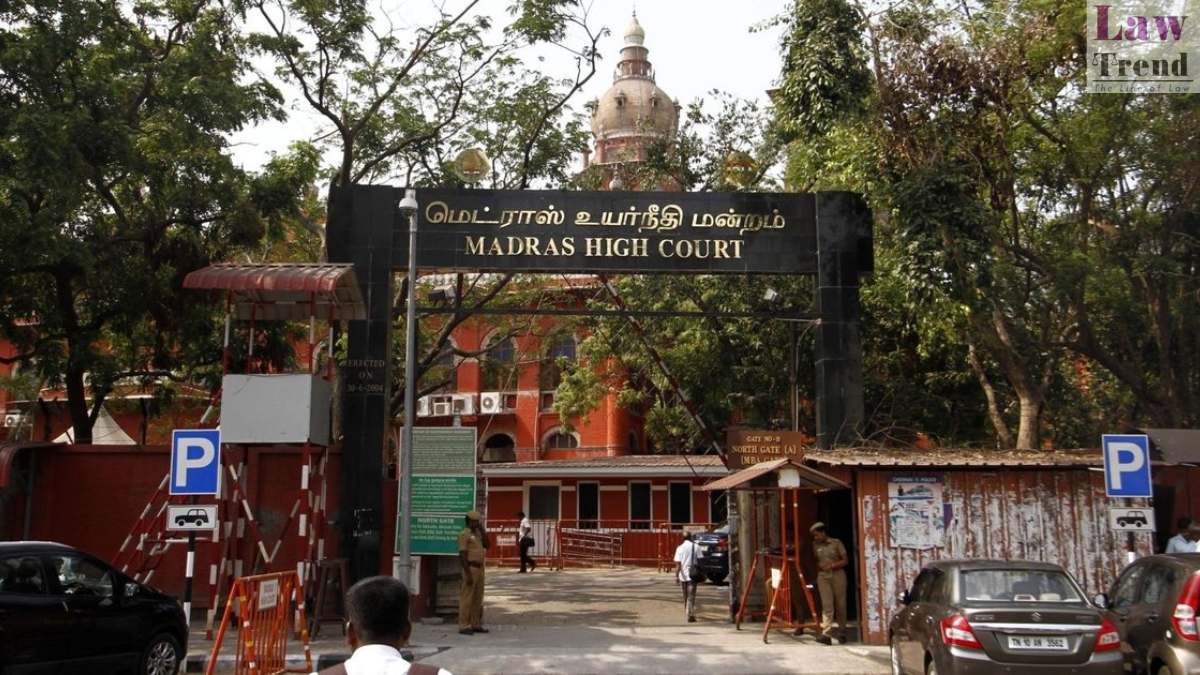
The Madras High Court has invalidated a Tamil Nadu government rule restricting the transportation of rough stones and aggregates to other states, holding that the state cannot prohibit the movement or sale of minerals lawfully extracted under valid mining leases.
A Division Bench of Chief Justice Sushrut Arvind Dharmadhikari and Justice G Arul Murugan, while deciding a batch of writ petitions on Tuesday, declared Rule 3-A of the Tamil Nadu Prevention of Illegal Mining, Transportation and Storage of Minerals and Mineral Dealers’ Rules, 2011, unconstitutional and beyond the state’s legislative competence.
The court also quashed a July 27 directive issued by the Director of Geology and Mining, which had imposed a three-month restriction on transporting rough stones and aggregates outside Tamil Nadu, with exemptions for Puducherry and Karaikal.
Restrictions Cannot Extend to Lawfully Extracted Minerals
The High Court held that minerals extracted under a valid lease become the property of the lessee once the prescribed statutory conditions have been fulfilled.
It distinguished between the state’s authority to prevent illegal mining and its power to regulate trade involving minerals obtained through lawful operations.
Referring to Section 23-C of the Mines and Minerals (Development and Regulation) (MMDR) Act, the bench concluded that the provision concerns illegal mining activities and does not authorise restrictions on the transportation of legally excavated minerals.
The court relied on Supreme Court precedents and the earlier Division Bench decision in C Stephen v State of Tamil Nadu to reaffirm that the state cannot prevent minerals from being transported beyond its territorial boundaries.
The bench held that any state action prohibiting inter-state mineral transportation or restricting sales, except as permitted under Part XIII of the Constitution, would be unconstitutional and exceed legislative powers.
Government Defended Ban as Measure Against Illegal Mining
The dispute arose from an amendment introduced by the Tamil Nadu government on July 9, incorporating Rule 3-A into the 2011 rules.
The provision sought to control the movement of processed mineral materials, including M-Sand, metal jelly and boulders, outside Tamil Nadu to maintain sufficient supplies within the state.
Following the amendment, the Director of Geology and Mining issued an order on July 27 imposing a temporary three-month prohibition on transporting rough stones and aggregates to other states, excluding Puducherry and Karaikal.
The government defended the restrictions as a precautionary response to excessive inter-state movement of minerals and illegal mining.
However, mining leaseholders and crusher operators challenged the measures, arguing that the state lacked statutory authority to restrict commercial transactions involving minerals legally extracted after payment of the applicable royalties.
Court Identifies Permissible Limits on State Regulation
While rejecting the transport ban, the High Court clarified that the government retains certain regulatory powers concerning mining operations and public safety.
It observed that restrictions serving public interests could be incorporated at the stage of granting mining leases. The state could also prescribe maximum load and speed limits for safety purposes or exercise powers available under Section 4-A of the MMDR Act.
However, these powers do not extend to directly controlling mineral sales or imposing a general prohibition on transportation outside Tamil Nadu.
The bench consequently struck down Rule 3-A and the July 27 order, finding that the restrictions exceeded the state’s lawful authority over minerals extracted and transported in compliance with statutory requirements.


