

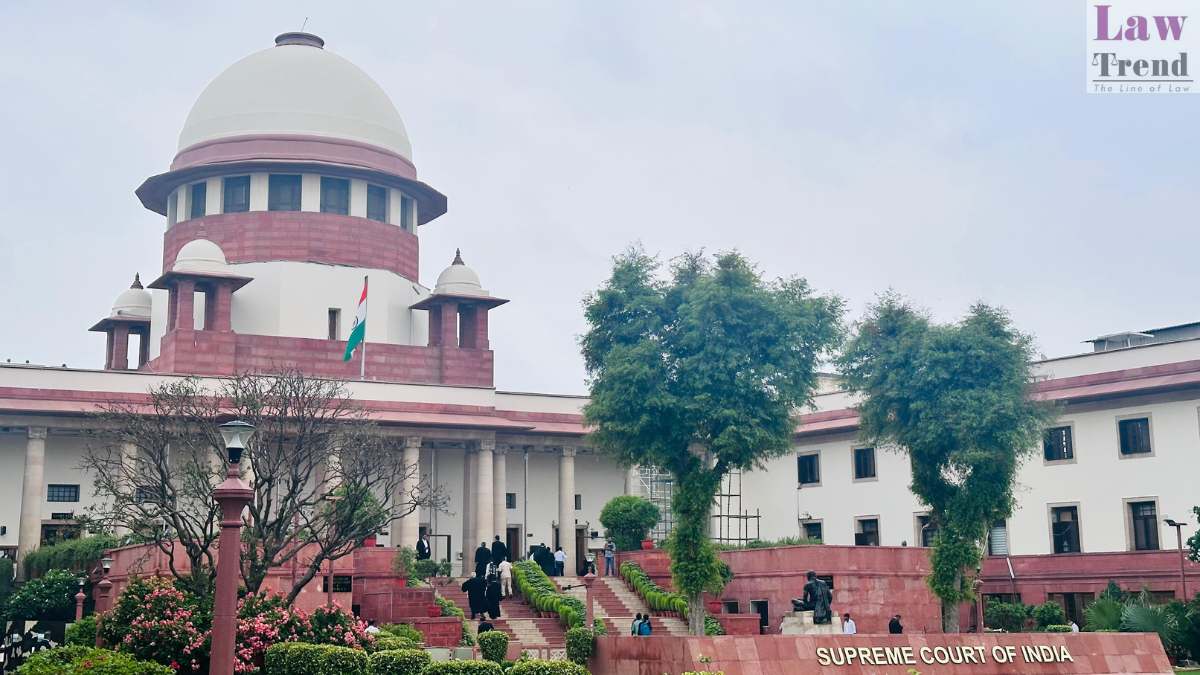
The Supreme Court has held that once a rehabilitation scheme under the Sick Industrial Companies (Special Provisions) Act, 1985 (SICA) is approved, it binds all unsecured creditors. A clause letting them wait out the scheme and later claim their full dues is not valid.
A Bench of Justice Sanjay Kumar and Justice Sanjeev Sachdeva allowed an appeal by M/s. Ganesh Benzoplast Ltd. The Bench set aside a National Company Law Appellate Tribunal (NCLAT) judgment that had revived the State Trading Corporation of India’s (STC) insolvency petition against the company.
Background
Ganesh Benzoplast, a Maharashtra chemicals company, had business dealings with STC between 2003 and 2006. In 2010, the Board for Industrial and Financial Reconstruction (BIFR) declared it a sick industrial unit. After the BIFR ceased to function, the Delhi High Court approved its Draft Rehabilitation Scheme on December 4, 2015.
Clause 11.11 of the scheme provided that unsecured creditors would be paid 25% of their principal dues in five annual instalments. They also had the option to refuse the scaled-down amount and wait until the scheme worked itself out, or seven years. STC was not among the 191 unsecured creditors listed. Instead, it appeared in a separate list of “contingent liabilities”, with a claim of ₹11.35 crore, and it never challenged this classification.
On March 20, 2018, STC issued a demand notice under Section 8 of the IBC for ₹24,26,44,490. It then filed a Section 9 petition before the NCLT, Mumbai. In 2019, the company offered to settle by paying 25% of the principal dues. On February 13, 2020, the NCLT disposed of the petition and directed payment of ₹2,18,88,421, which STC accepted without prejudice.
On January 21, 2026, the NCLAT held that STC could not be forced to accept 25% and restored the petition to the NCLT for a fresh decision.
Supreme Court’s Findings
The Court found that the NCLAT had overlooked two points. STC’s demand notice was issued within the seven-year window. And the options in Clause 11.11 were available only to unsecured creditors, not to those listed as contingent liabilities whose claims had not crystallised.
The Bench noted that STC had accepted its classification as a contingent liability and never challenged it. It observed, “It was, therefore, too late in the day for it to claim otherwise or raise that issue.”
Relying on Modi Rubber Limited v. Continental Carbon India Limited and Fertilizer Corporation of India Limited v. Coromandel Sacks Private Limited, the Court held that the option of waiting seven years and then claiming full dues was invalid. It observed, “Once the DRS was sanctioned, the approved RS was binding on all concerned, i.e., the unsecured creditors and the unsecured creditors in waiting.”
The Bench explained that reopening claims after the scheme had worked itself out would put the rehabilitated company “at the risk of becoming sick again.”
The Court said the NCLAT’s attempt to distinguish Modi Rubber on the ground that STC was only a contingent liability “defies logic”. At best, STC could become an unsecured creditor once its dues crystallised, and then it could claim only 25% of its principal dues and no more.
The Court rejected STC’s argument that it should have been paid in instalments from 2015, since its dues had never crystallised. It noted that STC took no steps to have its dues crystallised and went straight to a demand notice for the full amount. The Bench observed, “The regime of the IBC does not provide for determination of liability or quantification thereof.”
Since the claim relating to ‘C’ Forms ended once the forms were handed over on January 30, 2020, and STC had already received the amount quantified by the NCLT, the Court held that “nothing remained to be adjudicated in the company petition”.
Outcome
The Supreme Court set aside the NCLAT’s judgment dated January 21, 2026 and restored the NCLT’s order dated February 13, 2020. The parties were directed to bear their own costs.
Case Title: M/s. Ganesh Benzoplast Ltd. v. The State Trading Corporation of India
Case No.: Civil Appeal No. 3097 of 2026
Bench: Justice Sanjay Kumar and Justice Sanjeev Sachdeva
Date: November 16, 2026


