

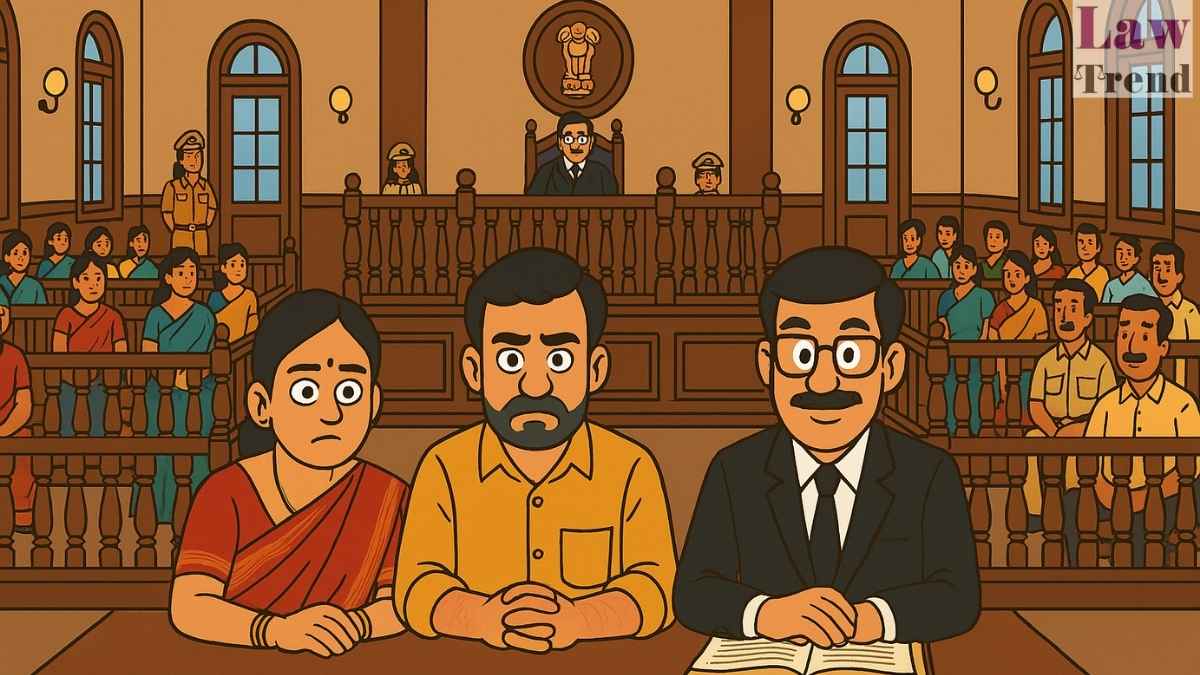
The Jharkhand High Court has held that a husband who accuses his wife of an extramarital affair just because she talks to another man is relying on a gender stereotype, and that such allegations amount to cruelty towards the wife. The Court dismissed the husband’s appeal against a Family Court decision refusing him a divorce on the grounds of cruelty and desertion.
A Bench of Chief Justice M. S. Sonak and Justice Manoj Prasad upheld the judgment of the Additional Principal Judge, Additional Family Court, Bermo at Tenughat, Bokaro. That court had dismissed the husband’s divorce petition under Section 13(1)(i-a) of the Hindu Marriage Act, 1955.
Background
The couple married on 30.04.2005 and have a son and a daughter. The husband alleged that his wife kept her distance from him, disregarded his family and kept talking to another man on his mobile phone. He called her “a lady of suspicious character”. He said she left the matrimonial home on 15.04.2015 and has lived with her parents since then.
The wife denied the allegations. She said she had been tortured and harassed for dowry, and that her husband had been in an extramarital relationship with a woman he worked with. She had filed a complaint under the Dowry Act and Section 498-A IPC, which was later compromised so that the couple could live together again. She told the Court she was still willing to resume married life if she was treated with respect, and that she had not been allowed to meet her children.
The Family Court held that neither cruelty nor desertion had been proved and dismissed the suit. The husband then filed a First Appeal under Section 19(1) of the Family Courts Act, 1984.
Arguments
Advocate Atanu Banerjee, appearing for the husband, argued that the couple had lived apart since 2015, that both children live with the husband, and that all efforts to settle had failed. He submitted that the daughter’s evidence that her mother often quarrelled with her father and grandmother had been ignored. He also argued that the case covered desertion under Section 13(1)(i-a) and Section 13(1)(i-b), because desertion had been pleaded and an issue framed on it, but the Family Court had not given a reasoned finding on it.
Advocate Ranjan Kumar, appearing for the wife, argued that she had left because of dowry harassment and the false allegation of an affair. He pointed to an order dated 05.05.2026 passed by a Co-ordinate Bench, which records that she was willing to live with her husband but he refused to cohabit. He argued that without any intention to desert, there could be no desertion, and that the husband “cannot be rewarded for his own wrongs.”
Mr Ashwini Bhushan, AC to Sr.SC-II, appeared for the State.
Court’s Findings on Cruelty
The Bench said that two of the husband’s three witnesses were his colleagues and friends rather than family members, and that their evidence “cannot be accepted without an element of suspicion.” It pointed out that the husband’s mother, who was said to be a victim of the quarrels, was not examined.
On the evidence of the couple’s daughter, who was about 11 years old when she testified, the Court observed, “when a minor child is residing with only one of her parents, the possibility of poisoning of mind against the other spouse/parent cannot be ruled out.” It noted that she admitted in cross-examination that her evidence had been prepared at her father’s dictation.
Turning to mental cruelty, the Court said that allegations of an affair, if proved, may amount to mental cruelty in appropriate cases. On the husband’s claim that his wife talked to another man on his phone, the Bench observed that “such allegations are typical gender-based stereotypes, where, if a woman talks to a man, even if he is a friend, charges of adultery or of an extramarital relationship are levelled.”
It held, “We are, therefore, of the considered view that such allegations amount to cruelty towards the wife.” The Court added that unproven counter-allegations by a wife may also amount to cruelty, but in this case the allegations had come from the husband. It concluded that no case of mental cruelty was made out.
Court’s Findings on Desertion
The Court held that not citing a specific provision is not fatal where desertion is pleaded and an issue is framed on it, and it went on to examine desertion on the merits.
It relied on the Co-ordinate Bench order recording that the wife wanted to resume married life and the husband refused. It also relied on documents showing that the couple had compromised the criminal case in 2015 and gone back to living together.
The Court noted that the husband had challenged an interim maintenance order of just ₹3,000 under Section 24 of the Act, a challenge that, “though dismissed, speaks volumes about the conduct of the present appellant.” It held that desertion had not been established either.
Outcome
The High Court dismissed the appeal without costs. It passed no separate order on interim maintenance but left the wife free to seek a modification of that order if circumstances change.
Case No.: F.A. No. 23 of 2024
Bench: Chief Justice M. S. Sonak and Justice Manoj Prasad
Date: 03.11.2026


