

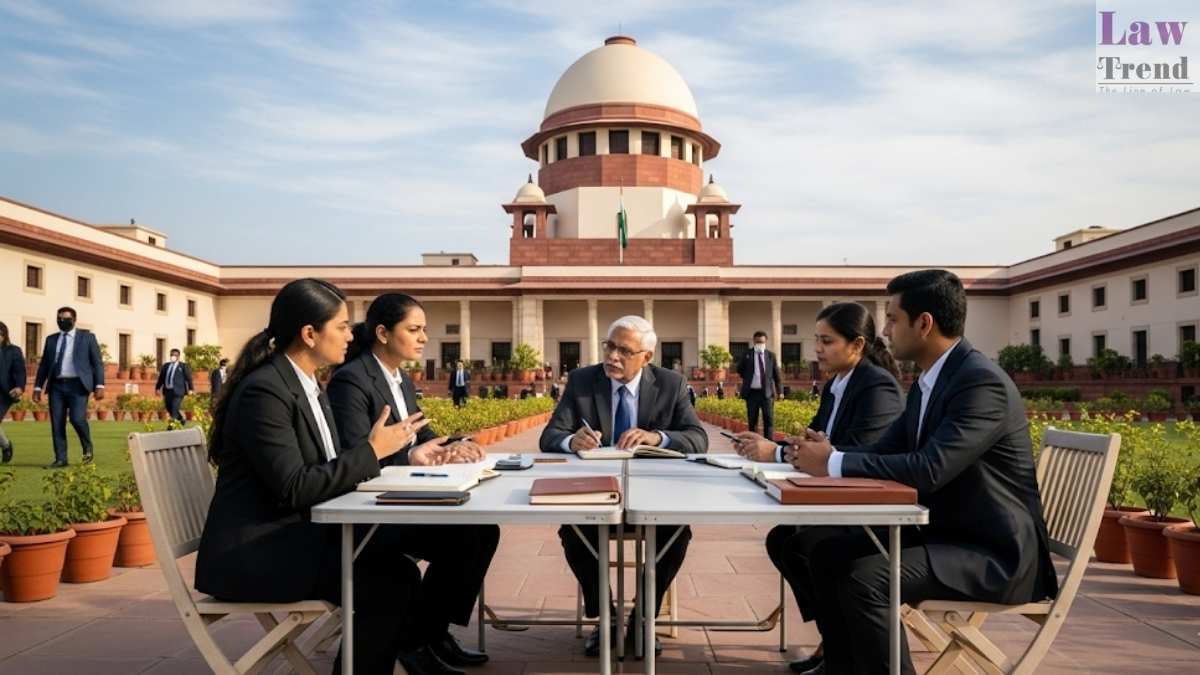
The Supreme Court has requested the Law Commission of India to study the legal and procedural framework for enforcing and executing arbitral awards. It noted that the parties before it were still litigating over enforcement more than twenty-four years after the award was passed.
A Bench of Justice Vikram Nath, Justice Sandeep Mehta and Justice Aparesh Kumar Singh also held that the Court cannot be asked, through a “clarification”, to supervise ongoing execution proceedings once the question referred to it has been answered.
Background
An internationally seated arbitration produced an award dated 10th August, 2002 in favour of M/s Royal Construction Company Pvt. Ltd., the award-holder. The amounts were denominated in Iraqi Dinars. M/s National Projects Construction Corporation was the award-debtor.
After the award was challenged in Indian courts, the Supreme Court, by judgment dated 24th February, 2015, stressed minimal judicial intervention and restored the directions in the award.
In execution proceedings, the Delhi High Court on 26th July, 2017 allowed the award-debtor to pay in Indian currency at the exchange rate prevailing on the date of the agreement. On 17th December, 2019, a Division Bench set this aside and certified a substantial question of law under Articles 134-A and 133(1)(a) of the Constitution on the relevant date for converting the awarded sum into Indian Rupees.
On 10th October, 2023, the Supreme Court held that no occasion arose to fix a conversion date. It said the terms of the agreement, the award and its 2015 directions should not be disturbed.
During the continuing execution, the award-debtor claimed that the principal amount had already been paid in 2009 under the High Court’s orders. By an interim order dated 16th February, 2026, the High Court gave the parties liberty to seek clarification from the Supreme Court on this. The award-holder appealed against that order.
Advocate Rishabh Sancheti appeared for the appellant, and Additional Solicitor General Vikramjit Banerjee appeared for the respondent.
Court’s Findings
The Court said that in 2023 it had only answered the certified question of law, without examining factual matters outside it. Having held that payment was to be made in foreign currency, it had no occasion to clarify factual questions about amounts deposited or withdrawn.
The Bench held:
“This Court cannot be called upon, in the guise of seeking clarification, to assume a supervisory role over the continuing execution proceedings or to adjudicate upon every issue that may arise therein.”
It said such questions are for the executing court and the appellate court over its orders. It added:
“Once the substantial question of law referred to this Court stood answered, the scope of the earlier appellate proceedings stood exhausted.”
Concern Over Enforcement Delay
In an epilogue, the Court noted that the arbitration began when the Arbitration Act, 1940 was in force. Despite nearly three decades of the Arbitration and Conciliation Act, 1996, the parties were still litigating over enforcement. It observed:
“The promise of arbitration remains unfulfilled if a party, having traversed the arbitral process, is compelled to embark upon another protracted course of litigation to secure the benefit of the award.”
The Court pointed out that Section 36 of the 1996 Act makes an award enforceable like a court decree, relying on the execution machinery under the Code of Civil Procedure, 1908. It said several issues merit focused scrutiny: identifying and disclosing the award-debtor’s assets, coordinating different modes of execution, disposing of repetitive or dilatory objections, and the time taken to finish execution.
It requested the Law Commission to identify practical obstacles to timely recovery and to examine the experience of other jurisdictions. The Commission was also asked to consider whether domestic and foreign awards need distinct enforcement procedures or a common framework with safeguards, and to recommend legislative or procedural changes.
Outcome
The appeal was disposed of. The Registry was directed to send a copy of the judgment to the Chairman of the Law Commission.
The Court also dismissed a Miscellaneous Application filed by the award-debtor seeking modification of the 2023 judgment, on the ground that the amounts it had deposited had been withdrawn by the award-holder in 2009. It gave the award-debtor liberty to raise all objections on adjustment or set-off of those amounts before the executing court.
Case Title: M/s Royal Construction Company Pvt. Ltd. v. M/s National Projects Construction Corporation
Case No.: Civil Appeal arising out of SLP (C) No. 14005 of 2026, with M.A. Diary No. 48152 of 2026 in Civil Appeal No. 1991 of 2019
Bench: Justice Vikram Nath, Justice Sandeep Mehta and Justice Aparesh Kumar Singh
Date: 28.10.2026


