

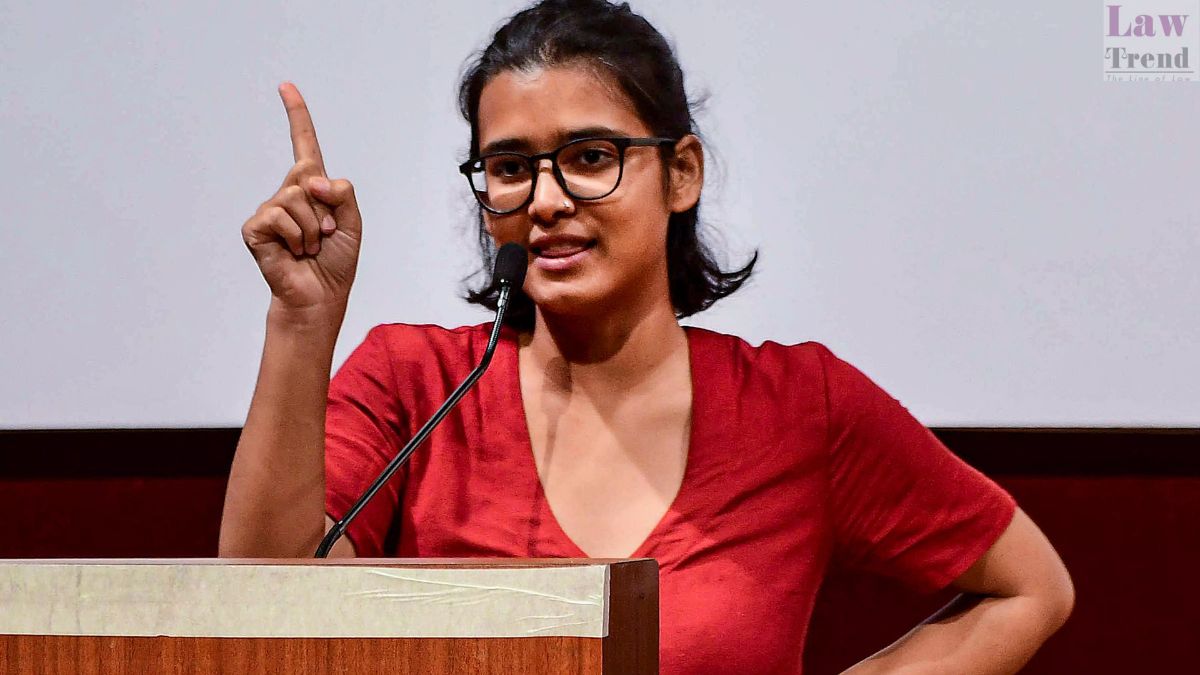
The Delhi High Court has refused to quash preventive proceedings initiated against All India Students Association (AISA) National President Neha Bora following her detention during a protest in Delhi. While dismissing her challenge to a ₹10,000 peace bond notice, the Court directed the Special Executive Magistrate (SEM) to supply all relevant material to her and examine whether the law permits demanding a bond before conducting an inquiry.
Justice Subramonium Prasad held that adequate safeguards were available in the proceedings and issued directions to ensure that the magistrate considered them before passing any order.
The Court specifically asked the SEM to examine the application of Section 135 of the Bharatiya Nagarik Suraksha Sanhita (BNSS), including whether a person could be required to furnish a bond immediately or whether such a requirement must be assessed during the inquiry.
The notice had directed Bora to appear before the SEM on October 19 and execute a personal bond of ₹10,000 with one surety to maintain peace during the inquiry.
Dispute Over Grounds for Preventive Action
The controversy centred on whether the authorities had sufficient grounds to initiate proceedings against Bora under Section 126 of the BNSS.
Her petition questioned the October 17 notice on the ground that it did not identify any specific material suggesting that she was likely to disturb public peace. It also challenged the absence of particulars identifying when or how the anticipated disturbance might occur.
Bora sought cancellation of the notice and all proceedings arising from it. She also requested protection against coercive action by the authorities.
The police relied on allegations concerning protest activities at multiple locations in Delhi. These included sloganeering at Mandi House, demonstrations around Jantar Mantar despite prohibitory orders, and alleged attempts to encourage participation in a gathering at Connaught Place.
The notice was issued under Sections 126 and 130 read with Section 135(3) of the BNSS and was served on Bora on October 18.
Arguments Centre on Peaceful Protest and Police Powers
Appearing for Bora, Senior Advocate Gopal Sankaranarayanan maintained that political opposition and calls for public demonstrations could not, by themselves, justify preventive proceedings.
He submitted that Bora had consistently advocated peaceful protests and reforms without encouraging violence. He also argued that demanding a change of government was legitimate in a democracy.
Counsel disputed the police’s attempt to connect Bora with the protest at Connaught Place, maintaining that her call was for a peaceful gathering at Mandi House.
Sankaranarayanan referred to Bora’s October 15 press conference concerning the de-notification of Jantar Mantar as a protest site. He also questioned the legal basis for requiring an interim bond without first undertaking a preliminary inquiry.
Another objection concerned the authority initiating the proceedings. Counsel pointed out that senior police officers had directed action under Section 126 and that the SEM responsible for issuing the notice was also an Assistant Commissioner of Police.
He additionally alleged factual errors in the notice and argued that permission was not necessary for hoisting the national flag.
Additional Solicitor General Chetan Sharma, representing the Delhi Police, rejected the contention that the notice lacked a legal foundation.
Sharma argued that the preventive mechanism under the BNSS allowed authorities to act on information suggesting a possible breach of peace rather than waiting for an actual disturbance.
He submitted that the magistrate’s satisfaction under Section 126 involved an assessment of the information received and need not necessarily rest on facts or evidence already established.
The ASG also maintained that Sections 126 and 130 operated together and should not be interpreted separately in a manner that weakened the preventive framework.
Challenging Bora’s version of events, Sharma stated that prohibitory restrictions under Section 163 were in force in the relevant area, including Mandi House. He alleged that police personnel were outnumbered and that Bora proceeded towards Connaught Place despite efforts to stop her.
Events Leading to the Legal Challenge
The dispute followed protest activities on October 16, when Bora had called for a gathering at Mandi House at 5 PM in connection with demonstrations against the Chief Election Commissioner.
The petition also referred to plans concerning the unfurling of the national flag at Central Park in Connaught Place.
According to Bora, police detained her around 5:30 PM while she was attending the Mandi House gathering. She alleged that officers first took her to an undisclosed location and subsequently to R.K. Puram Police Station.
She claimed that she was kept at the police station overnight and released at 6 AM on October 17.
The following day, she received the SEM notice directing her appearance and requiring the execution of a peace bond.
Bora alleged that the action amounted to an attempt to restrict peaceful dissent and interfered with her constitutional rights to freedom of speech, assembly and personal liberty.
Legal Question Concerning Interim Bonds
The proceedings involved three provisions of the BNSS dealing with preventive action.
Section 126 permits a magistrate to require a person to explain why a bond for maintaining peace should not be executed when information indicates a likelihood of breach of peace.
Section 130 deals with the written order required when a magistrate initiates such proceedings, while Section 135 provides for an inquiry into the truth of the information on which the action is based.
Under Section 135(3), a magistrate may require a bond or bail bond during the inquiry after recording reasons in writing. The provision also addresses detention until the bond is executed or the inquiry concludes, subject to its statutory conditions.
The central question raised before the High Court was whether the authorities could require Bora to furnish an interim bond at the initial stage without first examining the circumstances through an inquiry.
Court Leaves Issue for Magistrate’s Consideration
Justice Prasad declined to terminate the proceedings but directed the SEM to consider the statutory requirements before taking further steps.
The Court required the authorities to furnish Bora with all relevant material and directed the magistrate to examine whether Section 135 justified requiring a bond at the first instance or whether its necessity should be considered during the inquiry, including in light of any subsequent incident indicating a danger to public peace.
The Court also referred to the safeguards governing the process and directed that they be taken into account before any order was passed during the inquiry.
Senior Advocate Gopal Sankaranarayanan appeared for Bora along with advocates Abhik Chimni, Moksha Sharma, Ayan Dasgupta Samarendra, Pranjal Abrol and Gurupal Singh.
ASG Chetan Sharma and Central Government Standing Counsel Ashish Dixit represented the Delhi Police.


