

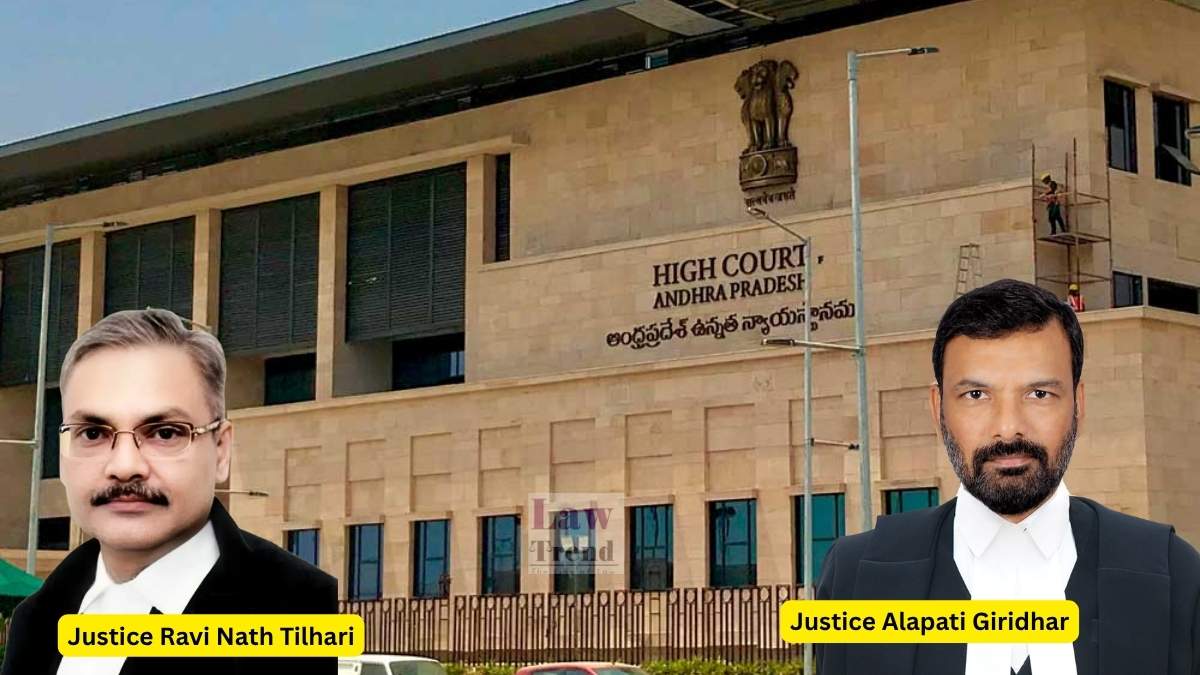
The Andhra Pradesh High Court has held that the travel time excluded under Article 22(2) of the Constitution, when counting the 24 hours within which an arrested person must be produced before a Magistrate, applies to every arrested person, irrespective of health. The Court rejected the argument that the exclusion covers only physically incapacitated accused.
A Division Bench of Justice Ravi Nath Tilhari and Justice Alapati Giridhar dismissed a habeas corpus petition seeking the release of YouTuber Batchalakuri Joseph @ Ravan, who was arrested in a case registered under the BNS and the UAPA. The Bench also directed the Registry not to accept written submissions or compilations of judgments without the Court’s order.
Background
The petition was filed by the Christian Joint Action Committee and Bhanu Murthy Mekala. It challenged the remand order dated 05.07.2026 passed by the XII Additional Junior First Class Magistrate, Gannavaram, in FIR No.188 of 2026 of Gannavaram Police Station, Krishna District. According to the petitioners, the detenu runs a YouTube channel named “PRASHNA”. He was apprehended on 04.07.2026 at around 7:00 p.m. near Vempadu Toll Plaza in Anakapalli District and produced before the Magistrate between 7:30 p.m. and 8:00 p.m. on 05.07.2026.
Arguments
Advocate Rana Sandeep Bussa, appearing for the petitioners, argued that the detenu was produced beyond 24 hours, in violation of Article 22(2) and Sections 57 and 58 of the BNSS. He contended that the exclusion of travel time applies only to accused persons who are physically incapacitated or need medical help during the journey, and that the detenu was in sound health. He also raised lack of territorial jurisdiction, non-supply of written grounds of arrest, and multiple FIRs over a single speech, relying on T.T. Antony v. State of Kerala.
Senior Advocate Siddharth Luthra, assisted by T. Vishnu Teja, Special Government Pleader, appeared for the respondents. He argued that habeas corpus was not maintainable against a judicial remand order, relying on Serious Fraud Investigation Office v. Rahul Modi and V. Senthil Balaji v. State. He submitted that the journey of about 250 km would take 4 to 4½ hours, and that once this was excluded, production was within 24 hours. He added that the FIR related to content on the detenu’s YouTube channel extolling the CPI (Maoist), a banned terrorist organisation, and was distinct from the earlier FIRs.
Article 22(2) Travel Time: What the Andhra Pradesh High Court Held
The Bench first held the petition maintainable because the remand order itself was under challenge.
On the 24-hour rule, the Court said the language of Article 22(2) is clear and admits of no exceptions:
“The time necessary for journey from the place of arrest to the court of Magistrate which is to be excluded shall also apply to every person arrested and detained in custody, irrespective of health or any other condition or situation.”
Accepting the petitioners’ reading, the Bench said, “would be doing violence to the clear language of Article 22(2) of the Constitution of India and reading something in it which is not there.” Relying on the petitioners’ own Google Maps estimate of 4 hours 43 minutes, the Court found that production was within 24 hours.
On territorial jurisdiction, the Court held that since the FIR was lodged at Gannavaram, it could not be said that the Magistrate lacked jurisdiction. Whether the FIR could be lodged there could not be decided in habeas corpus proceedings. The Court further noted that an accused can be produced for remand even before a non-jurisdictional Magistrate.
On the grounds of arrest, the Bench noted that the plea was raised for the first time in the written submissions, with no averment in the writ petition. The remand report recorded that the particulars were communicated to the detenu’s spouse under Section 48(2) of the BNSS, which was not disputed. The Court left the petitioners free to pursue the successive-FIR issue in appropriate proceedings and found that the remand order was not mechanical.
Court Flags Written Submissions
The Court recorded that written submissions filed by counsel on record Dondapati Prasad Kumar were not prepared by him and that he was unaware of their contents. Advocate Rana Sandeep Bussa then withdrew them. Flagging what it called a growing tendency, the Bench observed:
“The written submissions, is no substitute of the oral submissions.”
“Many times, it appears to us that the written submissions or even the drafting of the writ petition is AI generated.”
It directed that, henceforth, written submissions or compilations of judgments filed without the Court’s order shall not be accepted by the Registry. On raising unargued points through written submissions, the Bench said, “We do not approve such practice. It would tend to shake the confidence and the trust of the litigant, in the judicial system and in the dispensation of justice.”
Outcome
The writ petition was dismissed without costs. The petitioners were left free to challenge the remand order on other grounds before the appropriate forum.
Case Title: Christian Joint Action Committee (CJAC) & Another v. State of Andhra Pradesh & Others
Case No.: Writ Petition No.19332 of 2026
Bench: Justice Ravi Nath Tilhari and Justice Alapati Giridhar
Date: 16.10.2026


