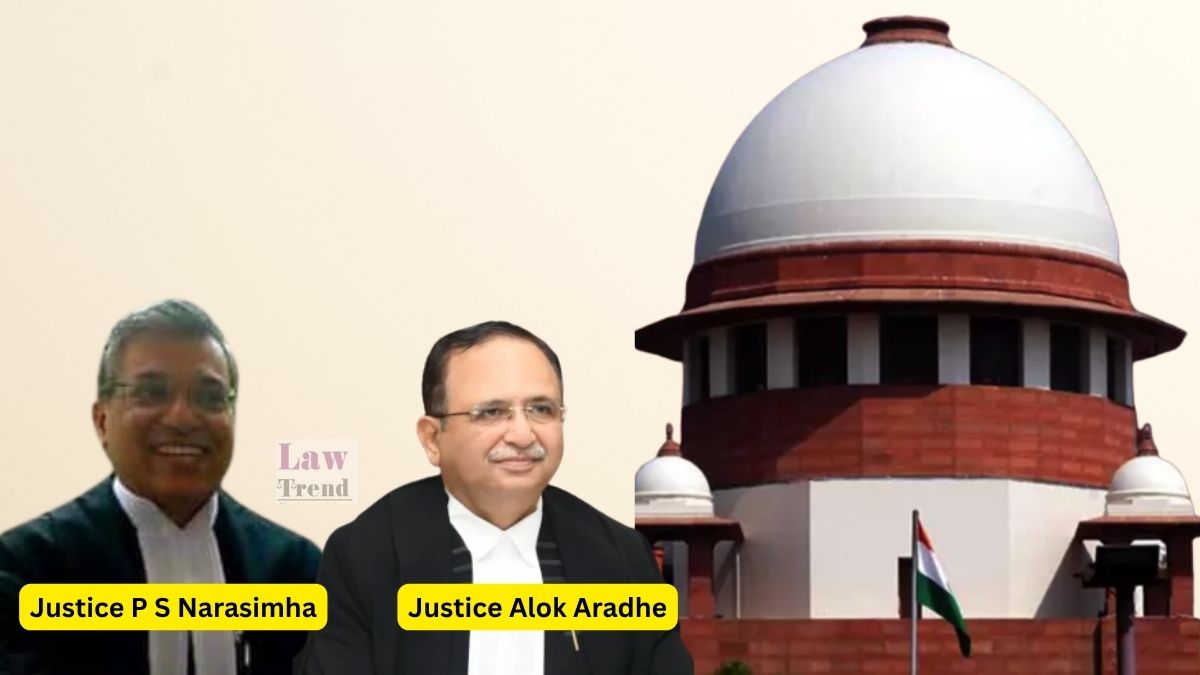
The Supreme Court has ruled that a public authority is fully justified in recalling or revisiting an e-auction process to secure price maximisation for public property, provided an enforceable contract has not come into existence through the execution of a conveyance deed. A Bench comprising Justice Pamidighantam Sri Narasimha and Justice Alok Aradhe set aside a Punjab and Haryana High Court judgment that had quashed the cancellation of a nursing home plot allotted to M/s Bedi Hospital. Allowing the appeals, the apex court directed the Chandigarh Administration to conduct a fresh e-auction for the commercial site within three months.
Background of the Dispute
The controversy stems from an e-auction notice issued by the Chandigarh Administration on August 31, 2022, inviting bids for two nursing home plots on a freehold basis at Sector 33C, Chandigarh—Site No. 3 and Site No. 4—each measuring 744.44 square yards with a reserve price set at Rs 6.91 crores.
In the auction held on October 20, 2022, the bid of Satinder Pal Singh (the appellant) was accepted for Site No. 3 at Rs 18.25 crores as the highest bid. For the adjacent Site No. 4, respondent M/s Bedi Hospital emerged as the highest bidder with an offer of Rs 12.58 crores. M/s Bedi Hospital deposited the mandatory 25 percent amount, leading to an Agreement to Sell executed by the Estate Officer on October 28, 2022, followed by the deposit of the remaining 75 percent balance consideration on November 16, 2022.
However, on January 11, 2023, the Chandigarh Administration revisited the allotment, observing that despite having the identical area and location, Site No. 4 fetched nearly Rs 6 crores less than Site No. 3. Consequently, on January 27, 2023, the Administration cancelled the bid contract on the ground that the bid amount was not reflective of the market trend. It processed a complete refund of the deposited funds and gave liberty to the hospital to participate in a re-auction. The formal Agreement to Sell was subsequently cancelled on February 9, 2023.
M/s Bedi Hospital challenged both cancellation letters before the High Court of Punjab and Haryana. At the admission stage on February 10, 2023, the High Court permitted the Administration to proceed with a fresh auction but directed that it should not be finalised. In that subsequent auction held on September 6, 2023, the appellant emerged as the highest bidder with an offer of Rs 18.30 crores, while M/s Bedi Hospital abstained from participating. Despite the outcome of the re-auction, the High Court allowed the writ petition, quashed both cancellation orders, and restored the original allotment in favour of M/s Bedi Hospital, prompting the present appeals before the Supreme Court.
Submissions by the Parties
Senior Advocate Guru Krishna Kumar, appearing for the appellant, contended that the appellant had participated in the subsequent auction held pursuant to judicial liberty, offered Rs 18.30 crores, and paid the entire consideration. He argued that it would be highly inequitable to displace the appellant after a concluded re-auction.
Additional Solicitor General Vikramjit Banerjee, representing the Chandigarh Administration, maintained that the Administration retained statutory powers under the Chandigarh Estate Rules, 2007, and tender conditions to cancel bids and withdraw sites to secure the highest revenue for the public exchequer.
Senior Advocate P.S. Patwalia, appearing for M/s Bedi Hospital, relied on past precedents to submit that a concluded auction process carries legal sanctity and cannot be discarded arbitrarily merely because the authority expected a higher amount. He added that the hospital was willing to match the appellant’s higher bid of Rs 18.30 crores to retain the site.
The Court’s Legal Analysis
The Supreme Court examined Rule 5 of the Chandigarh Estate Rules, 2007, framed under the Capital of Punjab (Development and Regulation) Act, 1952, along with the General Terms and Conditions of the auction notice. The Bench observed that an Agreement to Sell contemplated under Rule 5(iv) is not an enforceable contract under Section 2(h) of the Indian Contract Act, 1872.
The Court held: “An agreement enforceable in law alone is a contract. Such an enforceable agreement, in the present case, will come into existence only upon execution of the conveyance deed. Execution of the conveyance deed is the culmination of the process by which the promise, the offer, acceptance, payment of consideration, and execution of an Agreement to Sell are complete.”
The Bench clarified that until the allotment letter is issued and the conveyance deed executed, the rights and liabilities do not crystallise, leaving the Administration free to invoke its reserved powers of cancellation: “Under the Rules as well as the Tender Conditions, the Chandigarh Administration has reserved its right to “withdraw any site or building that may have been put up for auction” without assigning any reason, and the decision of the Estate Officer, acting for the Chandigarh Administration in this regard, is declared as final.”
Addressing the public law aspect, the Court referred to Chairman and Managing Director, SIPCOT, Madras & Ors. v. Contromix Pvt. Ltd. (1995), where it was established that the dominant consideration in the sale of public property is to secure the best price through maximum participation. The Bench noted: “However, while dealing with matters relating to sale or lease of public property, the action of a public authority to recall or revisit the auction process would be justified if the decision is intended to maximise the price for the sale/lease of public property. This is permissible as long as the enforceable contract has not been entered into. In the present case, the decision of the Chandigarh Administration to revisit the auction was taken before finalization of the allotment letter and the consequential execution of conveyance deed. At this stage, a substantial lower price fetched at the auction can be a relevant consideration for not finalising the contract in favour of a so-called “highest bidder”.”
The Court distinguished Vice-Chairman and Managing Director, City and Industrial Development Corporation of Maharashtra Limited and Another v. Shishir Realty Private Limited and Others (2022) and Golden Food Products India v. State of Uttar Pradesh & Ors. (2026), noting that the Chandigarh Administration acted transparently, assigned reasons in its cancellation communication, immediately refunded the full amount, and invited the hospital to bid again.
Critiquing the interim orders passed by the High Court, the Bench observed: “That interim arrangement made by the High Court, has opened up a second phase of litigation which has continued for more than two years. Surprisingly, when the High Court took up the writ petition for final hearing, it did not consider the consequences of the rights and liabilities of parties that had been created due to the subsequent auction.”
Recognising that the subsequent process proved the property could fetch an additional Rs 6 crores, the Bench held: “Six crores is not a small amount, and this Court cannot shut its eyes to the glaring reality of the facts that have unfolded about price discovery.”
Decision of the Court
Refusing to either hand over the plot directly to the appellant or allow M/s Bedi Hospital to simply match the price after having sat out of the re-auction, the Supreme Court determined that public interest demanded an open competitive process.
The Court allowed the appeals, set aside the High Court’s judgment, and directed the Chandigarh Administration to conduct a fresh e-auction for Site No. 4 in Sector 33C under the Chandigarh Estate Rules, 2007. The entire process has been ordered to commence and conclude within three months.
Case Title: Satinder Pal Singh & Ors. v. Bedi Hospital & Ors.
Case No.: Civil Appeal No(s). of 2026 (Arising out of SLP (C) Nos. 33791 & 33793 of 2025)
Bench: Justice Pamidighantam Sri Narasimha and Justice Alok Aradhe
Date of Judgment: October 16, 2026