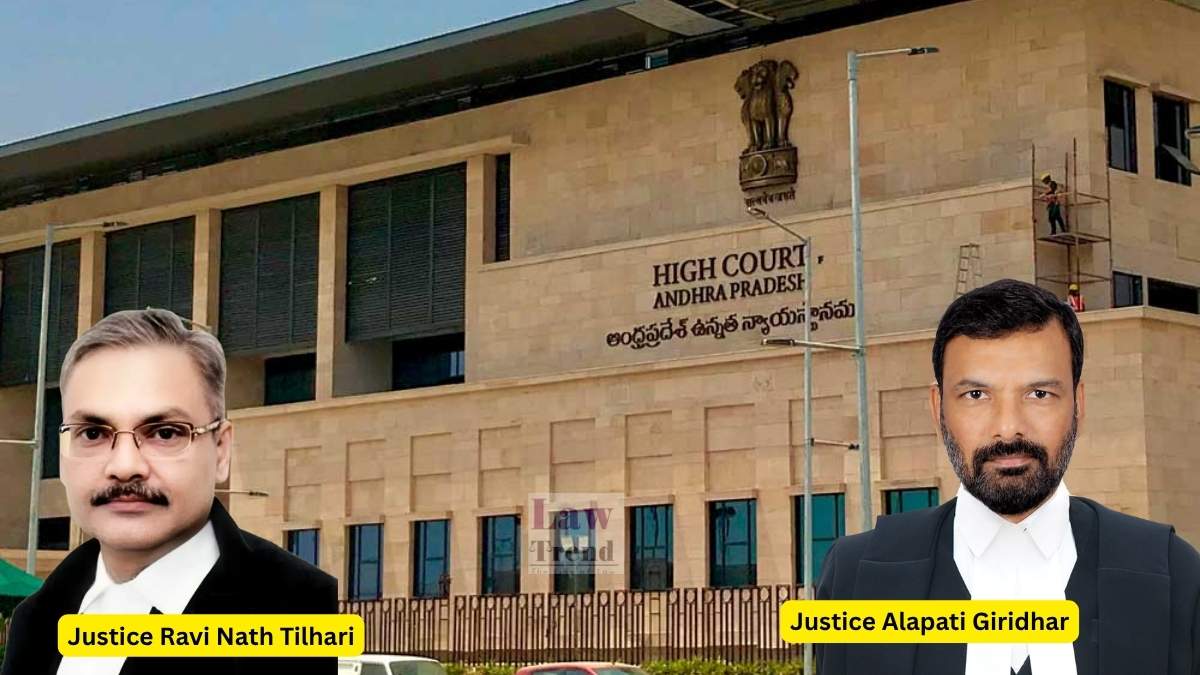
A division bench of the High Court of Andhra Pradesh comprising Justice Ravi Nath Tilhari and Justice Alapati Giridhar has ruled that the filing of a charge sheet by a state-appointed Special Investigation Team (SIT) cannot restrict constitutional courts from entrusting an investigation to the Central Bureau of Investigation (CBI), particularly when state police personnel are accused of custodial violence, custodial death, and the destruction of evidence. Allowing a writ petition of habeas corpus and an interlocutory application filed by the mother of deceased detenu Gade Sai Krishna, the High Court directed the CBI to immediately register a regular criminal case and take over the probe. The bench further awarded Rs 25,00,000 as interim compensation to the victim’s mother and ordered disciplinary proceedings against the delinquent police officers under relevant service rules.
Background of the Case
The petitioner, Gade Vijaya Lakshmi, approached the High Court seeking a writ of habeas corpus directing the authorities to produce her 25-year-old son, Gade Sai Krishna, dead or alive. She stated that her son had past criminal cases—several of which ended in acquittal, compromise, or disposal—and had relocated to Markapuram due to continuous police visits to their residence.
On May 9, 2026, two police constables from Krishnalanka Police Station took the petitioner into custody, confiscated her mobile phone, and questioned her about Sai Krishna’s whereabouts, remarking that he was going to die. Her phone was retained for 15 days, during which its call logs and personal data were accessed to track her son. On May 13, 2026, upon visiting Markapuram, the petitioner learned from local residents that the police had taken her son away and seized his personal belongings. When she enquired at Krishnalanka Police Station, she received contradictory answers from the police personnel and the then Station House Officer (SHO), Inspector S.S.V.V. Nagaraj, leading her to suspect undisclosed detention.
Despite representations to the Human Rights Committee and higher authorities, no arrest memo was provided, no remand report was furnished, and the detenu was never produced before any jurisdictional magistrate. Consequently, the petitioner filed the habeas corpus petition. During its pendency, she submitted a complaint on June 19, 2026, leading to the registration of Crime No. 107 of 2026 under Sections 127(4), 127(6), 103(1), and 238 of the Bharatiya Nyaya Sanhita, 2023 (BNS). The state government subsequently formed a Special Investigation Team headed by Sri M. Ravi Prakash, IPS, to investigate the custodial death.
Submissions of the Parties
Learned counsel for the petitioner, Sri N. Ashwini Kumar, argued that the facts disclosed a grave, calculated sequence of illegal detention, custodial assault, death, and disappearance of the corpse. He contended that an independent investigation by the CBI under judicial supervision was essential to restore public credibility, as the accused officers were state functionaries who wielded institutional influence. He further argued that the state had grossly violated the fundamental rights to life and personal liberty guaranteed under Articles 21 and 22 of the Constitution of India, entitling the bereaved mother to public law monetary compensation.
Opposing the plea for a central agency probe, learned Special Government Pleader Ms. S. Pranathi submitted that while the material prima facie indicated the death of Sai Krishna in police custody, the state government had acted swiftly by constituting an SIT. The SIT had conducted a fair and unbiased probe, arrested several accused police personnel, and filed a charge sheet on September 19, 2026, before the Court of the II Additional Civil Judge (Junior Division) cum II Additional Judicial Magistrate of First Class, Vijayawada. She argued that the submission of the charge sheet obviated any need for a CBI probe and maintained that monetary compensation could only be pursued through private law remedies before a civil court.
The Findings and Status Report
Examining the status report submitted by the SIT, the High Court observed that Gade Sai Krishna had been apprehended by a Task Force team at Markapuram at around 3:00 AM on May 6, 2026, to execute two pending non-bailable warrants. He was brought to Krishnalanka Police Station at 7:00 AM the same day and handed over to the sentry, later coming under the custody of SHO Nagaraju (Accused No. 1).
The court noted that although the initial apprehension was lawful, the detenu was never produced before a magistrate within the mandated statutory period. Evidence gathered by the SIT revealed that Sai Krishna was assaulted in custody, sustained visible bruises and swellings noted by a Registered Medical Practitioner (RMP) on May 8, 2026, and died of injuries sustained during custodial torture. To screen the crime, Accused No. 1 to Accused No. 4 shifted the body and cremated it at Swargapuri Burial Grounds around midnight on May 12–13, 2026.
The SIT report also revealed extensive evidence tampering:
- The original four 8-TB hard disks containing CCTV recordings of Krishnalanka Police Station for the relevant period (and the preceding 18 months) were removed and replaced with unauthorized drives with the help of Home Guard Koneti Venkata Raju (Accused No. 7).
- Two entrance CCTV cameras connected to the Command Control Centre were detached.
- A painter was hired by Head Constable Potarlanka Ashok Kumar (Accused No. 2) to repaint dried blood-like stains on the walls of the second-floor Crime Room.
- The detenu’s mobile phone was sent to Goa through an acquaintance between May 30 and June 9, 2026, and activated there to create a misleading digital trail that he was alive and absconding.
- Accused No. 1 furnished false written instructions to the High Court during initial hearings, falsely stating that the detenu’s whereabouts were unknown.
The Court’s Legal Analysis
The bench formulated three core points for determination: whether the case involved custodial violence and death; whether an investigation by the CBI was warranted; and whether monetary compensation should be awarded under Article 226.
Answering the factual query, the court held that the uncontroverted record definitively established custodial violence, custodial death, and the concealment of the body. Addressing the constitutional mandate, the bench highlighted the severity of such police lawlessness, recalling the Supreme Court’s pronouncement in D.K. Basu v. State of West Bengal:
“Custodial violence, including torture and death in the lock-ups, strikes a blow at the rule of law, which demands that the powers of the executive should not only be derived from law but also that the same should be limited by law. Custodial violence is a matter of concern. It is aggravated by the fact that it is committed by persons who are supposed to be the protectors of the citizens. It is committed under the shield of uniform and authority in the four walls of a police station or lock-up, the victim being totally helpless. The protection of an individual from torture and abuse by the police and other law-enforcing officers is a matter of deep concern in a free society.”
The court also cited State of M.P. v. Shyamsunder Trivedi, noting that:
“The courts must not lose sight of the fact that death in police custody is perhaps one of the worst kind of crimes in a civilised society, governed by the rule of law and poses a serious threat to an orderly civilised society. Torture in custody flouts the basic rights of the citizens recognised by the Indian Constitution and is an affront to human dignity. Police excesses and the maltreatment of detainees/undertrial prisoners or suspects tarnishes the image of any civilised nation and encourages the men in ‘Khaki’ to consider themselves to be above the law and sometimes even to become law unto themselves.”
On the issue of transferring the probe to the CBI despite the filing of a charge sheet, the High Court relied on Rubabbuddin Sheikh v. State of Gujarat, where the Supreme Court held:
“although the charge-sheet was submitted but considering the nature of crime that has been allegedly committed not by any third party but by the police personnel of the State of Gujarat, the investigation concluded in the present case cannot be said to be satisfactorily held… on the other hand in order to make sure that justice is not only done, but also is seen to be done and considering the involvement of the State police authorities and particularly the high officials of the State of Gujarat, we are compelled even at this stage to direct the CBI Authorities to investigate into the matter.”
The bench observed that the principles in State of West Bengal v. Committee for Protection of Democratic Rights, Pooja Pal v. Union of India, Legislative Council, U.P. Lucknow v. Sushil Kumar, Khursheed Ahmad Chohan v. Union Territory of Jammu and Kashmir, and Hansura Bai v. State of Madhya Pradesh settle that while CBI probes should be ordered sparingly, exceptional cases involving institutional bias, tampering with evidence by local police, and custodial crimes demand an independent agency to sustain public faith in the administration of justice.
Addressing the state’s objection to granting monetary relief under Article 226, the bench rejected the argument that the petitioner must be relegated to a civil suit. Citing the landmark rulings in Nilabati Behera v. State of Orissa, Sube Singh v. State of Haryana, In Re-Inhuman Conditions in 1382 Prisons, and State of A.P. v. Challa Ramakrishna Reddy, the bench observed:
“The claim of the citizen is based on the principle of strict liability to which the defence of sovereign immunity is not available and the citizen must receive the amount of compensation from the State, which shall have the right to be indemnified by the wrongdoer. In the assessment of compensation, the emphasis has to be on the compensatory and not on punitive element. The objective is to apply balm to the wounds and not to punish the transgressor or the offender, as awarding appropriate punishment for the offence (irrespective of compensation) must be left to the criminal courts in which the offender is prosecuted, which the State, in law, is duty-bound to do.”
The court refused to apply the motor accident multiplier method referenced in Delhi High Court’s Shyam Sundar v. State (NCT of Delhi), finding an intentional violation of Article 21 by state officials distinct from accidental negligence. Following the Supreme Court’s approach in Lahra Bai Tamre v. State of Chhattisgarh, the bench deemed an award of Rs 25,00,000 as appropriate interim monetary compensation.
The bench also reviewed binding preventive directions on arrests and detentions codified in Arnesh Kumar v. State of Bihar, Mihir Rajesh Shah v. State of Maharashtra, and Vihaan Kumar v. State of Haryana, reiterating that non-compliance with the constitutional requirement of communicating written grounds of arrest under Article 22(1) and the right against arbitrary detention under Article 22(2) strikes at the very root of personal liberty.
The Decision
Allowing the writ petition and Interlocutory Application No. 2 of 2026, the High Court issued the following operative directions:
- Investigation into the circumstances leading to the custodial death of Sai Krishna is entrusted to the Central Bureau of Investigation. All officials found responsible shall be prosecuted in accordance with law upon completion of the inquiry.
- The Director, CBI, New Delhi, must immediately ensure the registration of a regular criminal case and assign the probe to a senior officer for expeditious investigation.
- The Director General of Police, Andhra Pradesh, is directed to transmit complete case records to the Director, CBI, New Delhi, through a special messenger within one week.
- The Government of Andhra Pradesh shall deposit compensation of Rs 25,00,000 directly into the bank account of the petitioner within four weeks.
- The State Government shall initiate departmental disciplinary proceedings against the erring police personnel under applicable service rules.
All other pending miscellaneous applications were closed.
Case Title: Gade Vijaya Lakshmi v. The State of Andhra Pradesh and 4 others
Case No.: Writ Petition No. 15132 of 2026
Bench: Justice Ravi Nath Tilhari and Justice Alapati Giridhar
Date: 16.10.2026