

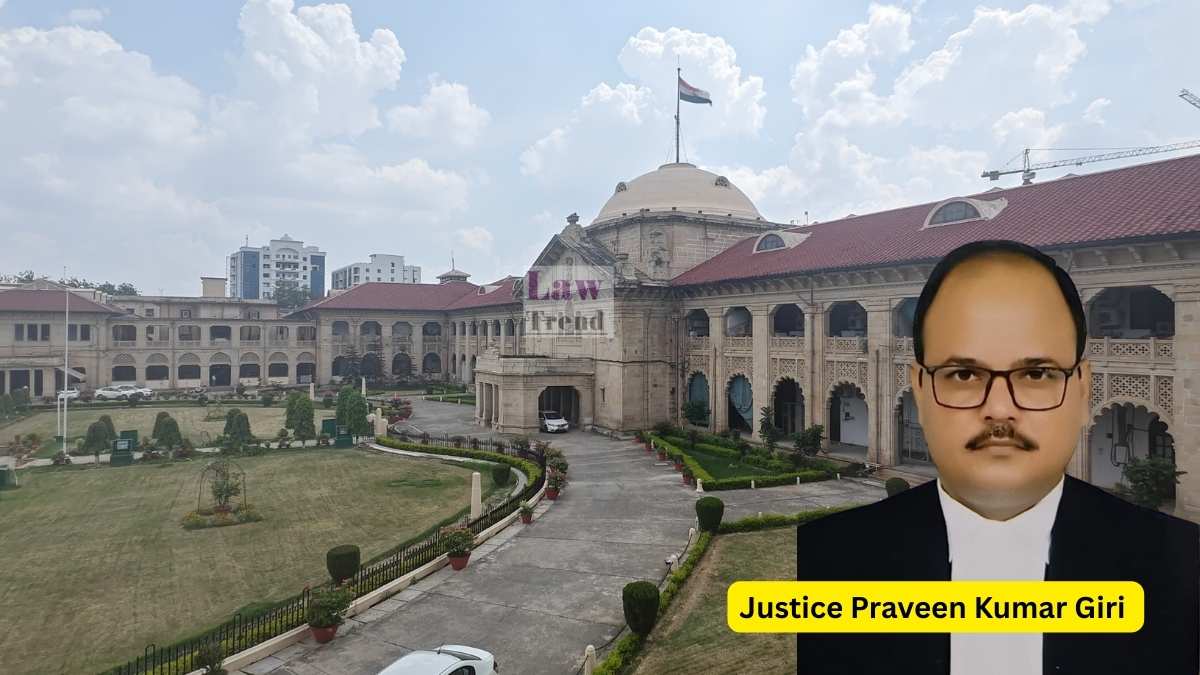
The Allahabad High Court has held that while the one-year limitation under the first proviso to Section 125(3) of the Code of Criminal Procedure (CrPC) restricts the issuance of recovery warrants and coercive execution, it does not extinguish a wife’s substantive entitlement to accrued maintenance arrears, which may still be pursued through a civil suit. A single-judge bench comprising Justice Praveen Kumar Giri dismissed a criminal revision petition filed by a wife challenging the rejection of her recovery application filed more than three years after the default began, affirming that statutory coercive mechanisms cannot be invoked after the prescribed one-year period has elapsed.
Background of the Case
The revisionist, Smt Sunita, married Avaneesh Kumar (Opposite Party No. 2) on February 16, 2021. Following matrimonial disputes, she was ousted from her matrimonial residence on August 22, 2021, and subsequently initiated maintenance proceedings under Section 125 of the CrPC. By an order dated June 3, 2023, the Principal Judge, Family Court, Hamirpur, directed the husband to pay monthly maintenance of Rs. 15,000/-. Under that order, the arrears from the date of the application up to the date of the decision were to be paid in two equal installments within three months, while subsequent maintenance was payable by the 10th of every month.
The husband deposited the arrears covering the period up to June 3, 2023, but failed to make regular payments thereafter. On May 8, 2026, the wife filed an application under Section 125(3) CrPC / Section 144(3) of the Bharatiya Nagarik Suraksha Sanhita (BNSS) seeking recovery of Rs. 1,80,000/- for the 12-month period spanning from June 3, 2023, to May 2, 2024.
On the very same day, May 8, 2026, the Principal Judge, Family Court, Hamirpur, rejected the recovery application as non-maintainable on the ground that it was filed beyond the one-year limitation period prescribed under the first proviso to Section 125(3) CrPC. Aggrieved by this decision, the wife approached the High Court in revision.
Arguments of the Parties
Learned counsel for the revisionist, Sri Raja Ram Kushwaha, argued that the order dated June 3, 2023, had attained finality and the Family Court erred in declining execution merely because the application was moved more than three years after the initial order. Relying on the Supreme Court ruling in Poongodi and Anr v. Thangavel (2013), counsel contended that the first proviso to Section 125(3) CrPC does not extinguish the claimant’s entitlement to maintenance, which represents a continuing liability, nor does it bar enforcement under Section 128 CrPC / Section 147 BNSS.
Opposing the plea, learned Additional Government Advocate (A.G.A.) Sri Pankaj Kumar submitted that the facts in Poongodi were distinguishable because the wife in that case had moved her initial execution application within the prescribed one-year period. In contrast, the revisionist in the present case failed to file any execution application within one year from the date the amount fell due. The State argued that because the statutory condition precedent for issuing a warrant was not met, the Family Court rightly declined to deploy coercive recovery for the time-barred claims.
Court’s Analysis and Legal Framework
Analyzing the statutory scheme, the High Court observed that Section 125(3) CrPC (corresponding to Section 144(3) BNSS) provides a specific coercive procedure: the court may issue a warrant to levy unpaid maintenance in the manner provided for levying fines under Section 421 CrPC / Section 461 BNSS, and if the sum remains unpaid, sentence the defaulter to imprisonment for up to one month for each month’s default.
Examining the Supreme Court’s ruling in Poongodi, the Court observed:
“What the proviso contemplates is that the procedure for recovery of maintenance under Section 125(3) CrPC, namely, by construing the same to be a levy of a fine and the detention of the defaulter in custody would not be available to a claimant who had slept over his/her rights and has not approached the Court within a period of one year commencing from the date on which the entitlement to receive maintenance has accrued. However, in such a situation the ordinary remedy to recover the amount of maintenance, namely, a civil action would still be available.”
Distinguishing the revisionist’s circumstances, the Court highlighted:
“In the present case, admittedly, no application for recovery of the amount of maintenance due under the order of maintenance was filed within one year from the date on which the amount became due, however, in the judgment of the Hon’ble Supreme Court in Poongodi (supra), the application was moved just one month after the date of the maintenance order. Consequently, the restriction contained in the first proviso to Section 125(3) CrPC would operate against the revisionist (wife) insofar as recovery of the amount through the coercive process contemplated under Section 125(3) CrPC is concerned.”
The Court clarified that if a timely application is instituted within one year, recurring defaults continue to remain enforceable without necessitating successive applications:
“The expression ‘amount became due’ means the date of order on which the claim of maintenance has been accepted by the court and to comply the order of maintenance, an execution application is filed. Therefore, the period of one year shall be counted from the date of granting of maintenance and once, the execution application is filed for the first time, the period of one year shall be counted to execute the maintenance order by issuing warrant to recover the amount of maintenance.”
Reviewing comparative maintenance laws, the Court noted that while execution of decrees under Section 24 of the Hindu Marriage Act, 1955, and Section 18 of the Hindu Adoptions and Maintenance Act, 1956, are governed by the Code of Civil Procedure (CPC) with civil detention restricted to a cumulative maximum of three months under Section 58 CPC (citing Mohiet Anand v. Parul Anand (2024)), Section 125(3) CrPC allows repeated terms of imprisonment extending up to one month for each individual month of default. The bench also referenced Damini v. State of U.P. (2026) and Section 12 of the Gram Nyayalayas Act, 2008, affirming the jurisdiction of Gram Nyayalayas over maintenance proceedings, and reiterated Sagar v. State of U.P. (2025) regarding Rule 6(5) of the Protection of Women from Domestic Violence Rules, 2006.
Furthermore, citing the Supreme Court decisions in Rajnesh v. Neha (2021), Rahul S. Shah v. Jinendra Kumar Gandhi (2021), and Periyammal v. Rajamani (2025)—as well as High Court Administrative Circular C.L. No. 16/Admin G-II dated May 24, 2025—the Court underscored the mandate that execution petitions must be decided and disposed of within six months.
Decision of the Court
The High Court affirmed the Family Court’s order, holding:
“In view of the aforesaid discussion, this Court is of the considered opinion, that the first proviso to Section 125(3) CrPC does not extinguish the substantive right of the revisionist to receive the maintenance awarded under the order dated 03.06.2023; however, in the absence of any application having been moved within the period prescribed therein, the coercive mode of recovery contemplated under Section 125(3) CrPC cannot be invoked in respect of the amount for which the prescribed period had already expired.”
Dismissing the revision, the Court granted liberty to the revisionist to recover arrears beyond the limitation period by instituting a civil suit as a money decree under the Code of Civil Procedure, in accordance with paragraph 125 of Rajnesh v. Neha.
The Court issued the following directions for cases involving non-compliance with maintenance orders:
- A show-cause notice must be issued under Section 125(3) CrPC / Section 144(3) BNSS calling on the defaulter to explain non-payment.
- If sufficient cause is not shown, the trial court shall issue a warrant for levying the amount in the manner provided for fines under Section 421 CrPC / Section 461 BNSS. In the event of no or insufficient movable/immovable property, an arrest warrant shall be issued to sentence the defaulter to imprisonment for up to one month for each month of default or until payment, with the execution proceedings to be completed within six months.
- For amounts falling beyond the one-year limitation, claimants may recover dues through the procedure for money decrees under the CPC, while claims within limitation may proceed via recovery warrants under Section 125(3) CrPC / Section 144(3) BNSS.
The Registrar (Compliance) was directed to communicate the order to the District and Sessions Judge, Hamirpur, and the Principal Judge, Family Court, Hamirpur, and transmit a copy to the Judicial Training and Research Institute (JTRI), Lucknow, for academic purposes.
Case Title: Smt Sunita Versus State of U.P. and another
Case No.: Criminal Revision Defective No. 1632 of 2026
Bench: Justice Praveen Kumar Giri
Date: October 16, 2026




