

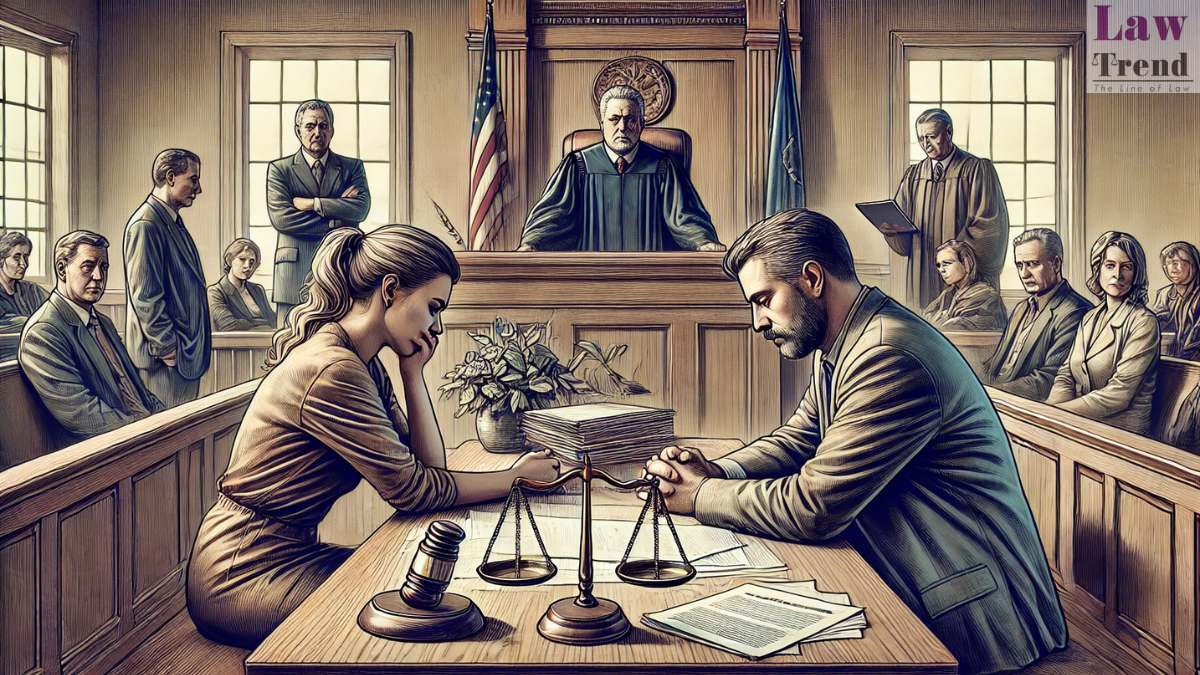
The Calcutta High Court has affirmed a trial court decree granting a divorce to a wife on the ground of cruelty under Section 13(1)(ia) of the Hindu Marriage Act, 1955, ruling that forcing a spouse out of the matrimonial home coupled with years of total neglect and separation amounts to cruelty. A Division Bench comprising Justice Madhuresh Prasad and Justice Partha Pratim Roy dismissed the husband’s first appeal, holding that while irretrievable breakdown of marriage is not an independent statutory ground for divorce under the Hindu Marriage Act, keeping alive the legal facade of an acrimonious and irreparably broken marriage inflicts mental cruelty on the parties.
Background of the Dispute
The parties solemnized their marriage according to Hindu rites and customs on July 14, 2010, at the wife’s parental home, after which she moved to her matrimonial home in Bankura. The marriage was consummated, and the wife gave birth to a male child on July 30, 2011. According to the plaintiff wife, immediately following the birth of their son, the husband began exerting pressure on her to bring money from her family. Because her father’s financial condition was not sound, she was unable to meet the demand.
The wife alleged that the husband subjected her to both mental and physical torture due to her inability to bring money, frequently returning home intoxicated and physically assaulting her. She also stated that she was neglected and denied medical treatment during illness, before eventually being driven out of her in-laws’ home along with her infant child. Following the eviction, the husband neither visited her at her parental home, nor took steps to bring her back, nor paid any maintenance for her or their minor son. Consequently, the wife instituted a matrimonial suit seeking dissolution of marriage on the ground of cruelty.
Contesting the proceedings, the husband filed a written statement denying all allegations, labeling the statements in the plaint as false and concocted. He denied causing torture or demanding money, contending instead that the wife was unwilling to reside at the matrimonial home and refused to return despite his several visits to her parental home.
The trial court framed four issues regarding maintainability, cruelty, and entitlement to relief. The wife examined herself and her elder sister as PW1 and PW2, while the husband examined himself as the sole witness (OPW). On October 12, 2023, the trial court decreed the suit in favor of the wife on the ground of cruelty, prompting the husband’s appeal before the High Court.
Arguments Before the High Court
Appearing for the appellant husband, Advocate Soumit Ganguli contended that the plaintiff wife had failed to prove the allegation of cruelty. He highlighted that during cross-examination, the wife admitted she did not lodge any complaint with the police station or the Panchayat regarding the alleged torture or money demands, nor did she file any police complaint after leaving the matrimonial home. He argued that in light of these admissions, no specific incident of cruelty was established. The counsel further submitted that irretrievable breakdown of marriage is not a statutory ground under the Hindu Marriage Act, and a defaulting party cannot secure a divorce decree merely because the parties have stayed separately for a considerable period.
In response, Advocate Debrup Choudhury, representing the respondent wife, submitted that the husband’s written statement contained only evasive denials, which under law amounted to an admission of the facts alleged. He pointed out from the husband’s cross-examination that the husband did not even know the present whereabouts of his wife, the name of his son’s school, or the status of the child’s education, having admitted that he took no steps to support the child’s schooling.
The counsel emphasized that during the wife’s cross-examination, the husband’s side failed to put any questions disputing her oral testimony regarding her forceful eviction or challenging the allegations concerning his conduct and failure to discharge familial responsibilities. Relying on the Supreme Court’s ruling in Rakesh Raman vs. Kavita (2023) 17 SCC 433, he argued that a relationship rendered bitter and acrimonious over years inflicts mutual cruelty, justifying the dissolution of the marriage.
The Court’s Analysis and Findings
Examining the evidence and legal principles, the High Court observed that while the word “cruelty” is not explicitly defined under the Hindu Marriage Act, 1955, judicial interpretation recognizes it as any physical or mental conduct that makes it unsafe, harmful, or impossible for spouses to live together. The Bench noted that mental cruelty includes ignoring emotional needs or withdrawing affection, which results in mental agony.
The Bench observed that the testimony established that the wife was forced to leave the matrimonial home shortly after marriage and live separately with her child. Crucially, the husband admitted in his deposition that he was ignorant of his son’s school and academic activities, and knew nothing about his wife’s condition, despite her parental home being situated in an adjacent village, Bhurkunda. The Court observed that this admission proved he had no intention to live with his wife or perform his duties as a husband and father.
Furthermore, the Court took note of the procedural failure during trial, where the husband chose not to cross-examine the wife regarding her forceful eviction. Citing the Division Bench decision in A.E.G. Carapiet vs. A.Y. Derderian (AIR 1961 CAL 359), the Court reiterated the established rule of evidence:
“Wherever the opponent has declined to avail himself of the opportunity to put his essential and material case in cross-examination, it must follow that he believed that the testimony given could not be disputed at all. It is wrong to think that this is merely a technical rule of evidence. It is a rule of essential justice. It serves to prevent surprise at trial and miscarriage of justice, because it gives notice to the other side of the actual case that is going to be made when the turn of the party on whose behalf the cross-examination is being made comes to give and lead evidence by producing witnesses. It has been stated on high authority of the House of Lords that this much a counsel is bound to do when cross-examining that he must put to each of his opponent’s witnesses in turn, so much of his own case as concerns that particular witness or in which that witness had any share. If he asks no question with regard to this, then he must be taken to accept the plaintiff’s account in its entirety. Such failure leads to miscarriage of justice, first by springing surprise upon the party when he has finished the evidence of his witnesses and when he has no further chance to meet the new case made which was never put and secondly, because such subsequently testimony has no chance of being tested and corroborated.”
Addressing the issue of marital breakdown, the Bench acknowledged that irretrievable breakdown is not an independent ground under Section 13 of the Hindu Marriage Act. However, referencing the Supreme Court’s decision in Samar Ghosh vs. Jaya Ghosh (2007) 4 SCC 511, the Bench noted that where there is a long period of continuous separation, the matrimonial bond becomes a fiction, and refusing to sever it displays scant regard for the parties’ emotions, culminating in mental cruelty.
The High Court endorsed the view expressed in Rakesh Raman vs. Kavita, quoting the Supreme Court:
“22. Irretrievable breakdown of a marriage may not be a ground for dissolution of marriage, under the Hindu Marriage Act, but cruelty is. A marriage can be dissolved by a decree of divorce, inter alia, on the ground when the other party ‘has, after the solemnization of the marriage treated the petitioner with cruelty.’
23. In our considered opinion, a marital relationship which has only become more bitter and acrimonious over the years, does nothing but inflict cruelty on both the sides. To keep the façade of this broken marriage alive would be doing injustice to both the parties. A marriage which has broken down irretrievably, in our opinion spells cruelty to both the parties, as in such a relationship each party is treating the other with cruelty. It is therefore a ground for dissolution of marriage under Section 13 (1)(i-a) of the Act.”
Decision
The High Court found that the wife was compelled by the husband’s conduct to leave the matrimonial home, and both had been living separately for more than 14 years. It noted that the husband demonstrated no care, concern, or eagerness to maintain ties with his wife or child.
Holding that the trial court had arrived at the correct finding, the Division Bench dismissed the appeal (F.A.T. 423 of 2023) without costs, formally affirming the judgment and decree dated October 12, 2023.
Case Details:
Case Title: Arup Kumar Sur vs. Anandamoyee Sur
Case No.: F.A.T. 423 of 2023
Bench: Justice Madhuresh Prasad and Justice Partha Pratim Roy
Date: 14th October, 2026




