

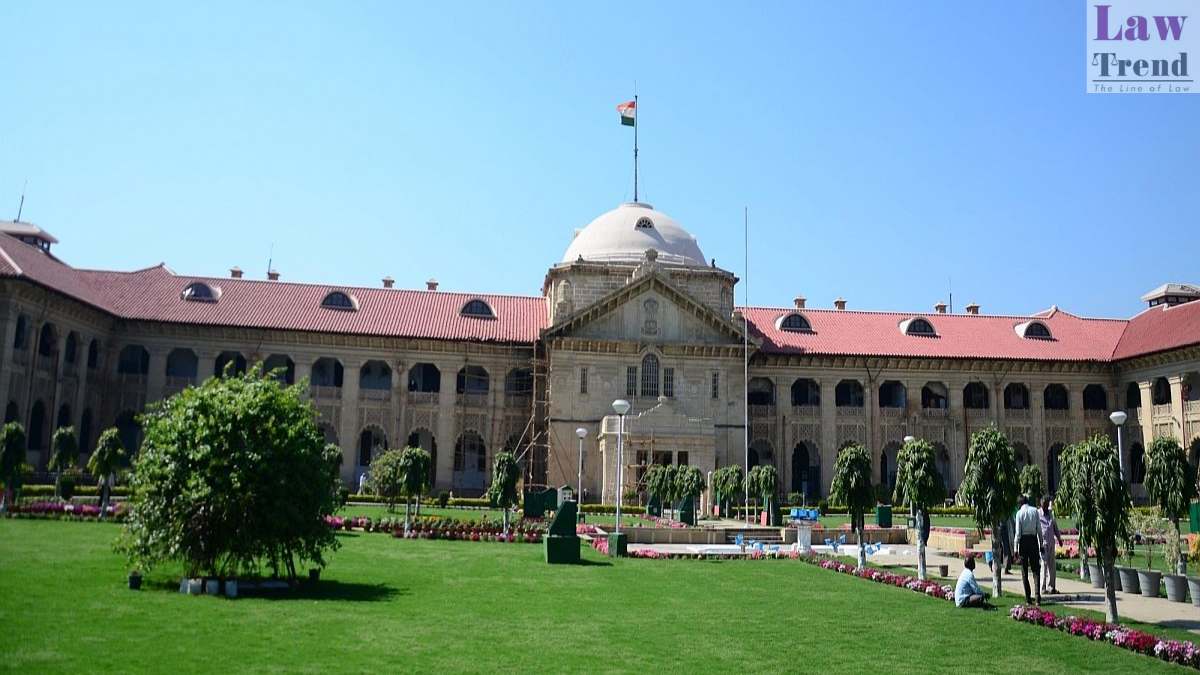
The High Court of Judicature at Allahabad, presided over by Justice Vikas Budhwar, has dismissed an appeal filed under Section 37 of the Arbitration and Conciliation Act, 1996, after refusing to condone an inordinate delay of 831 days. The Court ruled that the explanation offered by the appellants failed to inspire confidence, observing that litigants cannot remain in deep slumber without tracking the progress and stage of their legal proceedings.
Background of the Case
The dispute arose out of land acquisition proceedings under the National Highways Act, 1956. The appellants—claimants who stated they were residents of Village Aurangpur, Pargana Dankaur, District Gautam Buddha Nagar—were co-owners of Khasra No. 954/1 (measuring 1,092.50 square meters) and Khasra No. 514 (measuring 3,479.8 square meters) situated in the village.
Following statutory notifications issued under Sections 3A and 3D of the National Highways Act between 2006 and 2012, an arbitral award was rendered by the Arbitrator / District Magistrate / Collector, Gautam Buddha Nagar, on May 16, 2016.
Aggrieved by the award, the claimants instituted objections under Section 34 of the Arbitration and Conciliation Act, 1996, before the Court of the District Judge, Gautam Buddha Nagar (registered as Arbitration Case No. 85 of 2023). On January 8, 2024, the District Judge dismissed their objections.
The appellants subsequently challenged this dismissal by filing an appeal under Section 37 before the Allahabad High Court on August 19, 2026, alongside a delay condonation application (Delay Condonation Application No. 2 of 2026), reporting a delay of 831 days.
Arguments of the Parties
Appearing for the appellants, learned counsel submitted that the delay was bona fide, beyond control, and ought to be condoned in the interest of justice so that the appeal could be adjudicated on merits. The appellants stated in their supporting affidavit that following the lower court’s order on January 8, 2024, they had handed over the case papers to an advocate in the High Court, Sri Manoj Kumar, alongside other aggrieved persons in connected matters. They contended that Sri Manoj Kumar later fell seriously ill and ultimately passed away. Unaware of his death, the appellants remained under the impression that their appeal had been filed and was pending. Upon making inquiries, they discovered the appeal had not been filed, after which they engaged new counsel and presented the appeal without further delay.
Opposing the application, Sri Pranjal Mehrotra, learned counsel appearing for the National Highways Authority of India (NHAI), argued that the grounds asserted were wholly misconceived, out of context, and amounted to a mere lame excuse, failing to make out any valid ground for condoning the extensive delay.
Court’s Analysis and Key Observations
Evaluating the statutory framework and the timeline, Justice Vikas Budhwar observed that the challenge under Section 34 itself had been preferred in 2023 against an arbitral award dated May 16, 2016. Referring to Section 34(3) of the Act and its proviso, the Court noted that an application for setting aside an award cannot be entertained after three months, with an extendable grace window of thirty days if sufficient cause is shown, “but not thereafter.”
The Court referred to the Supreme Court’s decision in Bhimashankar Sahakari Sakkare Karkhane Niyamita v. Walchandnagar Industries Ltd. (WIL) (2023), wherein the Apex Court reiterated the principles laid down in Popular Construction Co., Assam Urban, and Hindustan Construction Co. regarding the strict limitation periods under the Arbitration Act:
“54. … Section 43(1) of the Arbitration Act specifically provides that the Limitation Act, 1963 shall apply to arbitrations as it applies to proceeding in Court. However, as observed and held by this Court in Assam Urban, the Limitation Act, 1963 shall be applicable to the matters of arbitration covered by the 1996 Act save and except to the extent its applicability has been excluded by virtue of express provision contained in Section 34(3) of the Arbitration Act.
55. In Popular Construction Co., when Section 5 of the Limitation Act was pressed into service to proceedings under Section 34 of the Arbitration Act for setting aside the arbitral award, this Court has observed that the Arbitration Act being a special law and provides a period of limitation different from that prescribed under the Limitation Act, the period of limitation prescribed under the Arbitration Act shall prevail and shall be applicable and to that extent the Limitation Act shall be excluded…
56. In Hindustan Construction Co., in fact this Court has emphasised the mandatory nature of limit to the extension of period provided in the proviso to Section 34(3) and has held that an application for setting aside an arbitral award under Section 34 of the Arbitration Act has to be made within time prescribed under sub-section (3) of Section 34 i.e. within three months and a further period of 30 days on sufficient cause being shown and not thereafter.”
Addressing the 831-day delay in lodging the Section 37 appeal, the Court held that the explanation tendered did not inspire confidence:
“11. Further, apart from the same, the present appeal has been preferred after a period of 831 days, and the reason set forth does not inspire confidence of the Court, particularly when it cannot be said that a litigant is to be in deep slumber as he has to take the whereabouts of the status and the stage of the proceedings.”
The Court also cited the Supreme Court ruling in Government of Maharashtra v. M/s Borse Brothers Engineers & Contractors Pvt. Ltd. (2021) regarding the standards for condoning delay in arbitration appeals:
“61. Given the aforesaid and the object of speedy disposal sought to be achieved both under the Arbitration Act and the Commercial Act, for appeals filed under section 37 of the Arbitration Act that are governed by Articles 116 and 117 of the Limitation Act or section 13(1A) of the Commercial Courts Act, a delay beyond 90 days, 30 days or 60 days, respectively, is to be condoned by way of exception and not by way of rule. In a fit case in which a party has otherwise acted bona fide and not in a negligent manner, a short delay beyond such period can, in the discretion of the court, be condoned, always bearing in mind that the other side of the picture is that the opposite party may have acquired both in equity and justice, what may now be lost by the first party’s inaction, negligence or laches.”
The High Court emphasized that the reasons presented were thoroughly insufficient to explain an inordinate delay of 831 days, especially when such delay is required to be accounted for on a day-to-day basis.
Decision of the Court
Holding that no good ground existed to condone the delay, the High Court rejected Delay Condonation Application No. 2 of 2026 as misconceived. Consequently, the defective Section 37 appeal stood dismissed.
Case Details
Case Title: Rami (Since Deceased) and 4 others v. Union Of India And Another
Case No.: Appeal Under Section 37 of Arbitration and Conciliation Act 1996 Defective No. 147 of 2026
Bench: Justice Vikas Budhwar
Date: October 12, 2026




