

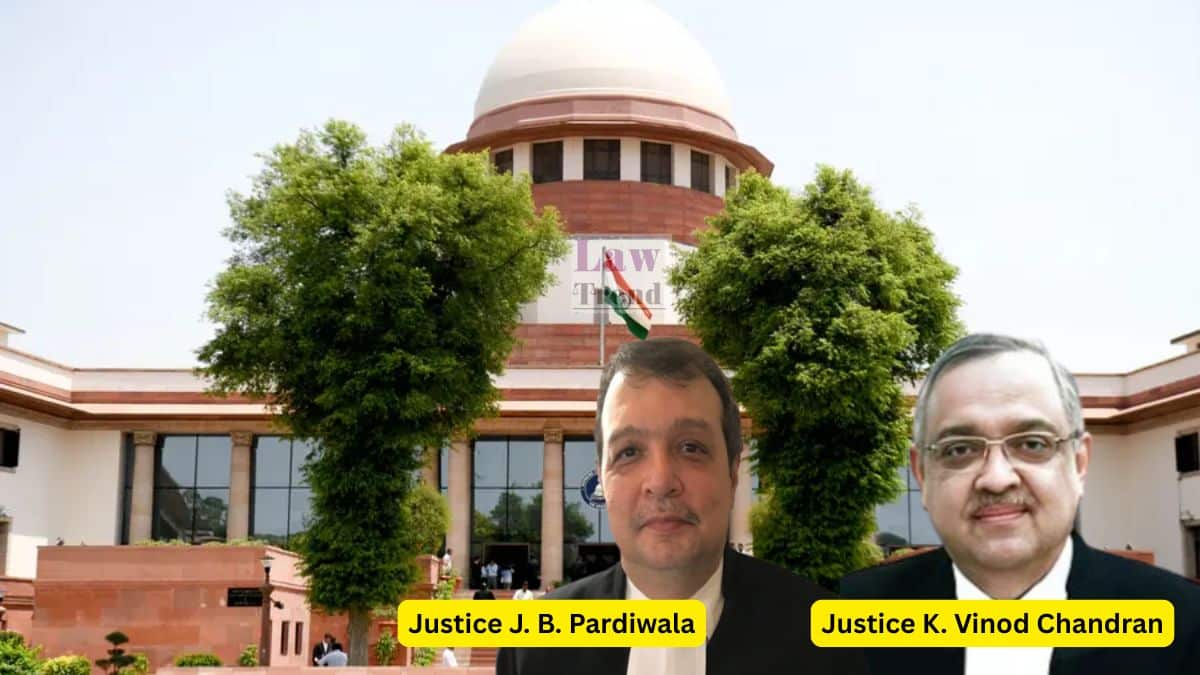
The Supreme Court bench comprising Justice J.B. Pardiwala and Justice K. Vinod Chandran has quashed criminal proceedings for abetment of suicide against a man and his family members, holding that a refusal to marry following a relationship breakup cannot automatically be construed as instigation or abetment to suicide under Section 306 of the Indian Penal Code, 1860 (IPC).
Background of the Case
The criminal proceedings arose from a First Information Statement (FIS) lodged by the sister of the deceased woman. According to the first informant, she had contacted a friend of the deceased after her sister failed to answer phone calls, learning that the deceased had been residing with the first appellant at his house. The informant’s elder sister then visited the house and brought the deceased back to their residence.
The record established that the deceased and the first appellant were in a consensual live-in relationship for three months, which had been accepted by the first appellant’s family. The Court noted that in such circumstances, it was difficult to comprehend why the informant and her sister removed the deceased from the first appellant’s house.
The following morning, the deceased left for work. In the evening, the first appellant phoned the informant to ask where he should drop her younger sister, and the informant requested that he bring her home. However, the deceased did not return. Subsequently, the deceased telephoned her eldest sister, stating that the first appellant had refused to marry her and that she was consequently ending her life. The deceased subsequently died by suicide at the house of the first appellant.
Allegations Levelled Against the Accused
The prosecution was initiated against six accused persons under Section 306 read with Section 34 of the IPC:
- The first appellant (the partner of the deceased);
- The second appellant (father of the first appellant);
- The sixth appellant (mother of the first appellant);
- The third appellant (sister of the first appellant);
- The fifth appellant (the proposed bridegroom of the third appellant); and
- The fourth appellant (a friend of the first appellant).
The case projected by the siblings of the deceased was that the fourth appellant spoke ill of the deceased to the first appellant, prompting him to withdraw from the marriage proposal. Furthermore, the third appellant had implored the first appellant not to continue the relationship because the fifth appellant refused to marry her if the first appellant married the deceased. The parents (second and sixth appellants) concurred with this position. The prosecution framed these events as the instigation that drove the deceased to commit suicide.
Court’s Analysis and Observations
Examining the record, the Supreme Court observed that while the death by suicide inside the first appellant’s house was unequivocally proved and the consensual relationship was admitted, there was an absence of any instigating act on the part of the accused. The bench also pointed out that when the deceased contacted her eldest sister threatening suicide, the sister did nothing to avert the threatened act.
Addressing the threshold of criminal liability under Section 306 IPC, the bench observed:
“We are unable to find any instigation by the accused/appellants to drive the deceased to death by suicide. It was neither intended nor can it be said to be abetment. At the worst, even if we fully believe what has been stated by the 1st informant, there was a refusal of marriage, which led to the woman committing suicide.”
The Court further clarified the legal distinction between an emotional reaction to a failed relationship and the penal offence of abetment:
“People react differently to situations and if a breakup ends up with suicide, it cannot always be termed an abetment to suicide. The refusal to marry was not with an intention to drive the woman to death by suicide nor can knowledge be attributed to the accused that on such refusal, she would commit suicide.”
Decision of the Court
Holding the allegations to be untenable, the Supreme Court ruled:
“We are unable to sustain the prosecution initiated against the accused on such frivolous allegations and we quash the proceedings in Sessions Case No.101 of 2024 pending before the Learned IInd Additional Senior Civil Judge-cum-Additional Chief Judicial Magistrate, Medchal-Malkajgiri District at Kushaiguda, Telangana.”
The Court directed that the appellants, if in custody, be released forthwith if not required in any other case, and directed that if they were already on bail, their bail bonds stand cancelled. The appeal was accordingly disposed of.
Case Title: Chittibarika Chandra Shekar & Ors. Versus The State of Telangana & Anr.
Case No.: SLP (Crl.) No. 7239 of 2026
Bench: Justice J.B. Pardiwala and Justice K. Vinod Chandran
Date: October 05, 2026




