

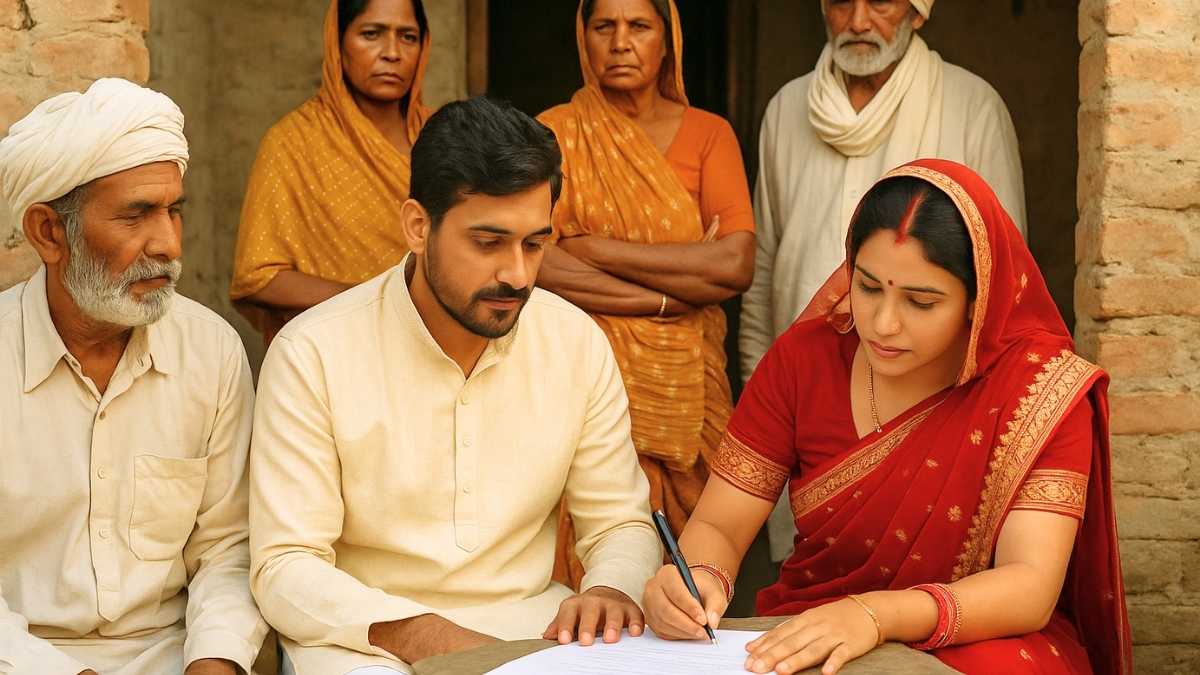
The Kerala High Court has held that a property purchased entirely with money provided by a wife’s father for her benefit can be declared her exclusive property even if the sale deed stands jointly in the names of the wife and husband. A Division Bench of Justice Sathish Ninan and Justice P. Krishna Kumar modified a Family Court decree and declared the wife the exclusive owner of a residential property, while directing the husband to vacate it within three months.
The case arose from matrimonial proceedings in which the wife had sought return of gold ornaments and money, past maintenance and relief concerning a residential property purchased in the joint names of the spouses.
Background
The parties were married on September 15, 2012 in accordance with Mohammadan law. The wife claimed that she had taken 85 sovereigns of gold ornaments to the matrimonial home and later entrusted 80 sovereigns to her husband for safe custody.
She also alleged that her father had paid money to the husband and had financed the purchase of a residential property measuring seven cents in Manjeri Municipality. According to her, although the entire consideration for the property was provided by her father, it was registered jointly in her and her husband’s names in the interests of their marital relationship.
The husband denied receiving the gold ornaments and claimed that the wife had retained them. He also maintained that he had purchased the residential property from his own funds and had registered it jointly in their names in the interests of the family.
He further disputed liability for maintenance and raised a counterclaim seeking recovery of ₹3 lakh, which he claimed to have deposited in the account of the wife’s father.
The Family Court rejected the wife’s claims relating to gold ornaments, money and maintenance. It also dismissed the husband’s counterclaim. However, it found that the property had been purchased exclusively with money raised by the wife’s father and awarded her ₹15 lakh towards the value of the husband’s half share.
Both sides challenged the parts of the decree that went against them.
Claim for Gold Ornaments Not Proved
On the claim relating to 80 sovereigns of gold ornaments, the High Court noted that the only evidence regarding entrustment was the wife’s oral testimony, which was denied by the husband.
The Court referred to her cross-examination and the evidence concerning a marriage function in the husband’s family shortly before the couple went abroad. The Bench agreed with the Family Court that the version regarding entrustment of the ornaments was not probable.
“We do not find her claim that she had entrusted her gold ornaments to the respondent, to be a probable version.”
The Court therefore held that she was not entitled to recover the gold ornaments.
The Bench also upheld the rejection of her claim that her father had paid ₹5.5 lakh to the husband, observing that there was no reliable supporting material apart from oral testimony.
Similarly, the husband’s counterclaim for ₹3 lakh was rejected because he failed to establish that the amount allegedly deposited in the account of the wife’s father had been paid on behalf of the wife.
The Court also declined to interfere with the rejection of the wife’s claim for past maintenance for 13 months, finding that she had not placed sufficient material to substantiate it.
Bank Records Supported Wife’s Case Over Property
The main dispute before the High Court concerned the residential property purchased in the joint names of the spouses.
The wife’s father testified that he had raised funds through the Nilambur Co-operative Urban Bank for purchasing the property. The bank statement showed that ₹25 lakh was debited from his account on November 9, 2015, the date on which the sale deed was executed. It also showed that ₹25 lakh had been credited to his account on November 2, 2015, apparently as a loan.
The husband, however, did not produce evidence showing the source of the money allegedly contributed by him.
During cross-examination, he stated that the money belonged to him but was kept with his brother-in-law, who worked abroad with him. The Court noted that the brother-in-law was not examined and no documents were produced to show how the money was brought to India for the purchase.
The Bench also took note of the husband’s admission that the original title deed remained with the wife and that she had obtained the deed from the Sub-Registry.
The Court consequently held that the wife had established that the property had been purchased for her with funds provided by her father.
Family Court Can Consider Evidence Beyond Strict Evidence Act Rules
The husband argued that the wife’s claim regarding the actual consideration paid for the property could not be accepted because of the bar under Section 92 of the Indian Evidence Act, 1872.
His counsel submitted that the sale deed recorded the consideration as ₹7.58 lakh and that the Family Court could not rely on evidence suggesting a different amount.
The High Court noted that Section 92 generally bars oral or other evidence intended to contradict, vary, add to or subtract from the terms of a written instrument.
However, the Bench referred to Section 14 of the Family Courts Act, 1984, which permits a Family Court to receive any report, statement, document, information or matter that may assist it in effectively dealing with a dispute, whether or not such material would otherwise be admissible under the Evidence Act.
The Court observed:
“Once the Family Court arrives at such conclusion, it can rely on any such evidence dehors Section 92, in the light of Section 14 of the Act, which gives an overriding effect to the provisions relating to relevancy and admissibility under the Indian Evidence Act, 1872.”
At the same time, the Bench cautioned that such power must be exercised carefully.
“While Section 14 of the Act gives discretion to the Family Court, in a given case, to admit evidence which may otherwise be inadmissible under Section 92 of the Indian Evidence Act, such discretion should be exercised with due care and caution.”
Referring to Pramod E.K. v. Louna V.C., the Court added that Family Courts are still required to follow fundamental rules of evidence founded on logic, fairness and expediency as well as principles of natural justice.
Entire Consideration Came From Wife’s Father
After examining the oral and documentary evidence, the High Court held that the testimony of the wife and her father, substantially corroborated by the bank statement, established that the entire sale consideration had been paid by her father.
The Court found that the property had been purchased for the welfare and benefit of the wife.
It also considered the earlier decision in Shereefa Shanavaz v. Shanavaz, in which parties named jointly in a sale deed had been treated as co-owners in equal shares in the particular facts of that case. The Bench said that decision had been rendered in its own factual circumstances.
The Court further referred to Section 45 of the Transfer of Property Act, 1882 and its earlier ruling in Vasanthakumary v. Omanakuttan Nair.
It recorded:
“In the present case, it is proved that the entire consideration was provided by the father of the petitioner in the best interests of his daughter and for her benefit and that it belongs to her.”
Relief Moulded to Declare Wife Exclusive Owner
The Family Court had observed that the wife was actually entitled to seek a declaration of exclusive ownership but had instead claimed only ₹15 lakh, representing the value of the husband’s half share.
Before the High Court, the wife sought to amend the petition to claim declaration of ownership and mandatory injunction directing the husband to vacate.
The husband opposed the amendment as belated.
The High Court observed that the role of courts in family disputes differs from ordinary civil litigation. It referred to Section 10(3) of the Family Courts Act, which permits a Family Court to lay down its own procedure for arriving at the truth of disputed facts.
The Bench held that the wife’s original pleadings themselves substantially raised a claim to exclusive ownership, as she had specifically pleaded that her father had paid the entire consideration and that the husband had contributed nothing.
The Court therefore found no impediment in declaring her exclusive title even without formally allowing the amendment application.
Referring to Order VII Rule 7 CPC and Syamini S. Nair v. Sreekanth R., the Bench held that the relief could be moulded in the interests of justice.
“We are compelled to conclude that, in the interests of justice, the relief in the present case has to be moulded, declaring the exclusive ownership of the property upon the petitioner, while incidentally permitting her to obtain vacant possession thereof.”
Accordingly, the husband’s appeal was dismissed and the wife’s appeal was partly allowed.
The High Court declared the wife the exclusive owner of the 2.8 Ares of land and the building standing on it and directed the husband to vacate the property within three months. The Family Court’s decree awarding her ₹15 lakh towards the husband’s share was modified accordingly, while the remaining findings were upheld.
Case Title: Kurudankandi Shamseer v. Raslin / Raslin v. Kurudankandi Shameer
Case No.: Mat. Appeal Nos. 84 & 581 of 2022
Bench: Justice Sathish Ninan and Justice P. Krishna Kumar
Date: September 26, 2026




