

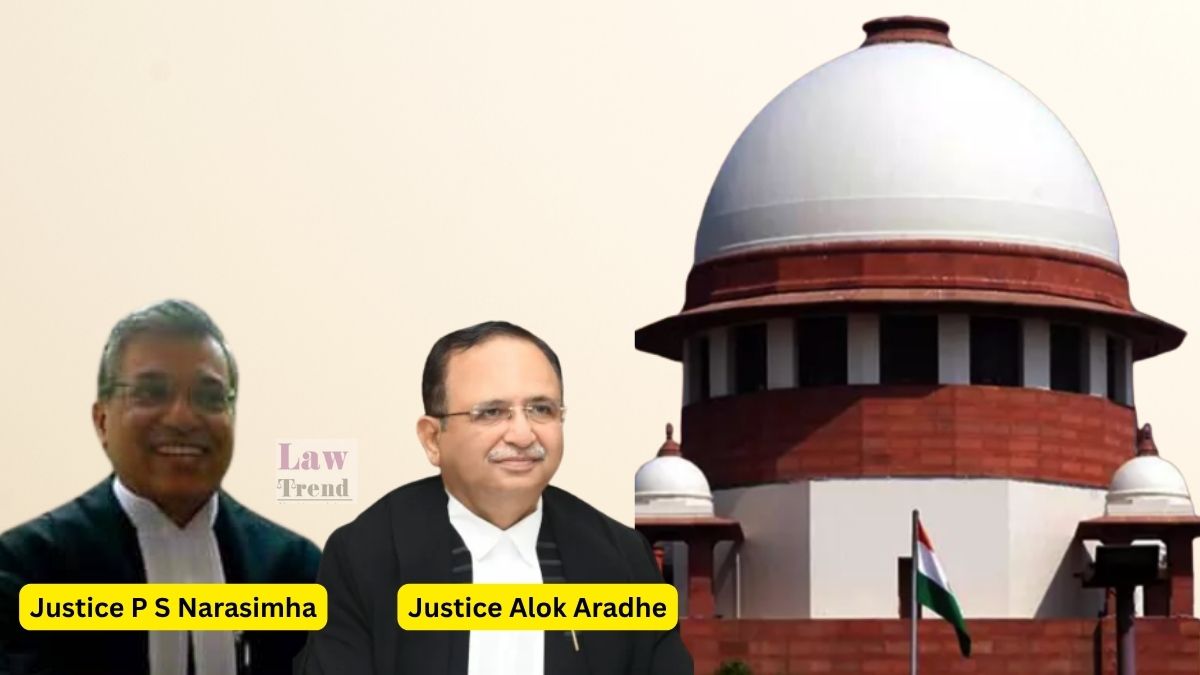
In a significant ruling clarifying the limits of contractual recoveries by government entities, a Supreme Court bench comprising Justice Pamidighantam Sri Narasimha and Justice Alok Aradhe held that the State cannot unilaterally deduct disputed overpayments alleged under an earlier agreement from running bills of separate and ongoing contracts without explicit contractual authority and adherence to natural justice. Setting aside a common judgment of the High Court of Chhattisgarh, the Supreme Court quashed a recovery order issued by an Executive Engineer of the Chhattisgarh Rural Road Development Agency (CGRRDA) and directed the immediate refund of Rs. 84,17,003/- to the contractor along with 6% interest per annum.
Background of the Dispute
The dispute originated from road works under the Pradhan Mantri Gram Sadak Yojana (PMGSY) awarded to M/s Awadhesh Singh Gautam, a partnership firm. On January 3, 2023, the firm had initially been awarded contracts for constructing two roads at an approved cost of roughly Rs. 437.43 lakhs (“the earlier works”), under which substantial disbursements were made.
Subsequently, pursuant to tenders floated by CGRRDA, the firm secured three distinct work packages under PMGSY through work orders dated September 1, 2023, and November 5, 2024 (“the subsequent works”). After executing nearly 40% of the work under these subsequent packages, the firm submitted running bills amounting to Rs. 39,78,500/-, Rs. 45,62,000/-, and Rs. 23,55,000/-. These amounts remained unpaid despite written reminders in September 2025.
Meanwhile, following complaints regarding the execution of the earlier works, the Collector of South Bastar, Dantewada, constituted a five-member inquiry committee. In its report dated January 9, 2024, the committee concluded that against payments of Rs. 3,55,82,055/-, the actual work executed on the ground was valued at only about Rs. 1,54,75,938/-, pointing to an alleged excess payment of Rs. 2,01,06,117/-. The Collector directed revenue recovery proceedings under Section 146 of the Chhattisgarh Land Revenue Code, 1959. However, the High Court quashed the resulting demand note on March 5, 2025, for want of hearing and violation of natural justice, while granting liberty to the authorities to act afresh in accordance with law.
In addition, an FIR was registered against a partner of the firm and CGRRDA officials under Sections 420, 467, 468, 471, 409, and 120-B of the Indian Penal Code, culminating in a chargesheet filed on December 30, 2025.
Relying on internal departmental inspection reports, the Executive Engineer-cum-Member Secretary, Project Implementation Unit K-01, issued an order on September 27, 2025, blocking Rs. 84,17,003/- from payments due to the firm. This sum was deducted directly across the three subsequent, independent works in tranches of Rs. 28,00,000/-, Rs. 38,00,000/-, and Rs. 18,17,003/-. The contractor’s representation protesting the deduction from entirely distinct contracts went unanswered. The firm then approached the High Court of Chhattisgarh, which dismissed its three writ petitions on January 7, 2026, holding that the claims involved disputed questions of fact that could not be entertained under Article 226 of the Constitution.
Arguments Before the Apex Court
Appearing for the appellant contractor, Senior Advocate Gaurav Agrawal contended that the recovery order was issued without notice or hearing, in direct violation of Clause 4.1 of the Special Conditions of Contract in the Standard Bidding Document (SBD), which strictly governs technical audits and overpayments. He argued that the authorities could not appropriate dues under distinct, ongoing contracts to offset an alleged liability from an earlier one. He also highlighted that approximately Rs. 1.07 crore remained payable to the contractor under the earlier works themselves, yet the authorities bypassed that account to target unrelated ongoing packages.
Opposing the appeals, Additional Advocate General Bishwajit Dubey, appearing for the State of Chhattisgarh, submitted that cross-contractual recoveries are expressly permitted under the contractual framework. The State relied on Clause 7(iv) of the Pre-Contract Integrity Pact, Clause 38 of the Conditions of Contract, and Clauses 44.1 and 53.1(ii) of the General Conditions of Contract (GCC). The State argued that the dispute involved deliberate manipulation of measurement books to draw public money and asserted that an agreed contractual set-off is fully enforceable.
The Court’s Analysis
The Supreme Court examined each contractual provision cited by the State to determine whether the impugned recovery was legally traceable to the agreements:
- Clause 44.1 of the GCC: Confined strictly to liquidated damages for project delay, capped at 10% of the initial contract price. The Court found that the recovery was not founded on delay damages, rendering this clause wholly inapplicable.
- Clause 53.1(ii) of the GCC: Permits recovery from other State works only where a contract has been terminated for a fundamental breach of defect liability or five-year routine maintenance obligations under Clause 32, and where the security deposit is insufficient. The Court noted that neither the earlier nor the subsequent contracts were ever terminated on this ground.
- Clause 7(iv) of the Integrity Pact: Allows cross-contract recovery for pact violations, but requires a prior formal determination that the integrity pact was breached. The recovery order contained no reference to the pact or any finding of its violation.
- Clause 38 of the Conditions of Contract: Enables forfeiture and recovery for breach of contract terms, but requires that the breach be formally ascertained and notified to the contractor first. No notice or finding of breach preceded the recovery order.
- Clause 4.1 of the Special Conditions of Contract: Specifically governs technical audits and overpayments. The Court observed that this clause permits recovery only from the security deposit or dues payable from the account of the audited work itself—under which Rs. 1.07 crore remained due to the appellant but was never touched. Furthermore, the clause explicitly mandates: “no recovery should be made without orders of CEO, CGRRDA whose decision shall be final” and requires giving the contractor an opportunity to explain within twelve months of project completion. The Executive Engineer issued the recovery order unilaterally without obtaining the CEO’s order or providing any opportunity to the contractor.
Addressing the core legal principle, the Court held that the State could not convert an unadjudicated claim into an established debt to effect unilateral deductions:
“Until the alleged overpayment is established in accordance with law, it remains, a disputed and unadjudicated claim for damages and not a debt presently due; and a party to a contract cannot, merely because it also holds amounts otherwise payable under it, treat such a claim as though it were an ascertained debt and appropriate those amounts in satisfaction of it.”
The Court, citing its settled precedent in Union of India v. Raman Iron Foundry, observed:
“Therefore, the recovery effected by the recovery order was not only in contravention of the conditions prescribed in the clause but also in flagrant violation of principles of natural justice.”
The Supreme Court ruled that the High Court had erred in dismissing the writ petitions on the ground of disputed questions of fact. The apex court noted that the legal issue before the High Court was not the factual merits of the earlier works, but whether the State had the contractual and legal authority to withhold undisputed dues under separate, subsisting contracts.
Decision and Directions
Allowing the appeals, the Supreme Court quashed and set aside the Executive Engineer’s recovery order dated September 27, 2025. The respondents were directed to release the withheld amount of Rs. 84,17,003/- to the appellant firm along with 6% interest per annum calculated from September 27, 2025, until the date of actual payment.
The Court clarified that its ruling does not bar the State from initiating lawful proceedings to recover any amounts legitimately found due from the appellant regarding the earlier works. It further clarified that the judgment is strictly limited to the procedural legality of the recovery mode and will have no bearing on the pending criminal proceedings arising out of Chargesheet No. 87 of 2025 or the factual assessment of overpayment.
Case Title: M/s Awadhesh Singh Gautam v. State of Chhattisgarh & Ors.
Case No.: Civil Appeal Nos. of 2026 (Arising out of SLP (C) Nos. 10464, 12766, and 12346 of 2026) [2026 INSC 1072]
Bench: Justice Pamidighantam Sri Narasimha and Justice Alok Aradhe
Date: September 30, 2026




