

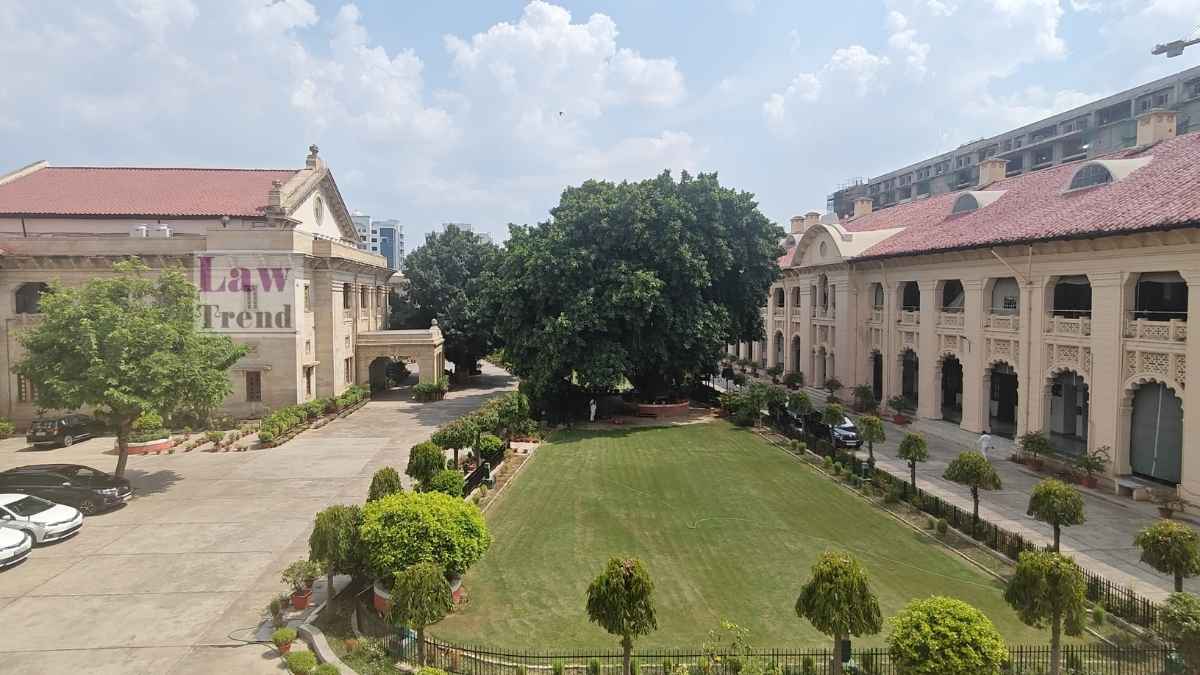
The Allahabad High Court has ruled that vicarious criminal liability under Section 34 of the Indian Penal Code cannot be sustained on the basis of mere presence or uncorroborated improvements in witness statements where common intention is not proved. Setting aside the conviction and five-year rigorous imprisonment sentence of an appellant in a 42-year-old attempt-to-murder case, a single-judge bench comprising Justice Santosh Rai held that the prosecution failed to establish beyond reasonable doubt the participation and shared common intention of the accused, extending to him the benefit of doubt.
Background of the Case
The case originates from an incident that took place on July 20, 1981, at around 9:30 a.m. in Hamirpur. According to the First Information Report lodged by the complainant Hiralal (PW-2), an orderly at the Family Welfare Centre, he was walking with his son Chunnu (PW-4) toward the bus station. Near a local shop, accused Munnilal (since deceased), his nephew Ballu armed with a country-made pistol, and two unidentified persons confronted them. Munnilal reportedly declared that he had come on behalf of one Gorelal to settle a dispute and grabbed Chunnu. When Hiralal raised an alarm, the assailants allegedly fired at Chunnu with the intention to kill him before fleeing the spot.
Chunnu was taken to the District Hospital in Hamirpur, where Dr. B.K. Nigam (PW-7) examined multiple firearm entry wounds across his abdomen, arm, thigh, and back. Hiralal subsequently lodged a written report at Police Station Kotwali, Hamirpur, at 10:15 a.m., just 45 minutes after the incident. Notably, the appellant Hassu was not named in the initial FIR.
Hassu was arrested on August 7, 1981, and a test identification parade was conducted months later, on December 2, 1981, before Special Magistrate M.P. Awasthi (PW-5). After committal proceedings, charges under Section 307 read with Section 34 of the IPC were framed against Munnilal, Ballu, and Hassu.
On August 16, 1984, the 5th Additional Sessions Judge, Hamirpur, convicted Ballu and Hassu under Section 307/34 IPC, sentencing them to five years of rigorous imprisonment and a fine of Rs. 2,000 each. Both convicts appealed to the High Court in 1984. During the pendency of the appeal, Ballu passed away, leading to the abatement of proceedings against him, leaving Hassu as the sole surviving appellant.
Arguments of the Parties
Before the High Court, the learned Amicus Curiae appearing for Hassu submitted that the appellant had been falsely implicated on account of enmity and that the evidence on record failed to substantiate his role or shared common intention. It was pointed out that Hassu was never named in the prompt FIR, that no knife injuries were found despite allegations that he was armed with a knife, and that the prosecution’s star witnesses contradicted themselves.
Conversely, the learned Additional Government Advocate (AGA) for the State argued that the prosecution had proved its case beyond reasonable doubt through seven witnesses, including the injured witness Chunnu and the prompt FIR. The State contended that Chunnu sustained serious firearm injuries and that Hassu had been identified during the identification proceedings in jail, establishing his active participation alongside the armed assailants.
The Court’s Analysis
In evaluating the evidence, the Court addressed whether the prosecution had established the surviving appellant’s participation and common intention under Section 307/34 IPC.
First, the Court scrutinized the testimony of the informant and father, Hiralal (PW-2). While Hiralal claimed in his examination-in-chief to have witnessed the assault, he admitted during cross-examination that he had not seen the occurrence with his own eyes and was at Bhalwa Sumerpur when he received a phone call about the shooting. The Court observed that this irreconcilable contradiction destroyed his status as an eyewitness, noting that prompt lodging of an FIR cannot cure a fundamental absence from the scene. Furthermore, the second alleged eyewitness, Gorelal Kewat (PW-3), turned hostile and denied witnessing any assault.
Next, the Court examined the testimony of the injured witness, Chunnu (PW-4). The Court recognized the established legal tenet that an injured witness’s testimony carries significant weight, but emphasized that it must still inspire confidence regarding the specific role of each accused. Chunnu explicitly attributed the firing of counter-made pistols to Munnilal and Ballu. In contrast, he alleged that Hassu was armed with a knife and caught hold of his hair.
The Court highlighted two critical defects in this claim:
- Absence of Corroborating Medical Evidence: Dr. Nigam’s medical examination disclosed multiple gunshot wounds, but not a single knife injury or mark consistent with Hassu’s alleged weapon or actions. The Court noted that if Hassu had been holding the victim while shots were fired at close range, the absence of any injury to Hassu or knife wounds on Chunnu cast serious doubt on the prosecution’s narrative.
- Material Omission Amounting to Contradiction: During his cross-examination, Chunnu introduced the specific allegation that Hassu held him by his hair—a detail completely absent from his initial statement recorded by the police under Section 161 of the Code of Criminal Procedure (Cr.P.C.).
Applying the Constitution Bench precedent in Tahsildar Singh and another Vs. State of Uttar Pradesh (AIR 1959 SC 1012), the Court held that significant omissions regarding important features of an incident amount to contradictions under Section 145 of the Evidence Act. The Court determined that the subsequent attribution of a specific physical role to Hassu constituted an impermissible material improvement.
The High Court also found the Test Identification Parade (TIP) conducted by Special Magistrate M.P. Awasthi (PW-5) wholly unreliable. The parade took place more than four months after the incident, the Magistrate admitted during cross-examination that the accused was not brought directly before him but was identified on the basis of an identification by his advocate, and the identification memo contained unexplained contradictions regarding whether the accused was on bail or in jail custody.
Addressing the application of constructive liability, the Court analyzed the essential ingredients of Section 34 IPC, reiterating that vicarious liability requires both participation in a criminal act and proof of a shared common intention. Citing landmark Supreme Court jurisprudence, including Shivaji Sahebrao Bobade v. State of Maharashtra ((1973) 2 SCC 793), State of Punjab vs. Jagir Singh ((1974) 3 SCC 277), Yogesh Singh vs. Mahabeer Singh ((2017) 11 SCC 195), and Suresh Thipmppa Shetty vs. The State of Maharashtra (2023 LiveLaw (SC) 682), the Court reiterated that conviction cannot rest on conjectures or strong suspicion.
The Court recorded key observations on the threshold of proof and Section 34 IPC:
“The foundational requirement of participation in furtherance of a proved common intention is not satisfactorily established against Hassu. Mere presence or an uncertain allegation of having caught hold of the injured cannot, in the facts of the present case, be converted into constructive liability under Section 34 IPC. Consequently, the appellant cannot be held vicariously liable for the firearm injuries caused by the other accused with the aid of Section 34 IPC.”
“The conviction of one accused cannot be sustained merely because the occurrence and injuries are proved, unless the participation of the particular accused is also established beyond reasonable doubt.”
“Suspicion, however strong, cannot take the place of proof. Where two views are reasonably possible on the evidence, the view favourable to the accused is required to be adopted.”
Decision of the Court
Holding that the trial court failed to adequately consider the material contradictions, the omission of Hassu’s name in the prompt FIR, the lack of knife injuries, the material improvement under Section 161 Cr.P.C., and the flawed identification proceedings, the High Court allowed the appeal.
The judgment and order of conviction dated August 16, 1984, passed by the 5th Additional Sessions Judge, Hamirpur, in Sessions Trial No. 153 of 1982 was set aside. Appellant Hassu was acquitted of the charge under Section 307/34 IPC on the benefit of doubt, with directions for his immediate release if not detained in any other case, and discharge of his bail bonds.
Case Details
Case Title: Ballu and another Versus State of U.P.
Case No.: Criminal Appeal No. 2257 of 1984
Bench: Justice Santosh Rai
Date: September 29, 2026




