

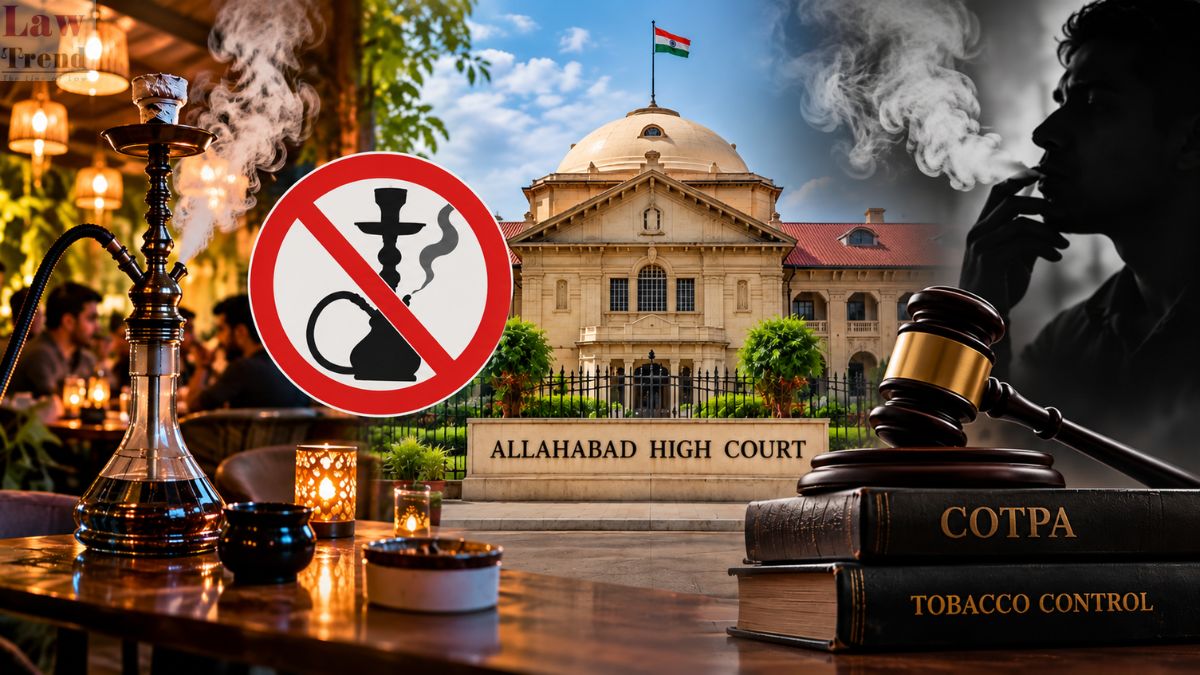
In a significant verdict on public health and tobacco regulation, a Division Bench of the High Court of Judicature at Allahabad, Lucknow Bench, comprising Justice Shekhar B. Saraf and Justice Abdhesh Kumar Chaudhary, has ruled that operating hookah bars and providing hookah service within Designated Smoking Areas of restaurants, hotels, and cafes is impermissible under Indian law. Dismissing a batch of 80 writ petitions filed by hospitality establishments across Uttar Pradesh, the Court held that the 2017 amendment to the Prohibition of Smoking in Public Places Rules, 2008, established an absolute prohibition against rendering any service whatsoever inside smoking enclosures, overriding earlier judicial precedents that allowed hookah under qualified terms.
Background of the Case
The litigation originated from statewide restrictions imposed during the COVID-19 pandemic. On August 27, 2020, the High Court in a Suo Motu public interest litigation (PIL No. 716 of 2020) directed the Chief Secretary to prohibit bars, cafes, and restaurants from serving hookah to curb viral transmission, leading to an executive ban on September 5, 2020.
Following the easing of pandemic measures, the High Court disposed of the PIL on February 21, 2023, without entering into the merits, granting establishments liberty to approach statutory authorities for requisite licenses. On March 29, 2023, the Commissioner of Food Safety and Drug Administration issued a circular directing authorities to dispose of food license applications from establishments operating hookah bars, provided they complied with the amended 2008 Rules.
However, enforcement actions by police authorities continued. On May 15, 2023, a preventive order under Section 133 of the Code of Criminal Procedure (CrPC) was issued against the lead petitioner, M/s Aftek Foods and Beverages Pvt. Ltd. (operating “Fashion TV Cafe” in Gomti Nagar, Lucknow), recording that hookah was being served without permission, in open spaces outside the cafe, and to minors, thereby causing a public nuisance. Establishments then approached the High Court under Article 226 of the Constitution, claiming that police interference violated their fundamental right to carry on trade and business under Article 19(1)(g).
Contentions of the Parties
Appearing for the petitioners, counsel Harshit Singh submitted:
- Temporary Nature of Pandemic Curbs: The September 2020 executive ban was an emergency health measure to curb COVID-19 transmission and could not serve as an indefinite statutory prohibition under the Cigarettes and Other Tobacco Products (Prohibition of Advertisement and Regulation of Trade and Commerce, Production, Supply and Distribution) Act, 2003 (COTPA).
- Lack of Authority under Food Safety and Municipal Laws: Tobacco products fall strictly within COTPA and outside the Food Safety and Standards Act, 2006 (FSSA), as tobacco is not consumed for nutritional purposes. Similarly, municipal statutes contain no framework to grant or withhold hookah licenses.
- Police Powers Confined: Section 12 of COTPA requires an officer to record a “reason to suspect” before conducting search and seizure, which does not permit blanket raids on compliant premises.
- Statutory Carve-Out: The proviso to Section 4 of COTPA explicitly permits restaurants with a seating capacity of 30 or more to maintain a Designated Smoking Area.
- The ‘Self-Service’ and ‘Rental’ Theory: Relying on the Supreme Court ruling in Union of India v. Mohit Minerals Pvt. Ltd. and the Madras High Court judgment in Anandcine Services Pvt. Ltd. v. Commissioner of Service Tax, counsel argued that providing a hookah apparatus is a “rental” or “transfer of right to use” rather than a “service.” Petitioners propounded a self-service model where the apparatus is pre-assembled and handed to patrons outside the smoking zone, who then carry, self-light, and consume it inside without waiting staff intervention, thereby avoiding the statutory bar on “service.”
Opposing the petitions, counsel Pankaj Khare for the State submitted:
- Constitutional Mandate: Tobacco control is an imperative public health obligation under Article 47 of the Constitution. Scientific studies establish that waterpipe smoke contains carbon monoxide, heavy metals, and carcinogens, severely affecting active smokers and non-smokers exposed to second-hand smoke.
- Absolute Statutory Bar: Rule 4(3) of the 2008 Rules originally stated that a smoking area shall be used only for smoking and “no other service(s)” shall be allowed. However, the Central Government amended the provision on May 23, 2017, substituting it with “No service shall be allowed in any smoking area or space provided for smoking.” This deliberate change instituted an unconditional commercial ban.
- Inherent Service Element: Hookah smoking cannot operate like cigarette smoking. It requires water pipe assembly, bowl packing, hot coals, and continuous replenishment by staff, making it fundamentally a commercial service, as held by the Karnataka High Court in R. Bharath v. State of Karnataka.
The Court’s Analysis
Evaluating the statutory architecture of COTPA alongside constitutional principles, the Division Bench recorded several definitive findings:
1. Regulation Encompasses Complete Prohibition
Addressing the argument that COTPA is merely regulatory and cannot impose a total commercial prohibition, the Bench cited Supreme Court rulings in G.K. Krishnan v. State of T.N. and Indian Handicrafts Emporium v. Union of India, observing that the concept of regulation is broad enough to include prohibition where public welfare demands it.
The Court held that commercial rights under Article 19(1)(g) must yield to the fundamental right of non-smokers to breathe clean air under Article 21, as recognized in Murli S. Deora v. Union of India.
2. The Impact of the 2017 Amendment to Rule 4(3)
The Bench held that the Supreme Court judgment in Narinder S. Chadha v. Municipal Corporation of Greater Mumbai (2014)—which permitted hookah in designated smoking areas—applied only to the pre-amended Rule 4(3) when the prohibition was limited to “other services” like food and beverages.
Highlighting the legislative shift, the Court observed:
“After the 2017 Amendment, this ambiguity has been comprehensively resolved. The substitution of ‘no other service(s)’ with ‘no service’, is in our view a deliberate removal of the single qualifying word ‘other’ that has transformed the legal position from a qualified prohibition to an absolute prohibition. The Narinder S. Chadha (supra) interpretation no longer serves as a precedent, having been specifically overridden by the legislative amendment. Hookah service, irrelevant of tobacco-based, nicotine-based, or herbal cannot be rendered within a Designated Smoking Area subsequent to the 2017 Amendment. The service of hookah in a Designated Smoking Area is, categorically, unconditionally, and absolutely prohibited under Rule 4(3) of Rules, 2008.”
Concurring with Justice M. Nagaprasanna’s reasoning in R. Bharath v. State of Karnataka, the Court affirmed that the statutory bar on service in smoking enclosures is total.
3. Rejection of ‘Self-Service’ and ‘Rental’ Pleas
The Court dismissed the petitioners’ contention that hookah could be provided under a “self-service” or “equipment rental” model.
Detailing the preparation and handling of a hookah—which involves filling the base, packing the bowl, perforating the foil, and managing burning charcoal—the Court observed:
“From a perusal of the methodology of hookah as delineated in aforesaid paragraph 32 of this judgment it is patently clear that the argument of the petitioners with regard to the self-service model is playing mockery on Rule 4(3) of the amended Rules which cannot be countenanced by us as we High Court judges are not an island marooned from the activities taking place in the mainland with regard to operation of Hookah bars and lounges and restaurants. This entire argument of self-service of Hookah is not just unfeasible but also demeans the intelligence and pragmatic knowledge of this Court.”
Rejecting the rental analogy under Anandcine Services and BSNL v. Union of India, the Court held that while a customer renting a self-drive car obtains exclusive possession and can drive anywhere, a hookah customer is strictly confined to using the apparatus inside the Designated Smoking Area. Because the customer never acquires absolute possession or control, the transaction constitutes a commercial service rendered for consideration.
4. Police Powers Affirmed, Food Safety & Municipal Jurisdiction Negated
The Bench clarified administrative boundaries:
- Food Safety and Municipal Authorities: The Court agreed that neither the Food Safety department under FSSA nor Municipal Corporations possess statutory authority to regulate or license hookah bars.
- Police Authorities: The Court upheld the powers of police officers (not below the rank of Sub-Inspector) under Sections 12, 13, and 15 of COTPA to enter, search, seize apparatus, and penalize non-compliance with Sections 4 and 6 of the Act.
The Decision
Answering the reference in the negative, the Court ruled:
“Upon sifting through the aforesaid principles this Court arrives at the unambiguous conclusion that the question that these writ petitions have posed before us as to whether hookah bars may lawfully operate and render hookah service in Designated Smoking Area within public places in the State of Uttar Pradesh is answered in the negative. The right of the non-smoker to breathe clean air in a public place is a fundamental right guaranteed under Article 21 of the Constitution of India, that cannot be abridged by commercial interest of an establishment having Right to Trade under Article 19(1)(g) of the Constitution of India. This Court holds, accordingly, that the operation of hookah bars and the rendering of hookah services by the restaurants within the State of Uttar Pradesh constitutes a flagrant violation of Rule 4(3) of the Prohibition of Smoking in Public Places Rules, 2008 as amended in 2017 and is in direct contravention of the scheme and object of COTPA.”
All 80 writ petitions were dismissed. The Registry was directed to transmit copies of the judgment to the Chief Secretary and Director General of Police, Uttar Pradesh, for strict compliance.
Epilogue: Health Warnings and State Action
Recording medical research, the Bench observed that a single one-hour hookah session involves roughly 200 puffs and delivers toxic harm equivalent to smoking 100 cigarettes, refuting claims that water filtration makes hookah less harmful. Noting that States such as Gujarat, Punjab, Rajasthan, Maharashtra, and Karnataka have enacted specific State amendments banning hookah bars with enhanced penal provisions, the Court expressed hope that the State of Uttar Pradesh would enact similar stringent measures.
Judge Recounts Personal Battle With Tobacco, Pens Poem to Caution Youth
In an unusual and candid conclusion titled “MY EXPERIENCE WITH TOBACCO SMOKING”, Justice Shekhar B. Saraf shared his personal journey with tobacco addiction in the hope of steering young people away from smoking:
“From my own experience of smoking, I pen these last paragraphs in an attempt to educate the young generation of this country to not become a prey to the deleterious and indelible habit of tobacco smoking:”
The judge then penned a 36-line poem recounting how his habit began in law school and grew into an addictive trap:
“I entered law school pure as morning dew,
Sneered at the smokers puffing by the gate,
“Weak-willed,” I scoffed, “I’d never join that crew”
Famous last words. Reader, I was bait.
It started with a ‘chaii’, innocent and warm,
A senior offered, “Try one, just for fun.”
I took it like a soldier joins a storm
Bravely, stupidly, and one by one.
The “occasional” ‘sutta’ soon grew bold,
It multiplied like rabbits, unrestrained.
My lungs, once mine, were quietly sold
To a landlord who never once explained the lease.
I told myself I merely dabbled,
A social smoker, cultured, in control.
Meanwhile the count crept steadily
From “just one more” to “buy the whole damn pack.”
Then came the cough, my body’s stand-up act,
Performing nightly, free of charge, unasked.
The phlegm arrived, a most unwelcome fact,
As if my throat had been recently tasked
With hosting a swamp. I tried the patch, it itched.
I tried the gum, I chewed it, then lit up regardless,
Like a dieter who’s sworn off cake, then switched
Straight to the icing, calling it “harmless.”
“I’ll quit,” I said, with great conviction twice,
Then thrice, then roughly forty times a year.
Each January brought the same advice
From me, to me, which I did not adhere.
I’ve quit the quitting now, if I’ll be honest,
The resolution’s gathering dust and shame,
But hope remains perhaps once this is finished
(This job, this judgment), willpower makes a claim.
So here’s my public service, dressed in rhyme,
From one who walked the very path you tread:
The first cigarette feels like harmless time
It isn’t. Trust the cough, not what I said
At twenty, full of swagger, sure and free.
Don’t be the fool who scoffed, only to become a boiling frog.”
Justice Abdhesh Kumar Chaudhary concurred with the judgment.
Counsels Appearing in the Matter
Counsel for Petitioner(s):
Vatsala Singh, Nitesh Kumar Mishra, Shobhit Mohan Shukla, Aarsh Raj, Abhay Pratap Singh, Abhilasha Rastogi, Abhishek Mishra, Abhishek Singh, Adarsh Pratap Singh, Ajay Kumar Singh, Ajeet Pratap Singh, Akansha Pathak, Akhileshwar Singh, Akriti Pandey, Aman Thakur, Anand Kumar, Anand Mishra, Anand Prakash Dixit, Anubhav Awasthi, Anuj Kumar Awasthi, Anuj Kumar Gupta, Anurag Singh, Arpit Verma, Arun Kumar Yadav, Aryan Singh, Ashish Kumar, Ashutosh Mishra, Atma Ram Mishra, Chandan Verma, Deepansi, Dharmendra Kumar Verma, Dhiraj Pratap Singh, Dinesh Kumar Mishra, Divya Dwivedi, Hari Krishna Chaubey, Harshit Singh, Harshita Rajnish, Indra Pratap Singh, Ishan Bhasin, Kamlesh Kumar Gupta, Kshemendra Shukla, Lakshmi Kant Tripathi, Mangal Sen Yadav, Manoj Kumar Mishra, Mohd. Imran Khan, Muskan Bharti, Neeta Tekwani, Palak Sahai Gupta, Pankaj Mishra, Pankaj Verma, Pawan Kumar Shukla, Piyush Tripathi, Prabhakar Trivedi, Prashant Mishra, Prerna Jalan, Raghvendra Pandey, Rahul Kumar, Raj Krishna, Rakesh Kumar Upadhyaya, Ratnesh Kumar Rawat, Ritic Bhardwaj, Ritick Bhardwaj, Sachin Dixit, Sagar Singh, Samanvya Dhar Dwivedi, Sanidhya Shukla, Sanjeev Kumar Dwivedi, Saurabh Kashyap, Shailendra Kumar Singh, Sheo Shankar Verma, Shikhar Chaube, Shivanshu Goswami, Shobh Nath Pandey, Sivendra Kumar Srivastav, Sudhanshu Singh, Suraj Sharma, Surya Bhan Singh, Sushil Kumar, Syed Aftab Ahmad, Syed Ahmad Mehdi, Tauheed, Vaibhav Srivastava, Vaibhav Upadhyay, Varsha Pandey, and Vineet Tripathi.
Counsel for Respondent(s):
C.S.C., Akhilesh Kumar Srivastava, Abha Srivastava, Adnan Hashmat, Aftab Ahmad, Anuj Kumar Srivastava, G.A., Jaiyesh Bhoosreddy, Krishna Kumar Pandey, Mohammad Talib Khan, Namit Sharma, Om Shankar Tiwari, Pankaj Khare, Rajesh Kumar Singh, Shailendra Singh Chauhan, Shailesh Kumar Pathak, Shashwat Dwivedi, Shruti Sahu, Siddarth Tripathi, Siddharth Shankar Dubey, Siddharth Tripathi, and Yatindra Pathak.
Case Title: M/s Aftek Foods and Beverages Pvt. Ltd. Thru. Auth. Signatory Vishnu Kumar Gupta and another v. State of U.P. Thru. Addl. Chief Secy. Deptt. of Food Safety and Drug Admin. U.P. Lko. and others
Case No.: WRIT-C No. 10713 of 2023
Bench: Justice Shekhar B. Saraf and Justice Abdhesh Kumar Chaudhary
Date: September 29, 2026




