

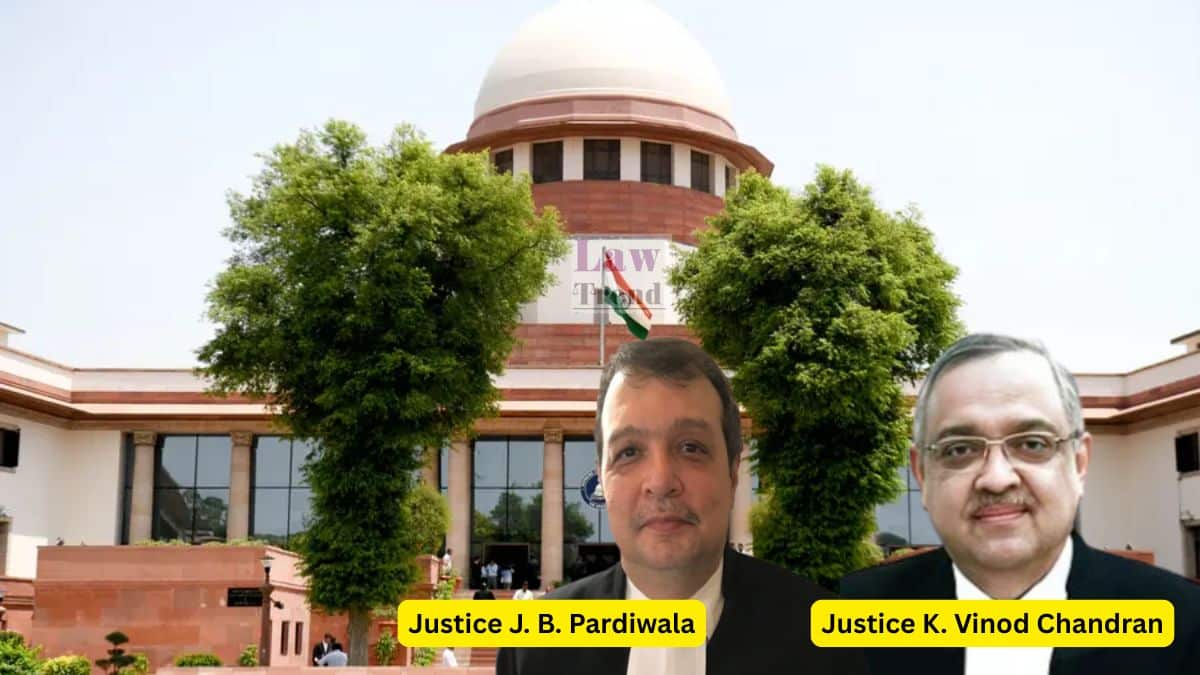
The Supreme Court of India, comprising a Bench of Justice J. B. Pardiwala and Justice K. Vinod Chandran, has held that the appointment of an arbitral tribunal without proven consent from the opposite party—and in the face of objections alleging bias—renders the entire initiation of arbitration non est in law. Setting aside an order of the High Court that had dismissed the borrower’s appeal on the technical ground of limitation, the apex court quashed three coercive interim orders passed by the tribunal and ordered the immediate restoration of properties and restitution of funds.
Background of the Case
Disputes arose between the appellants, Arth Micro Finance Private Ltd. and others, and the respondent, Shivalik Small Finance Bank Ltd., under an agreement that contained an arbitration clause. The respondent bank allegedly appointed an arbitral tribunal on consent, issuing a notice in this regard on May 2, 2024.
Upon receiving an initial communication from the tribunal, the appellants promptly issued a reply objecting to the appointment, explicitly pointing out that the arbitral tribunal had close links with the respondent bank.
Undeterred by this objection, the arbitral tribunal proceeded with the matter and passed three interim orders under Section 17 of the Arbitration and Conciliation Act, 1996. The appellants challenged these interim directions before the High Court under Section 37 of the Act. However, the High Court dismissed the appeal on the ground of limitation, pointing out that no application had been filed under Section 5 of the Limitation Act, 1963 to seek condonation of delay.
Arguments Before the Apex Court
Sri K. Parameshwar, learned Senior Counsel, appeared on behalf of the appellants, while Sri Bishwajit Bhattacharyya, learned Senior Counsel, represented the respondent bank.
The respondent bank maintained that the arbitral tribunal had been constituted on consent. However, upon scrutinizing the record, the Supreme Court observed that there was nothing to show that consent had ever been obtained from the appellants.
The Court further examined the nature of the three interim orders passed by the tribunal under Section 17, which had:
- Directed the freezing of the appellants’ bank accounts maintained with IDBI Bank, Bank of Baroda, HDFC Bank, and ICICI Bank linked to their specific PAN;
- Permitted the respondent bank to take over possession of the movable and immovable properties of the appellants; and
- Directed that amounts deposited by the appellants across those bank accounts be transferred and deposited directly into the respondent bank.
Court’s Analysis and Key Observations
Opening its analysis, the Bench underscored that arbitration cannot be reduced to a unilateral or oppressive procedure, observing:
“Arbitration, though rhymes with it, cannot result in an arbitrary measure, even in the appointment of an Arbitral Tribunal.”
The Court noted with concern that the sweeping interim measures had been granted despite a clear challenge to the tribunal’s independence, holding:
“We have to remind ourselves that this was done in the wake of the clear objection to the appointment of the Arbitral Tribunal and the allegation of bias raised against the said Arbitral Tribunal. The orders passed at the first instance, are also arbitrary in nature.”
Concluding that the inception of the tribunal lacked consent and legal validity, the Supreme Court found the very initiation of the arbitration proceedings to be non est in law.
Decision and Operative Directions
The Supreme Court set aside the impugned order of the High Court along with the three interim orders passed by the arbitral tribunal. To reverse the effects of the interim measures, the Bench issued the following directions:
- Restitution of Funds: Any amount deposited from the accounts of the appellants into the account of the respondent bank must be remitted back within a period of one week.
- Compound Interest on Default: If the amounts are not remitted back within one week, they will carry compound interest at the rate of 18% per annum from the date of debit at monthly rests, to be set off against any claim found in favor of the respondent in arbitration. The interest due on such amounts was directed to be one of the issues considered by the new arbitrator.
- Restoration of Assets: Any attachment or takeovers of the movable or immovable properties of the appellants were set at naught, with their possession directed to be restored to the appellants.
- Appointment of Independent Arbitrator: To facilitate lawful dispute resolution, the Court appointed Ms. Mayuri Raghuwanshi, Advocate, as the Arbitrator. The Registry was directed to intimate the arbitrator, who will issue notices to the parties and remains free to determine her fee in consultation with them.
The Court clarified that it expressed no opinion on the underlying merits of the dispute, leaving all aspects open for the parties to urge before the newly appointed arbitrator. All pending applications were rejected.
Case Title: Arth Micro Finance Private Ltd. And Ors. v. Shivalik Small Finance Bank Ltd.
Case No.: Civil Appeal No. 13015 of 2026
Bench: Justice J. B. Pardiwala and Justice K. Vinod Chandran
Date: September 17, 2026




