

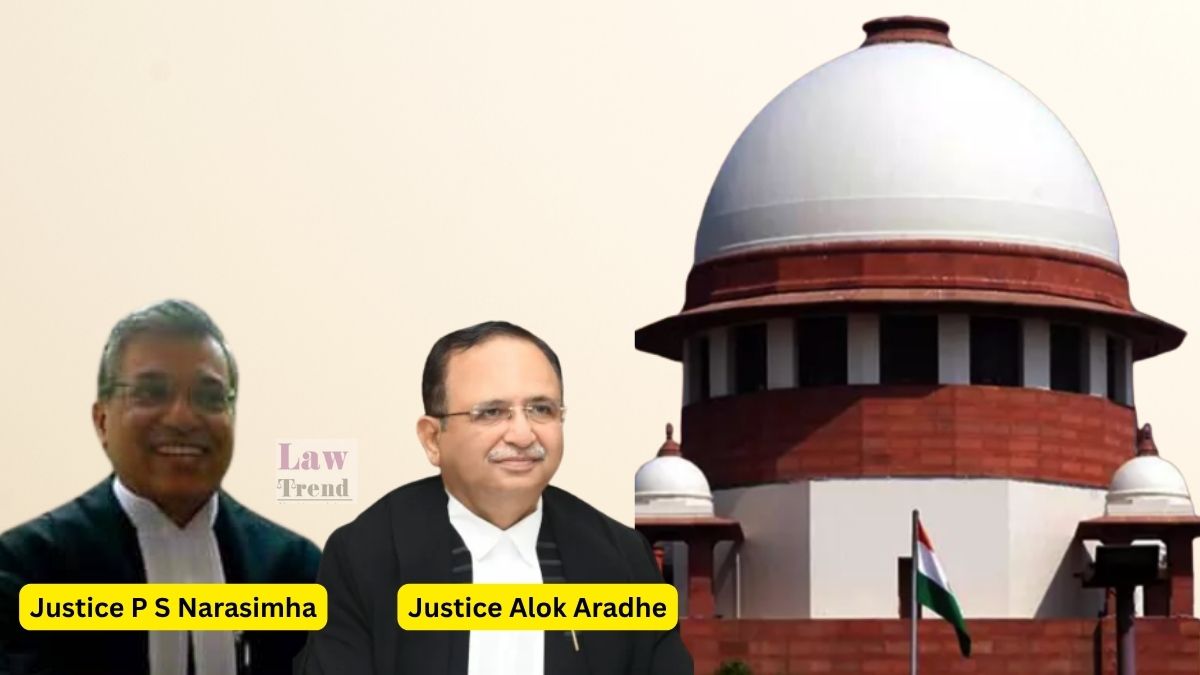
The Supreme Court of India, comprising a Bench of Justice Pamidighantam Sri Narasimha and Justice Alok Aradhe, has ruled that financiers and non-banking financial companies (NBFCs) cannot forcibly repossess hypothecated vehicles without strictly adhering to procedural safeguards and prior notice requirements mandated by the Reserve Bank of India (RBI). Setting aside an Allahabad High Court order that had dismissed a borrower’s writ petition on grounds of delay, the apex court held that arbitrary repossession by breaking locks in the dead of night violates the fundamental rights to equality and livelihood guaranteed under Articles 14 and 21 of the Constitution. The Court directed the financier to close the borrower’s loan accounts, refund the vehicle’s sale proceeds of ₹4.5 lakh with 6% interest per annum, pay ₹10 lakh as compensation for mental agony and loss of livelihood, and bear ₹50,000 in costs.
Background of the Case
On March 25, 2019, the appellant, Hari Dutta Sharma, availed a commercial vehicle loan from Cholamandalam Investment and Finance Company Limited for a Tata SFC 407 truck (registration number UP-16-GT-0449). Out of the sanctioned loan amount of ₹10,40,080.75, an amount of ₹9,36,000 was disbursed, repayable in 75 monthly instalments secured by the hypothecation of the vehicle. A supplementary loan of ₹1,04,080.75 was subsequently extended on June 12, 2021.
Following defaults in repayment, the company issued a recall-cum-demand notice on January 17, 2022, and repossessed the truck, issuing a pre-sale letter on June 13, 2022. The vehicle was released after Sharma deposited ₹86,726 and undertook to regularise his account. When defaults recurred, further notices were issued on July 7, 2022, and December 22, 2022. On April 9, 2023, the financier sent a pre-seizure notice to the Station House Officer at Police Station Ayodhya Cantt.
According to Sharma, on the night of April 9, 2023, while his truck was parked under CCTV surveillance at a consignor’s godown in Ayodhya after offloading goods, four unidentified individuals broke open the steering lock at approximately 1:00 a.m. and drove it away without prior notice. Sharma immediately filed a lost article report and an e-FIR on the same day, followed by a complaint to the Superintendent of Police, Ayodhya, on September 8, 2023.
On September 30, 2023, Sharma received a legal notice from the company stating that possession had been taken and the vehicle had already been sold on August 31, 2023, for ₹4,50,000 against outstanding dues of ₹5,71,914, leaving a deficit of ₹1,25,571. Sharma’s application under Section 156(3) of the Code of Criminal Procedure was dismissed by the Chief Judicial Magistrate, Ayodhya, on September 23, 2024, on the premise that the vehicle had been confiscated due to loan default. Sharma then moved the High Court of Judicature at Allahabad, but a Division Bench dismissed his writ petition on April 4, 2025, holding that the petition was belated as the vehicle had already been sold.
Submissions by the Parties
Before the Supreme Court, counsel for Sharma argued that the High Court erred in dismissing the petition on the ground of delay without examining the merits. It was submitted that the repossession took place in stark violation of Article 11 of the loan agreement, which expressly mandated a seven-day prior notice. Counsel contended that a financier’s contractual right of self-help repossession cannot be exercised through force, deceit, or breach of agreed terms, noting that Sharma continued to receive traffic challans in respect of the vehicle long after its purported sale.
Opposing the appeal, counsel for the company submitted that Sharma was a chronic defaulter whose vehicle had previously been repossessed and released only upon part-payment. The company maintained that pre-seizure intimation, an inventory list, post-seizure intimation, and a pre-sale notice were duly served on the police and the borrower, and that the sale for ₹4,50,000 was fair, reasonable, and strictly in terms of the contract.
The Court’s Legal Analysis
Addressing the balance between creditor rights and borrower safeguards, Justice Alok Aradhe, writing for the Bench, observed:
“A loan may create a debt, and a debt may confer upon the financier a right to recover what is due; but the manner in which that right is exercised is not without significance. The present appeal brings before this Court the contest between the right to recover a secured debt and the right of the borrower to have that recovery undertaken within the bounds of law.”
The Court acknowledged earlier precedents, including Orix Auto Finance (India) Ltd. v. Jagmander Singh and Anr. and Sundaram Finance Limited and Anr. v. T. Thankam, affirming that self-help repossession clauses are standard contractual terms that make asset-backed credit feasible for small operators lacking traditional collateral. However, the Bench cautioned that such rights cannot be unrestrained:
“left unchecked, it is capable of being read as an unbridled licence to seize property by stealth, by force or in the dead of night, converting a facility meant to promote financial inclusion into an instrument of oppression against the very class it was designed to serve.”
Tracing the regulatory regime, the Bench noted that directions issued by the RBI under Section 35-A of the Banking Regulation Act, 1949, possess statutory force and bind lending institutions, citing Internet and Mobile Association of India v. Reserve Bank of India. The Court highlighted the RBI’s Guidelines on ‘Fair Practices Code for Lenders’ issued on May 5, 2003, November 21, 2005, and September 28, 2006, which expressly prohibit lenders from resorting to undue harassment, contacting borrowers at odd hours, or deploying muscle power.
The Bench reiterated the landmark two-Judge decision in ICICI Bank Ltd. v. Prakash Kaur and Ors., reiterating that:
“ours is a country governed by rule of law and recovery of loans or seizures of vehicles could only be made through the legal means and the banks cannot employ ‘goondas’ to take possession of the vehicles by force.”
Synthesising successive RBI Master Circulars issued between 2008 and 2015, the Court reiterated core tenets for financial institutions: recovery must rely on lawful procedures conforming to the Indian Contract Act, 1872; repossession clauses must define notice periods, cure opportunities, and transparent auction procedures; recovery agents must adhere to the Banking Codes and Standards Board of India (BCSBI) standards; and recovery visits must avoid odd hours.
Examining Article 11 of the loan agreement, the Supreme Court held that the clause was invalid and contrary to both RBI guidelines and the Indian Contract Act, 1872. The Court observed that the clause impermissibly stipulated that rights over the vehicle terminated ipso facto without notice, gave agents unrestricted licence to enter any premises, omitted a defined auction procedure, and reserved a unilateral right for the lender to waive notice at its sole discretion:
“A contractual term which permits one party unilaterally to dispense with the procedural safeguards designed to protect the other cannot be regarded as being in conformity with either the RBI Guidelines or the general contractual requirement of fairness; to that extent, Article 11 does not meet the standard the law requires of a valid repossession clause.”
On the facts, the Bench held that the company failed to issue the mandatory seven-day pre-repossession notice. The seizure at 1:00 a.m. by breaking the steering lock, accompanied by an unsigned possession memorandum, was held to be an unlawful exercise of force. The Court also overruled the High Court’s finding of laches, pointing out that Sharma had lodged an FIR on the same day, filed a criminal complaint under Section 156(3) CrPC, and continued to receive traffic challans for the vehicle on January 18, 2024, November 18, 2024, and February 18, 2025.
Concluding on the financier’s conduct, the Bench observed:
“Where a financier steps outside that framework, breaks open a lock in the dead of night, takes possession without notice and without a signed memorandum, and thereafter treats the borrower merely as a source of residual liability, it forfeits the protection that the contract and the law would otherwise have afforded it, and exposes itself to the consequences in law of an unauthorised and arbitrary seizure.”
Decision and Directions
The Supreme Court quashed and set aside the High Court’s order dated April 4, 2025. While declining to set aside the third-party sale concluded on August 31, 2023, the Court held that Sharma, a transporter of modest means who was deprived of his sole livelihood arbitrarily in violation of Articles 14 and 21 of the Constitution, was entitled to substantial relief and compensation.
The Court issued the following directions:
- The company shall close both loan accounts of the appellant.
- The company shall refund the vehicle sale proceeds of ₹4,50,000 to the appellant along with interest at 6% per annum calculated from the date of sale until realization.
- The appellant is awarded ₹10,00,000 as compensation for mental agony and loss of livelihood.
- The appeal was allowed with costs quantified at ₹50,000 payable to the appellant.
Observing that RBI Master Circulars and Guidelines have largely remained on paper without effective enforcement, the Supreme Court directed the Reserve Bank of India to take concrete measures ensuring genuine compliance by banks and NBFCs, and instructed the Registry to communicate a copy of the judgment to the central bank.
Case Title: Hari Dutta Sharma v. State of U.P. & Ors.
Case No.: Civil Appeal No(s). ___ of 2026 (@ S.L.P. (C) No(s). ___ of 2026) (@ Diary No. 10952 of 2026)
Bench: Justice Pamidighantam Sri Narasimha and Justice Alok Aradhe
Date: September 16, 2026




