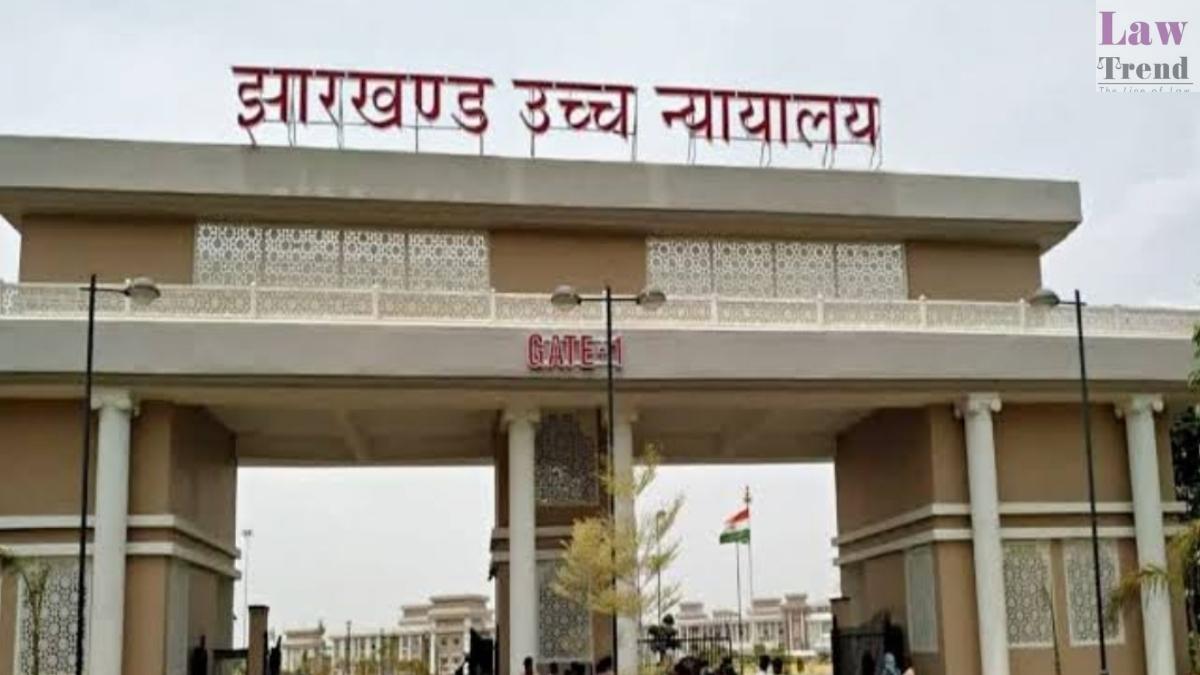
RANCHI: Holding that an indecent assault lacking proximate overt acts towards sexual intercourse cannot sustain a conviction for attempt to rape, the High Court of Jharkhand, presided over by Justice Pradeep Kumar Srivastava, altered the conviction of an appellant from Section 376/511 of the Indian Penal Code (IPC) to Section 354 IPC (assault or criminal force to woman with intent to outrage her modesty), while upholding his conviction under Section 452 IPC. Taking into account that more than 26 years had elapsed since the incident and that the appellant had already served approximately eight months in custody, the Court modified his substantive sentence to the period of imprisonment already undergone.
Background of the Case
The prosecution case was registered on the basis of a written report submitted by the informant alleging that on the midnight of December 27, 1999, while she was sleeping in her house, she heard the sound of the door being forcibly opened. The appellant, Kamalendu Mahto alias Khokaa, entered her room, mounted her body, engaged in physical contact, and attempted to commit rape after lifting her clothes. The informant raised an alarm and pushed him off. As her mother rushed into the room, the appellant fled. Neighbours gathered upon hearing the commotion, to whom the informant narrated the occurrence. Following the return of her brother on December 30, 1999, a formal FIR was lodged at Chakulia Police Station on December 31, 1999, under Sections 376/511 and 452 of the IPC.
Following the investigation, a charge-sheet was submitted, and the case was committed to the Court of Sessions as Sessions Trial Case No. 280 of 2000. During the trial, the prosecution examined ten witnesses, while the defence examined none, pleading false implication due to political rivalry. By a judgment dated July 25, 2006, and sentencing order dated July 28, 2006, the Additional Sessions Judge, Ghatsila, convicted the appellant under Section 376 read with Section 511 IPC, sentencing him to undergo rigorous imprisonment for four years. Aggrieved by the conviction, the appellant filed an appeal before the High Court.
Arguments of the Parties
Appearing for the appellant, Amicus Curiae Mr. Parth Jalan argued that the non-examination of the Investigating Officer caused grave prejudice and a failure of justice. He pointed out that although the mother of the victim (PW-6) admitted during cross-examination that one Rudan Singh was sleeping in the same bedroom during the night of the incident, the prosecution withheld this direct eyewitness. The defence further highlighted an unexplained delay of four days in lodging the FIR under the pretext of a local panchayati, and contended that the testimony of the prosecutrix (PW-9) did not inspire confidence. Crucially, it was submitted that even if the prosecution case were taken to be true in its entirety, the essential ingredients constituting an attempt to commit rape under Section 376/511 IPC were not established, and at best, the allegations disclosed an offence under Section 354 IPC.
Opposing the appeal, learned Additional Public Prosecutor Mr. Jitendra Pandey, representing the State of Jharkhand, defended the Trial Court’s findings. He submitted that the Trial Court had appropriately analyzed and appreciated the evidence available on record, justifying the conviction on merits, and prayed for the dismissal of the appeal.
Court’s Analysis and Observations
Upon examining the depositions of the witnesses, the High Court observed that the surrounding witnesses (PW-2 to PW-5, PW-7, and PW-8) did not witness the actual occurrence inside the room and had merely seen the accused fleeing after the alarm was raised.
Evaluating the testimony of the prosecutrix, the Court underscored the absence of any concrete overt act indicating an attempt to commit rape:
“The evidence of the prosecutrix, when considered in its entirety, does not disclose any specific overt act on the part of the appellant which can be said to constitute an act towards the commission of rape with her so as to attract the ingredients of an offence punishable under Section 376/511 of the I.P.C. The conduct of the appellant simply shows that he has committed some act of indecent assault with the prosecutrix, which may likely to outrage her modesty.”
Addressing the nature of the act and the immediate disclosures made to family members, Justice Pradeep Kumar Srivastava observed:
“However, there is no specific evidence regarding any attempt on the part of the appellant to commit sexual intercourse or any act sufficiently proximate to the commission of rape. The immediate disclosures made by the prosecutrix to her family members also indicate an act of assault and an attempt to outrage her modesty, rather than an attempt to commit rape.”
The Court held that the consistent evidence demonstrated the appellant had caught hold of the prosecutrix, establishing an assault committed with the intention or knowledge that her modesty would be outraged, thereby fulfilling the ingredients of Section 354 IPC.
Decision
Consequently, the High Court altered and modified the appellant’s conviction from Section 376/511 of the IPC to Section 354 of the IPC, while upholding his conviction under Section 452 IPC.
Regarding the sentence, the Court noted that this was the appellant’s first offence with no prior criminal antecedents, and that more than 26 years had elapsed since the incident. Observing that the ends of justice would be met by sentencing him to the period of imprisonment already undergone during trial and post-conviction (about eight months), the Court modified the substantive sentence accordingly. The appeal was dismissed on merits with these modifications, and the appellant, being on bail, was discharged from the liability of his bail bonds and sureties.
Case Title: Kamalendu Mahto @ Khokaa v. The State of Jharkhand
Case No.: Cr. Appeal (SJ) No. 1332 of 2006
Bench: Justice Pradeep Kumar Srivastava
Date: August 31, 2026